
Tay Ninh province is gradually changing the way it brings voluntary social insurance policies to the people. Instead of only focusing on peak propaganda and mobilization campaigns, the social insurance sector aims to advise closely to each person's circumstances, maintain participants and limit the situation of interrupted contributions.
By June 2026, Tay Ninh province had 707,407 people participating in social insurance, reaching 53.19% of the working-age population. Of which, 27,250 people participated in voluntary social insurance. These figures show that the policy is gradually going deeper into life, but also raises the requirement to change the approach so that people not only participate but also maintain long-term benefits.
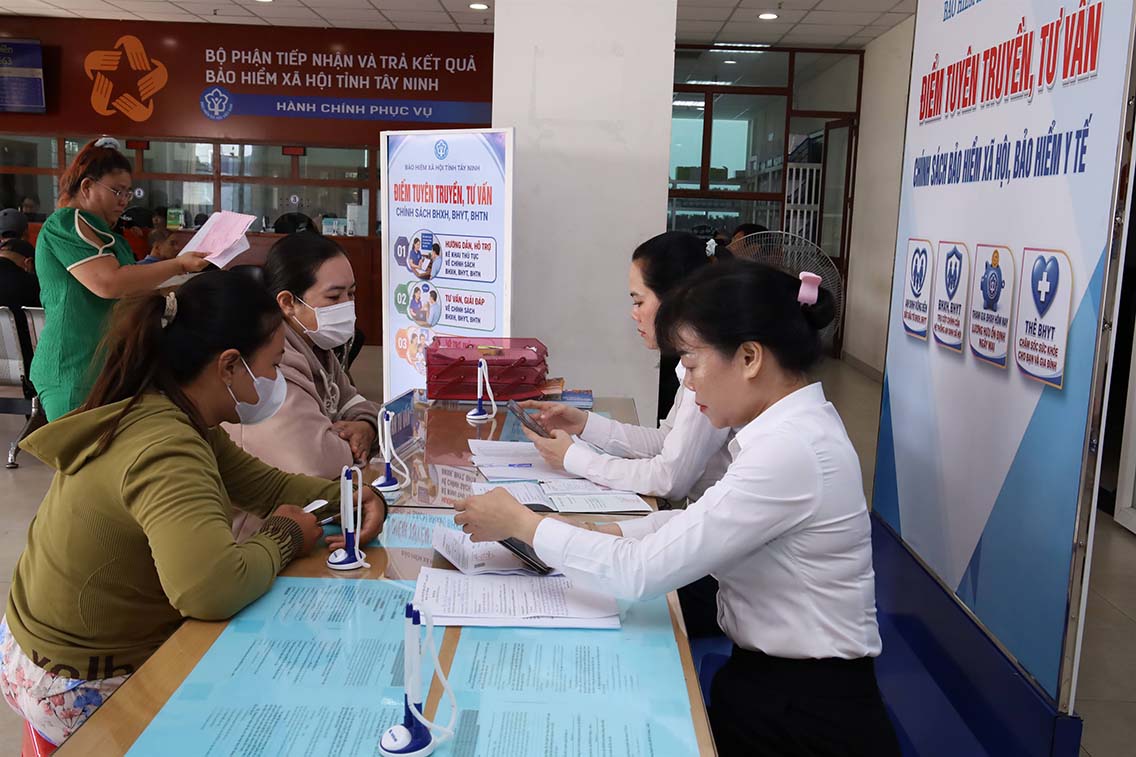
In the first 6 months of 2026, levels and sectors organized 787 training conferences, workshops, propaganda, and mobilization to participate in voluntary social insurance, attracting tens of thousands of people. Previously, in 2025 alone, the whole province organized 248 conferences, seminars, and workshops with 12,660 participants, including 214 propaganda, consulting, and answering conferences on voluntary social insurance and household health insurance policies.
Communication work has also been expanded on many channels. The provincial BHXH electronic information portal posted 1,000 news, articles, documents, and videos, attracting more than 1.09 million visits; Fanpage and Zalo OA posted 2,167 news and articles; officials and employees throughout the sector shared 8,396 news and articles on personal social networks. The grassroots broadcasting system carried out 26,443 broadcasts, of which 3,500 were about voluntary BHXH.
Notably, the public opinion survey conducted from July 28 to August 3, 2026 with 25,856 responses showed that 93.2% of surveyed people assessed that voluntary social insurance plays a role from relatively important to very important. However, 41.3% proposed to increase the level of contribution support; 32.5% were concerned about the long contribution period, price slippage, inflation; 46% wanted to diversify contribution methods; 40% proposed to simplify procedures and 33.9% wanted to expand the support network to hamlets and residential groups.
This reality shows that the problem of voluntary social insurance is no longer simply mobilizing more people to participate. It is necessary to develop new ones, maintain contributions and limit interruptions; shift from peak propaganda campaigns to management, care and regular companionship.
Tay Ninh is gradually shifting from "managing participants" to "accompanying participants". In the first 6 months of 2026, data of 131,919 people participating in voluntary social insurance and household health insurance have been sent to the system to proactively suggest and remind people. Along with that is the orientation to increase support levels for low-income groups, innovate consulting, expand networks to grassroots levels and take digital transformation as a tool to maintain participants.


