
In the context of a volatile economy, the Vietnamese job market is recording notable shifts. Faced with that reality, Coc Coc Research has analyzed and compiled data to outline the overall picture of the Vietnamese job market today.
The Vietnam Employment Market Report, released on the afternoon of January 21, was conducted through a survey with 1,009 respondents who are workers, candidates, and employers across the country in December 2025.
The report has the coordination of data application from the 24h Work platform, a trusted partner of more than 2.3 million businesses.
Labor market in 2025 has stable surface, waiting for momentum in 2026
According to the survey-based ratio, half of workers (53.8%) still maintain their positions in the past 12 months. However, behind the stable appearance is increasingly clear cautious psychology: 48.7% are considering new opportunities, while only 28.1% are willing to change jobs immediately if there is a sufficiently attractive offer.
In that general picture, Gen Z emerges as the group with the highest degree of mobility when up to 32.8% of Gen Z workers are actively looking for jobs and ready to move immediately.
In the opposite direction, businesses enter 2026 with expanding expectations, as 77% said they plan to recruit more personnel in the next 12 months. The mismatch between recruitment demand and the willingness of workers to move is creating a job market that is "stable in the surface but delayed in the deep".
Workers go hand in hand with AI pressure (artificial intelligence)
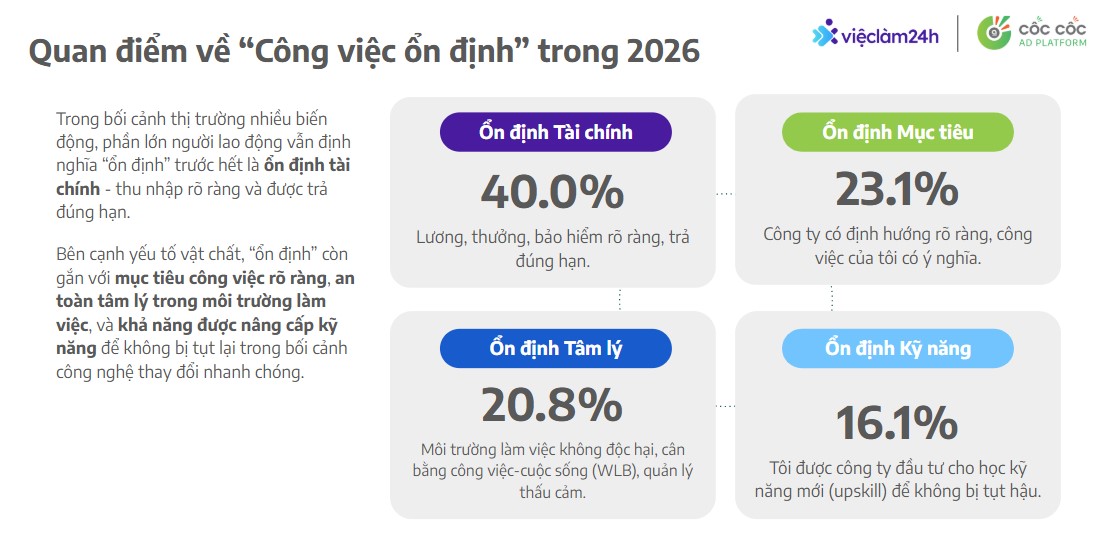
The report noted a clear shift in the occupational value system of workers. Although wages and benefits are still the foundation for creating a sense of "stability" (40%), income is no longer the top priority.
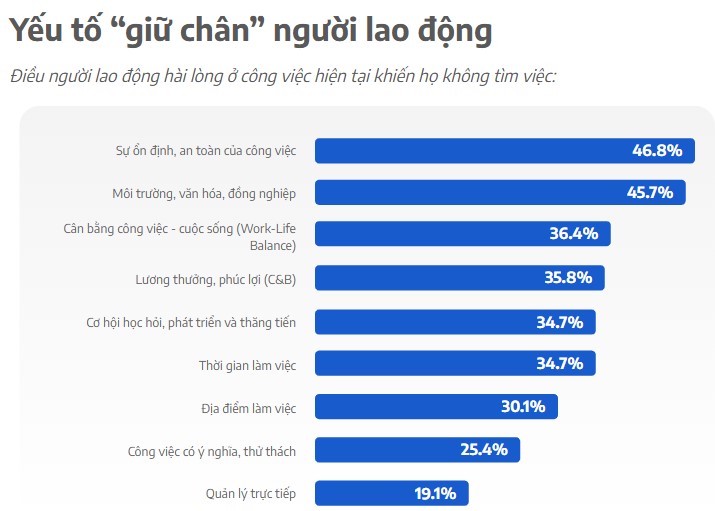
Specifically, 76.9% of workers participating in the survey are willing to choose a healthier, respectful and more balanced working environment, even if they have to trade for a higher salary. With Gen Z, this figure is even clearer when 60.8% are willing to accept a 1-10% reduction in income in exchange for a suitable working environment.
In parallel with that, the development of AI creates a clear two-way psychology. 36% of workers expressed optimism about the impact of AI on work, while 16.6% are concerned about the risk of being replaced. Notably, 64% believe that AI can reduce the connection between people in the working environment.
In the opposite direction, businesses are also facing increasingly complex recruitment challenges. The report shows that 54% of businesses have not met the income expectations of candidates, becoming one of the major barriers in the process of recruitment and retaining personnel.
In the context of increasingly popular AI, recruitment criteria are also shifting towards prioritizing skills that demonstrate human competence such as adaptability, independent thinking, creativity and emotional management. Mastering basic AI tools, in many cases, has become a basic requirement instead of a competitive advantage.
Another notable finding from the report is that 80% of workers actively use AI tools in their work, most of whom are using them even when businesses do not have specific guidelines or regulations.


