
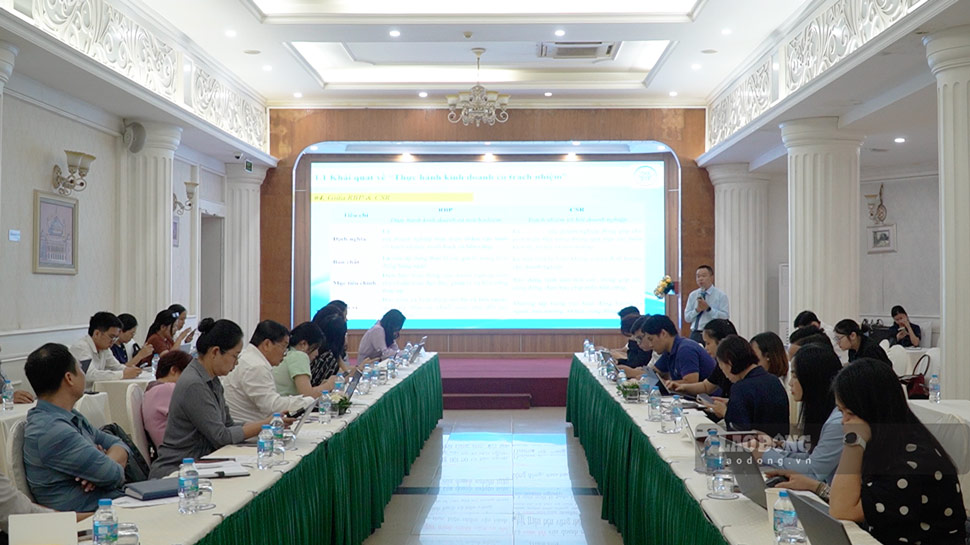
The 2026 Policy and Law Training Conference on responsible business practices in the field of Science and Technology was organized by the Ministry of Science and Technology on August 20.
It's not necessary to start with a large system
Sharing at the Conference, Dr. Nguyen Tien Dat - Faculty of Economic Law, Academy of Policy and Development (Ministry of Finance) said that businesses do not necessarily have to immediately deploy a large-scale responsible business administration system. Instead, businesses can test each solution in a small scope, evaluate the effectiveness before expanding. This is an approach according to the sandbox testing mechanism.
In addition, Mr. Dat also suggested that businesses should choose suitable activities to implement first, instead of having to change the entire process at the same time.
One of the ways to start is to self-assess the level of ESG (environmental, social and governance criteria) implementation through simple tools such as tests and quizzes. Through this, businesses can identify what has been done and what needs to be further improved in the three groups of environment, society, and governance.
According to Dr. Nguyen Tien Dat, businesses can also start from digitizing and applying technology to reduce costs. This is both a solution to improve operational efficiency and helps businesses gradually build a foundation for more transparent and responsible governance.
From product traceability to feedback receiving mechanism
One of the solutions proposed by Dr. Nguyen Tien Dat is to build a "passport" to trace information for products, goods and services. This tool helps businesses better manage product information, while increasing transparency in the production and supply process.
Businesses can also experiment with new management mechanisms, including internal denunciation and feedback receiving systems. This is one of the ways for businesses to detect and handle problems arising in the operating process early.
According to Dr. Nguyen Tien Dat, responsible business practice needs to be shifted from "commitment" to "action". Regarding social issues, businesses can include ESG criteria in labor management, pay attention to the diversity of the human resources and build a mechanism to monitor sustainability in the supply chain.
Regarding the environment, the solutions mentioned include using green financial tools, promoting credit and carbon quota exchanges, and implementing circular economy models such as water reuse and waste treatment and reuse.
In corporate governance, Dr. Nguyen Tien Dat proposed strengthening ESG reporting and information disclosure, building an independent ESG monitoring department and researching the establishment of an AI ethics committee.
Thus, according to the approach given, businesses do not necessarily have to deploy many solutions simultaneously from the beginning. It can start from specific tasks such as product information transparency, operation digitization, receiving feedback and self-assessing ESG, then gradually expanding to environmental, social and governance requirements.


