
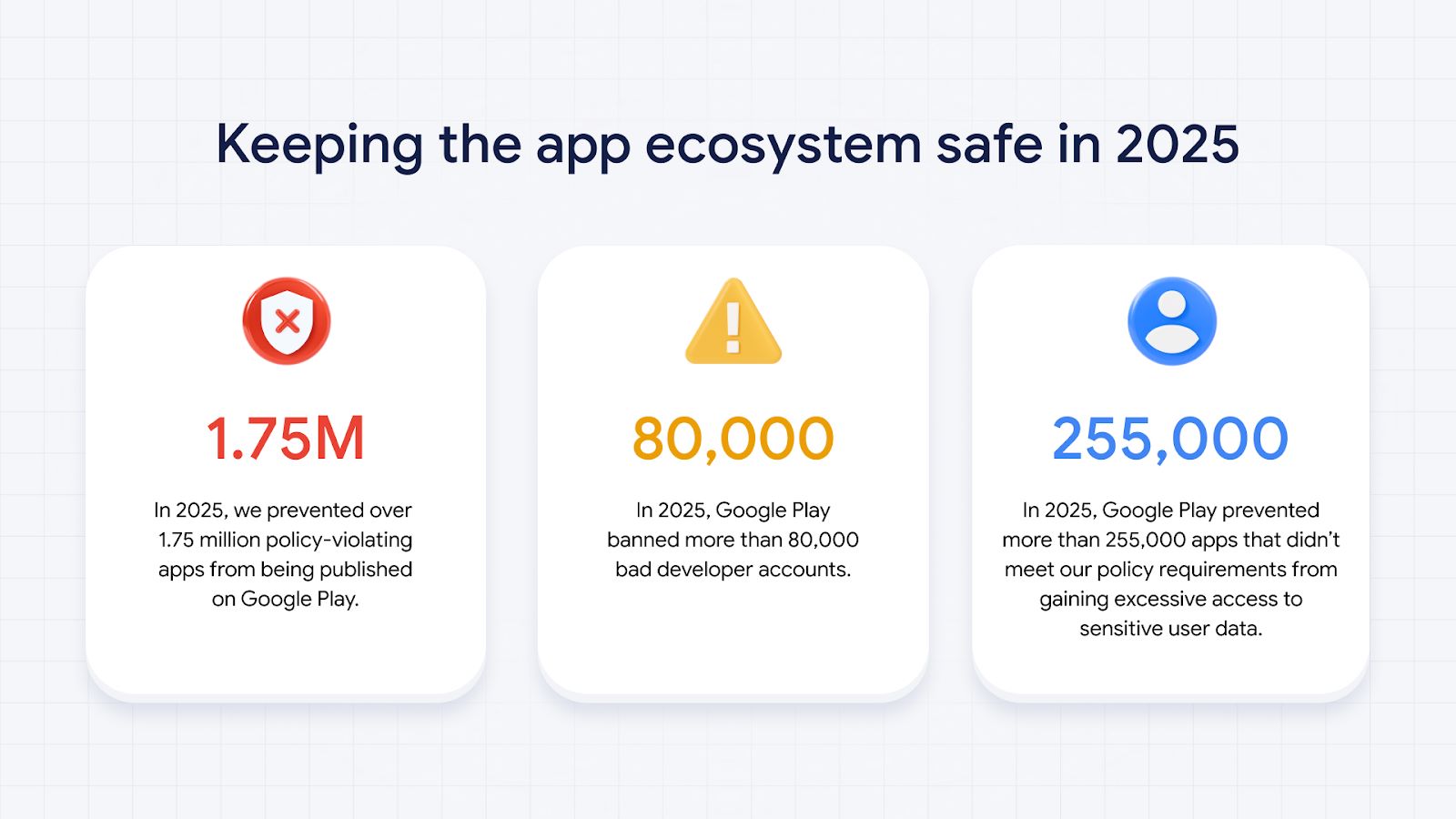
In a newly released Android app ecosystem safety report, Google said it has prevented 1.75 million policy-breaking apps published on Google Play in 2025, down from 2.36 million apps in 2024 and 2.28 million apps in 2023.
This annual report provides an overview of how Google protects Android users by reviewing and monitoring applications to combat malware, financial fraud, privacy infringement, unlicensed service subscriptions and other threats.
For example, Google said it banned more than 80,000 developer accounts in 2025 for efforts to release these malicious applications. This number also decreased compared to the previous year, from 158,000 accounts in 2024 and 333,000 accounts in 2023.
Google emphasized how investment in artificial intelligence and other real-time defense measures has helped counter these threats, and also said that they play a deterrent role.
“Initiations such as developer verification, mandatory pre-browsing checks and test requirements have raised standards for the Google Play ecosystem, significantly reducing the paths for bad actors to intrude,” and added that their “multi-layered protection measures based on artificial intelligence” have “prevented bad actors from releasing malicious applications,” Google shared.
Google said it currently conducts more than 10,000 safety tests on each application it releases and continues to review applications after release. The company has also integrated the latest generative AI models into the application review process, helping assessment experts find more complex and faster malicious patterns. Google said it plans to increase investment in AI in 2026 to always stay ahead of emerging threats.
In addition, Google said it has blocked more than 255,000 applications from over-accessing users' sensitive data, a decrease from 1.3 million applications in 2024.
Meanwhile, Android's defense system, called Google Play Protect, has identified more than 27 million new malicious applications and warned users or blocked applications from running.
This number is higher than the 13 million apps that were not on the Play Store identified in 2024 and the 5 million apps in 2023. This increase seems to suggest that bad actors are now frequently avoiding the Play Store when targeting users with their malicious apps.


