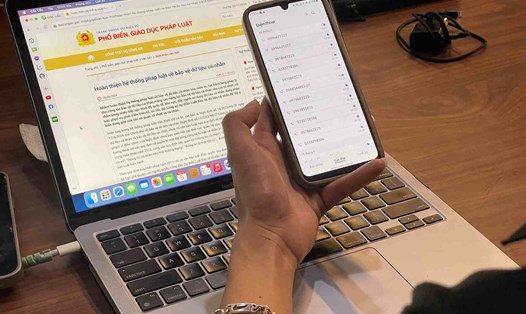
Still having a headache because of spam messages and calls
Advertising messages, calls "inviting to borrow capital", "inviting to invest" are still rushed every day, despite the fairly complete legal framework. This reality shows a worrying gap between regulations and life, when people still have to "brace themselves" to deal with uninvited calls.
At 7:30 am, just as she was taking her child to school, Ms. Nguyen Thu Ha (Hai Ba Trung, Hanoi) received a call from a strange number. Before she could "call", the other end of the line fluently introduced a consumer loan package with preferential interest rates and quick disbursement. Ms. Ha hung up, but just a few minutes later, another number called with similar content.
“Some days I receive 3 - 5 such calls. The day they called during lunch break, it was very uncomfortable,” Ms. Ha said. Not only calls, her phone also appeared with real estate and insurance advertising messages, even services she had never researched.
“I used to be the owner of an apartment, although I had transferred ownership a long time ago, but sometimes I received phone calls asking to buy or rent. Now, whenever I see a strange phone, I don't answer it, but that way I miss many important calls” - Ms. Ha shared.
Ms. Ha's story is not isolated. To control this situation, the Government has issued Decree 91/2020/ND-CP, setting out the core principle that businesses are only allowed to send advertising messages, calls or emails with the prior consent of the recipient.
The regulations also require a clear refusal mechanism, no contact outside the permitted hours, and especially, people can register in the "no advertising" list to completely block marketing content. In parallel, the spam feedback receiving system via the number 5656 operated by the Department of Information Security has created an additional channel for people to protect themselves.
The penalty level according to regulations is also not light at all. The act of sending spam messages can be fined up to 100 million VND, spam calls can be up to 170 million VND, and even if it is related to fraud or data breach, it can be criminally handled.
Looking at the regulatory system, it can be seen that Vietnam does not lack legal tools to handle spam messages, calls and emails. However, the paradox lies in the fact that, although the law is in place and increasingly strict, spam still appears a lot, becoming increasingly sophisticated and difficult to control.
Personal data is not really safe
The root of the problem lies in personal data. Just one registration to buy goods, participate in surveys or leave a phone number online, user information can be collected, stored and shared with a third party. In fact, there is an underground market for buying and selling data, where phone number lists are classified according to needs such as buying a house, borrowing capital, investing... at very cheap prices. Once the data has been disseminated, control becomes extremely difficult, even almost impossible to trace the original source.
Not only stopping at the issue of data, many businesses also find ways to "circumvent the law". Instead of calling from a fixed number, they use a series of different numbers, hire virtual switchboards or automated calling software. Even, there are cases where calls are made from abroad, making it complicated to identify the source of transmission and handle violations.
Worryingly, spam messages and calls have been transformed into scams with sophisticated scenarios such as impersonating banks, functional agencies, and inviting investment. Even using fake voice technology, causing money loss, data leakage and information security risks.
Building sanctions to prevent from the root
The Ministry of Public Security is drafting a Decree regulating penalties for administrative violations in the field of network security and personal data protection. The first highlight is expanding and deeply concretizing violations. If previously, the regulations mainly revolved around "sent spam messages" or "calls without permission", this draft has gone into each stage in the spam distribution chain. Not only penalizing the act of sending advertising without consent, but also handling the failure to store registration information, failure to confirm refusal requests, and failure to have a mechanism to check user consent.
A very noteworthy point is that for the first time, detailed regulations on technical responsibilities of enterprises are stipulated, forcing enterprises to have a technical system to prevent spam, including limiting the frequency of sending, controlling the source, blocking messages that pose a risk of information insecurity, and having to send copies of advertising content to the technical system of the management agency. This is a very large change, because it turns the responsibility to prevent spam from an administrative obligation into a mandatory technological obligation.
The draft of the Ministry of Public Security also clearly shows the trend of "tracking responsibility down to telecommunications infrastructure and service platforms". Not only advertising businesses are penalized, but also message, email, VoIP, SIP Trunk service providers are bound. If they do not deploy an unidentified call blocking system, do not monitor unusual traffic, do not provide data for investigation... they can all be heavily fined, up to 200 million VND. This is a new point that is "attacking the root", because most spam calls today take advantage of intermediate technical infrastructure.
If promulgated and effectively implemented, this will be an important tool to gradually "clean up" the information environment, reduce spam messages, spam calls and fraudulent acts in cyberspace.