
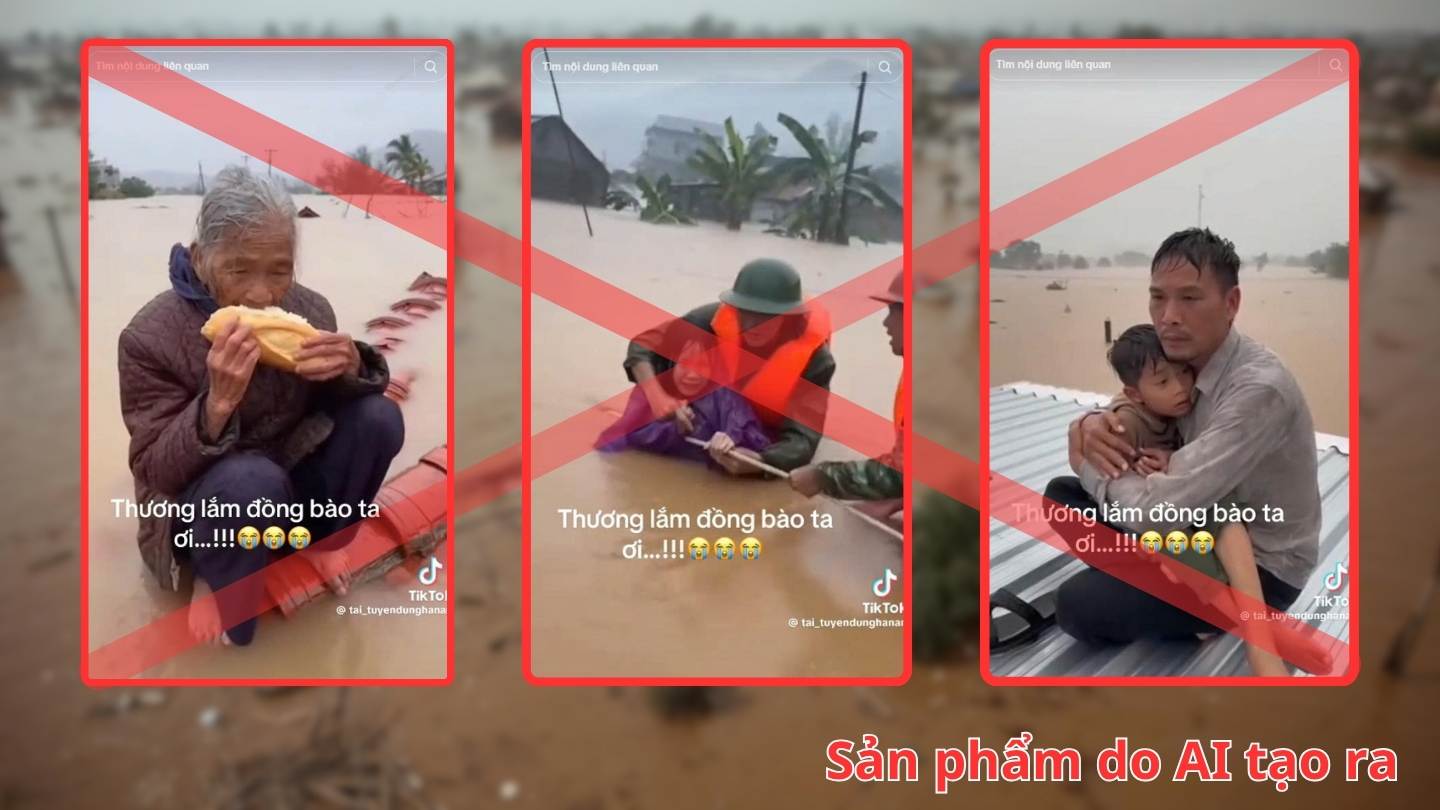
The situation of using AI to create fake videos about storms and natural disasters to attract views and interact is raising many concerns about the risk of causing information confusion in cyberspace. Many videos use images of floods and storms created using AI technology, even attaching logos of press agencies or weather reports to increase reliability, causing many users to misunderstand that it is real information.
In that context, the requirement to strengthen the fight against false information, taking advantage of natural disasters to cause public panic is being raised more urgently.
According to the Propaganda Plan Conclusion No. 213-KL/TW on continuing to implement Directive No. 42-CT/TW of the Secretariat, propaganda work needs to "strengthen information and propaganda work, fight against wrong and hostile views that take advantage of natural disasters, storms, floods, and climate change to affect order, security, safety, and affect people's lives and activities".
The plan also requires "promoting propaganda to raise awareness about research, application of scientific and technological achievements, innovation, digital transformation, building large databases, artificial intelligence" in disaster prevention and response.
Along with policies to strengthen the fight against false information in cyberspace, many current legal regulations also have sanctions for the act of posting and spreading fake content that causes public confusion.
Talking to Lao Dong Newspaper, Lawyer Tran Thi Thanh Lam - Chinh Phap Law Office said that using AI to create fake videos about storms and natural disasters and then posting them on social networks may be considered an act of providing and sharing fake information, false information in cyberspace.
According to Ms. Lam, in case the posted content is fake, untrue, distorted or causes public confusion, this is an act strictly prohibited according to point d, clause 1, Article 8 of the 2018 Law on Network Security.
Depending on the nature, severity and consequences of the act, the person who posts false information may be penalized according to point a or point d, clause 1, Article 101 of Decree 15/2020/ND-CP, amended and supplemented by Decree 14/2022/ND-CP," lawyer Lam said.
According to current regulations, acts of taking advantage of social networks to provide and share fake, untrue information or cause confusion among the people may be fined from 10-20 million VND for organizations. In case individuals violate, the fine is equal to half of the fine of the organization. In addition, violators may also be forced to remove false information or cause confusion.
Lawyer Lam said that in cases where the uploader uses fake AI videos to attract views, sell goods or create trust for viewers to transfer money and contribute assets, this act may also be considered from the perspective of the crime of Fraudulent appropriation of property under Article 174 of the 2015 Penal Code, amended and supplemented in 2017.
Fake AI videos, false information or staged images can be seen as a means to commit fraudulent acts to appropriate property," Ms. Lam said.
According to the lawyer, if the act causes serious consequences such as adversely affecting security, social order and safety, causing economic damage or infringing upon the legitimate rights and interests of other organizations and individuals, the functional agency may also consider criminal responsibility for the crime of illegally providing or using information on computer networks and telecommunications networks according to Article 288 of the 2015 Penal Code, amended and supplemented in 2017.
Another problem that is also appearing commonly today is that many fake AI videos use press logos, weather forecast images or interfaces of organizations to create trust for viewers.
According to Lawyer Tran Thi Thanh Lam, in case of using logos, interfaces or images that make viewers misunderstand that this is the official information page or content of another agency or organization, the performer may be considered for sanctioning for the act of forging the electronic information page of an organization or individual according to point a, clause 3, Article 99 of Decree 15/2020/ND-CP, amended and supplemented by Decree 14/2022/ND-CP.
The fine for this act is from 20-30 million VND for organizations; individuals who violate are fined half the fine of the organization," Ms. Lam said.


