
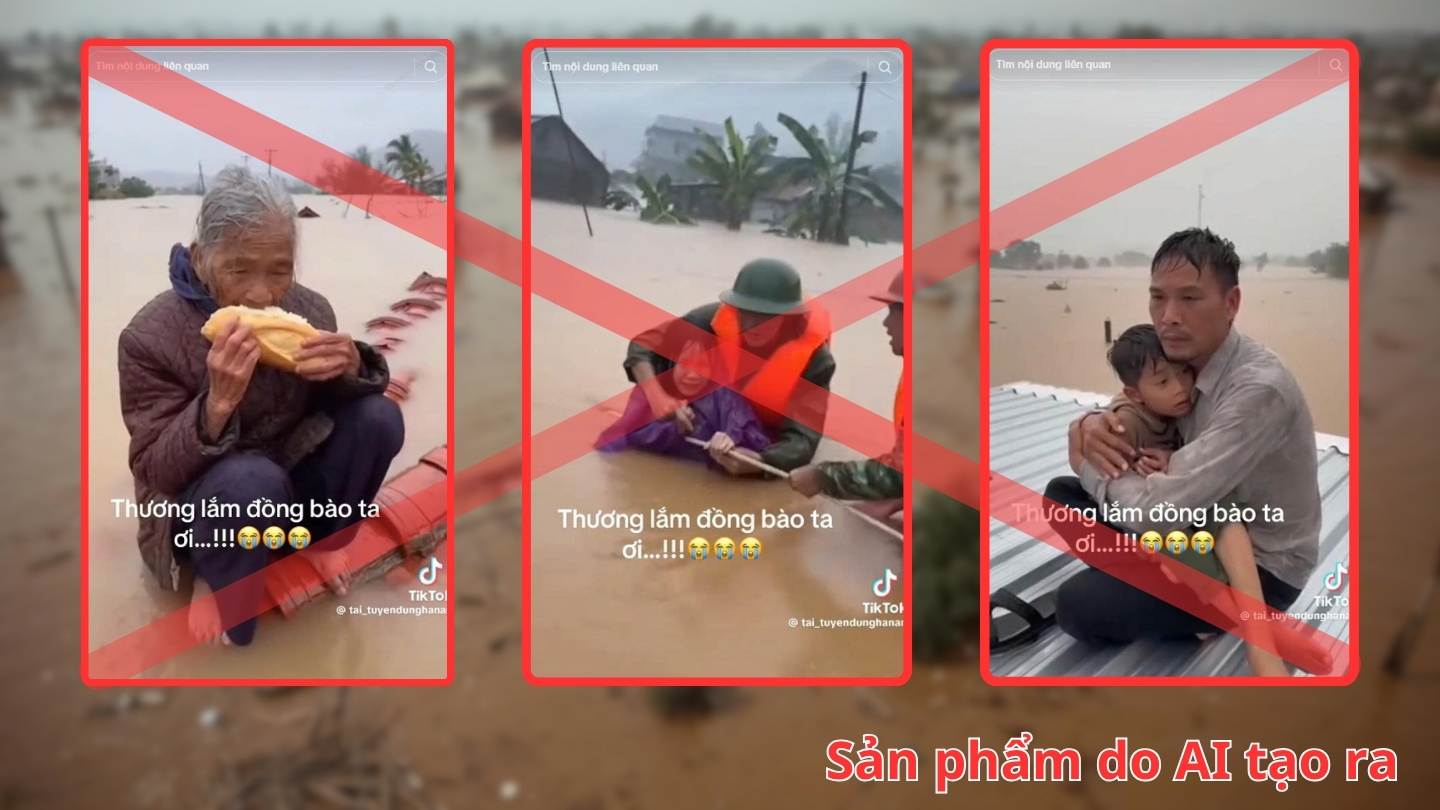
Just typing keywords related to storms on social networking platforms, users can easily encounter a series of videos with shocking titles such as "super typhoon makes landfall", "the whole city is submerged in sea of water", "rainy rock destroys a series of cars". Many contents attract hundreds of thousands of views in just a few hours of posting.
According to records, many videos use images from abroad, old natural disasters, especially products created with artificial intelligence (AI) and then attached to the context in Vietnam. Some clips also insert fake weather agency logos to increase reliability.
In addition, the accounts also continuously broadcast live the scene of "apocalyptic storms", using AI voice reading and images built using generative technology to stimulate curiosity and interaction. There are videos simulating scenes of deep flooded streets, uprooted trees, houses swept away, people sitting on flooded roofs,... although in reality in the locality only normal thunderstorms occur.
Mr. Nguyen Van Tung - a worker working in Hanoi said that late at night after seeing a series of videos of hail and thunderstorms spreading on social networks, he immediately called his hometown because he was worried about his family.
At that time, the internet was intermittent, calling for a long time without success, so I was even more worried. On TikTok, there are all videos of roofs flying everywhere, cars breaking glass. Later, I learned that many clips were cut and pasted or taken from elsewhere," Mr. Tung recounted.
According to records, under these videos, a series of comments show the panic of viewers. Many people believe that the images of hail, flash floods or thunderstorms in the video are actually happening in their locality.
Many accounts also continuously ask about the location of the natural disaster, call home to relatives or share videos with family groups because of worry.

Mr. Do Manh Cuong (Hung Yen) said that he was once deceived by a clip of ice rain covering the streets because the images were too realistic. "I finished watching and immediately sent it to friends asking if it was near my area. Reading the comments below, I saw many people also thinking it was true," Mr. Cuong said.
Discussing this issue, AI expert Vu Thanh Thang - Director of AIZ Joint Stock Company said that AI is making fake news more dangerous because of its ability to create increasingly realistic images and videos.
According to Mr. Thang, in just a few minutes, users can use AI tools to create videos of storms and floods, collapsed houses or scenes of people fleeing. These contents strongly hit the psychology of fear, so they are very easy to spread.
Many accounts currently operate under the "timely view-baiting" model, taking advantage of hot events such as storms, earthquakes, and explosions to create shocking content to increase interaction, sales or earn money from the platform.
Social media algorithms often prioritize strong emotional content. Therefore, the more sensational the video, the easier it is to propose. This is why many accounts disregard creating false information," Mr. Thang said.
Mr. Thang also said that users now find it very difficult to recognize AI videos if they just scroll through them. Some signs that can be recognized are unnatural moving images, inconsistent sounds or unusual weather details. However, for older people or people who rarely access technology, distinguishing is almost not simple.
Over the past time, the Party and State have repeatedly emphasized the requirement to improve the effectiveness of disaster prevention, response and recovery in the new situation.
According to the Propaganda Plan Conclusion No. 213-KL/TW on continuing to implement Directive No. 42-CT/TW of the Secretariat, information and propaganda work is identified as one of the key tasks to raise awareness and skills in preventing, responding to and overcoming the consequences of natural disasters for officials, party members and people.
The plan also emphasizes the requirement to strengthen the struggle and refutation of wrong views and information affecting security, order, and people's lives in the context of natural disasters and storms; and at the same time promote the application of science and technology, digital transformation, artificial intelligence, and big data in the work of monitoring, forecasting, early warning and disaster risk monitoring.
In addition, the document requests to promote the leadership role of the Party Committee, the management and administration responsibility of all levels of government and heads in organizing the implementation of disaster prevention, response, and recovery.


