
Building a foundation for the future
At a working session with the Central Policy and Strategy Committee and a number of ministries, departments, and related sectors on the direction of material industry development in Vietnam on the afternoon of May 21, General Secretary and President To Lam directly chaired and issued breakthrough directives, clearly outlining the strategic direction for Vietnam's material industry in the new era.
From an overall perspective on national internal strength, the General Secretary and President emphasized that the material industry is one of the important foundations in the process of industrialization and modernization of the country. The material industry needs to be developed with focus and key points, avoiding spreading out and needs to be organized in 3 layers. In which, the group of base materials needs to be maintained and upgraded; strategic materials need to focus on breakthroughs; future materials need to be prepared early.
With a consistent orientation of strongly shifting from resource exploitation to deep processing, mastering technology and improving domestic added value; taking science - technology, standards, high-quality human resources and Vietnamese enterprises as the pillars of development; developing the material industry in a green, sustainable, self-reliant direction, with international competitiveness, in line with international commitments but protecting national interests to the highest extent.
The General Secretary and President assigned the Government Party Committee to lead and direct the research and development of the Vietnam Materials Industry Development Strategy to 2030, with a vision to 2045, to be promulgated as soon as possible. At the same time, he requested that the Strategy must closely follow the major policies of the Party on industrialization, modernization, science and technology, innovation, digital transformation, green transformation, private economic development, ensuring energy security, national defense, security and international integration.

The General Secretary and President clearly pointed out to focus on reviewing and correctly identifying priority material groups, avoiding spreading them. In the immediate future, 5 priority groups can be selected: rare earth materials; semiconductor materials; materials for batteries and energy storage; new materials; new generation building materials.
These are areas of fundamental significance for industrialization, modernization and economic self-reliance; they need to be carefully assessed in the Strategy to choose the right focus, the right roadmap, and the right support mechanism.
From resource advantages to technology mastery
In today's global industrial competition, materials are being seen as the "heart" of many high-tech fields. From electric vehicles, energy storage batteries, semiconductor chips to renewable energy or aerospace, every modern industry starts from the ability to master materials.
Vietnam is assessed to possess large resources with many types of strategic minerals such as rare earths, titanium, tungsten, graphite... Along with that, a number of large-scale material production industries have been formed and developed such as steel, cement, basic chemicals, building materials, fertilizers and plastics.
However, behind the growth figures, there is still a large gap between potential and actual capacity. Resource advantages have not been correspondingly converted into technological advantages.
Vietnam's material industry is still mainly developing in breadth rather than depth; has output but is not strong in high quality; has resources but deep processing capacity is still limited; has research but the rate of commercialization is still slow.
Talking to a reporter of Lao Dong Newspaper, Assoc. Prof. Dr. Le Manh Tu - lecturer, Head of Applied Electrification Research Group, AEC Lab, Faculty of Science and Materials Engineering, Phenikaa Technical School, Phenikaa University - said that the biggest bottleneck currently does not lie in resources but lies in human resources and technological capacity.
We are seriously lacking human resources in key industries such as metallurgy, metal materials, advanced alloys or rare earths. These are all foundational areas for the development of mechanical engineering, automobile, construction and defense industries," Assoc. Prof. Dr. Le Manh Tu assessed.
While many countries see the material industry as the pillar of industrialization, this field in Vietnam has not received commensurate investment. Traditional training industries related to materials are not really attractive to learners, leading to a prolonged shortage of human resources for many years.
In addition, research and development (R&D) activities still have many limitations. The link between businesses and universities and research institutes is not close, making many research results difficult to commercialize or put into practical production.
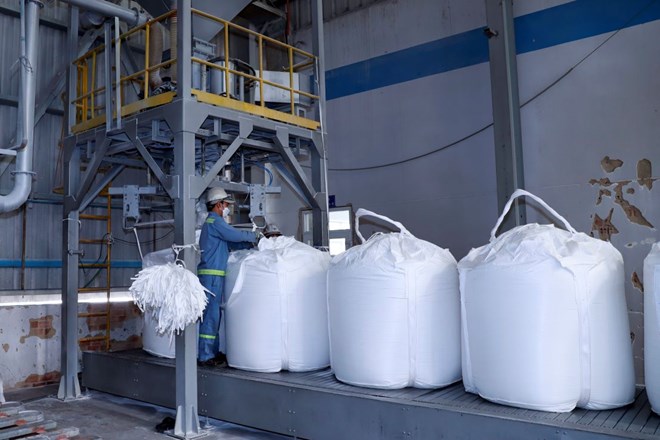
According to Assoc. Prof. Dr. Le Manh Tu, the three-tiered development orientation proposed by the General Secretary and President reflects a long-term vision in policy planning. No matter what development level, metal materials, semiconductor materials and energy materials still play a key role. Only when a strong material industry platform is built can Vietnam develop heavy industry, improve technological autonomy capacity and consolidate national defense potential.
Assoc. Prof. Dr. Le Manh Tu believes that future competitiveness is no longer in resource reserves, but in the ability to master materials technology and innovation. This requires systematic investment in scientific research, training high-quality human resources, building specialized research centers and forming an effective linkage mechanism between the State, businesses and training institutions.
Accordingly, it is necessary to invest more heavily in material research groups at universities and research institutes; build a modern laboratory system; create a stable working environment for scientists to focus on developing breakthrough technology ideas. The State and businesses need to order specific strategic material categories to orient research, focus resources and promote product commercialization.
Besides developing research, training high-quality human resources is also an urgent requirement. From university to postgraduate level, the materials engineering industry needs to be given more attention to investment to form a team of experts capable of receiving, transferring and developing new technologies. Businesses also need to build their own research centers to proactively deploy and apply research results to production practice.
In the context of green transformation and digital transformation taking place deeply and widely globally, the material industry is no longer a field standing behind but has become the foundation of national competitiveness. If Vietnam effectively utilizes resources and invests in the right direction for science and technology and people, it has every opportunity to shift from a raw material exporting country to a country that masters materials and material technology, creating a solid foundation in the future.


