
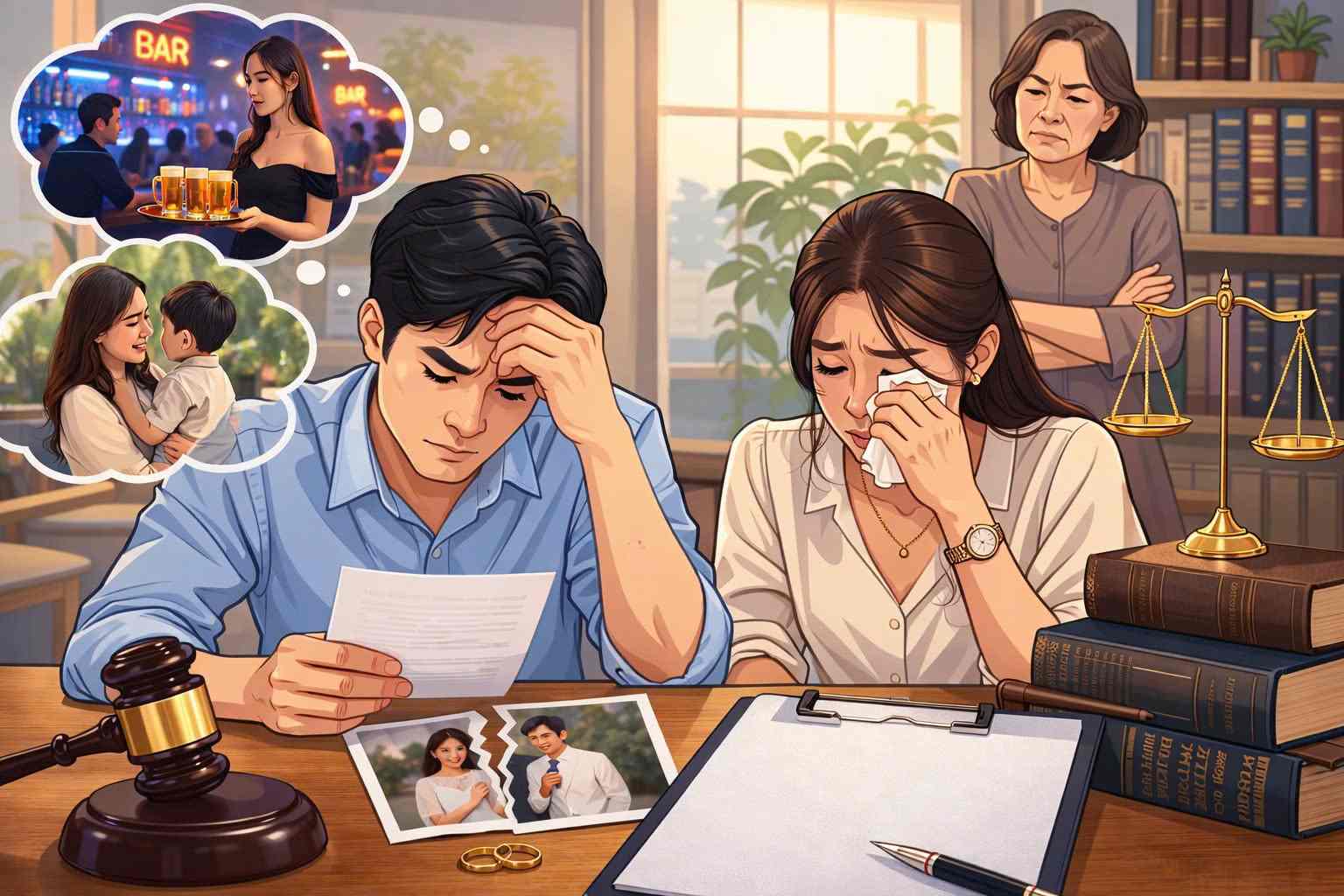
Ms. B.H. Y (in Quang Ninh) asked: "My husband and I have been married for 12 years and have 2 children together, 1 boy and 1 girl. In recent years, my husband and I have had many conflicts due to different views on life. My husband is playful, irresponsible, and friends don't take care of the children all day. I have also tried to have children with full parents, but the conflict between us is increasingly serious.
Tired and suffocated, I filed for divorce in court. After the mediation failed, the Court opened a trial, accepting my divorce request.
Ironically, right after the Court resolved for us to divorce, my husband had an accident and passed away. I still stood up to take care of his funeral and went to the Court to announce that my husband had died.
After my husband's work, my parents-in-law came and asked me to return my husband's property in the common property of husband and wife to them. His parents said that we had a divorce decision from the Court, so we are no longer husband and wife. Therefore, my husband's property must belong to his parents. I would also like to add that when my husband died, he did not leave a will.
I do not agree with my parents-in-law's request. I said that I am raising two children, so my husband's property must be left to his children. Moreover, our divorce judgment has not taken legal effect, so we have not really terminated our marital relationship.
Not being able to demand it, his parents put pressure on me. They used many harsh words in front of my children. His whole family thought I was greedy, "eating" their son's property for free.
Lawyer, may I ask, according to the provisions of law, has the marriage relationship between me and my husband ended? When my husband dies, how is his property handled? Do I have to return everything to his parents?
Regarding the legal issue you asked, lawyer Duong Thu Hien - Thanh Lam Law Company Limited - advises as follows:
Article 57 of the Law on Marriage and Family No. 52/2014/QH13 stipulates the time of termination of marriage and the responsibility for sending judgments and divorce decisions as follows:
1. Marriage relations cease from the date the court's divorce judgment or decision takes legal effect.
2. The court that has resolved the divorce must send the judgment or divorce decision that has taken legal effect to the agency that has carried out the marriage registration to be recorded in the civil registration book; the two parties divorce; other individuals, agencies, and organizations in accordance with the provisions of the Civil Procedure Code and other relevant laws.
According to the provisions of Clause 1, Article 273 of the 2015 Civil Procedure Code on the time limit for appealing against the judgment of the first-instance court, specifically as follows:
“1. The appeal period for the first-instance court's judgment is 15 days from the date of judgment pronouncement; for parties, representatives of agencies, organizations or individuals who initiate lawsuits who are not present at the court hearing or are not present at the judgment pronouncement but have legitimate reasons, the appeal period is calculated from the date they receive the judgment or the judgment is posted.
For cases where the litigant, representative of the agency, organization or individual who initiated the lawsuit has participated in the court session but is absent when the Court pronounces a judgment without a valid reason, the appeal period is calculated from the date of the judgment.
On the other hand, Clause 1, Article 280 of the 2015 Civil Procedure Code also stipulates: The protest period for the judgment of the first-instance Court of the same-level Procuracy is 15 days, of the directly superior Procuracy is 1 month, from the date of judgment pronouncement. In case the Prosecutor does not participate in the court session, the protest period is calculated from the date the same-level Procuracy receives the judgment.
Clause 1, Article 650 of the 2015 Civil Code stipulates that legal succession is applied in the following cases:
“a) No will;
b) Illegal wills;
c) Heirs according to the will die before or at the same time as the person making the will; agencies and organizations entitled to inheritance according to the will no longer exist at the time of opening the inheritance;
d) Those who are appointed as heirs according to the will but do not have the right to enjoy inheritance or refuse to receive inheritance.
Article 651 of the 2015 Civil Code stipulates the legal heir:
“1. The legal heirs are specified in the following order:
a) The first line of inheritance includes: wife, husband, biological father, biological mother, adoptive father, adoptive mother, biological child, adopted child of the deceased;
...
2. Heirs in the same line are entitled to equal shares of inheritance.
3. Those in the later line of inheritance are only entitled to inheritance if no one in the previous line of inheritance is left due to death, lack of inheritance rights, deprivation of inheritance rights or refusal to receive inheritance.
Based on the above regulations, her husband died immediately after the court issued the divorce decision, so this divorce is not legally valid. Meaning that she and her husband still have a marital relationship, according to the provisions of law, they are still husband and wife.
Her husband died without leaving a post, so her husband's property is divided according to the law. The first line of inheritance is determined to include: her, two children, father, mother-in-law. Thus, the property her husband left behind will be divided into 5 equal parts for the above-mentioned people. Her mother-in-law's demand to hand over all of her husband's property to her parents-in-law on the grounds that they have divorced is not in accordance with the provisions of law.
The above is the advice of the lawyer. Wishing you to soon solve your problems.
Legal advice
Please share with us your problems to receive advice from a lawyer at email address: toasoan.laodong@gmail.com


