
Born in the renovation breeze of Vietnamese cinema at the end of the 20th century, the movie "Lưới trời" (2003) was developed from the script of Nguyen Manh Tuan - a famous writer with works directly touching on socio-economic issues. Right from the first approach, director NSƯT Phi Tien Son realized that this is not an easy story to tell.
In the context that literature, journalism and cinema at that time were still hesitant about the topic of corruption, this script went further when it not only reflected power or position, but also peeled out social status and systemic connections.
That boldness both surprised the director and raised many hesitations, but at the same time became the motivation for him to pursue it to the end. That decision was later concretized by rare large-scale scenes, notably the court scene - the center of drama of the film.
If the content creates ideological depth, then the court landscape is a large investment.
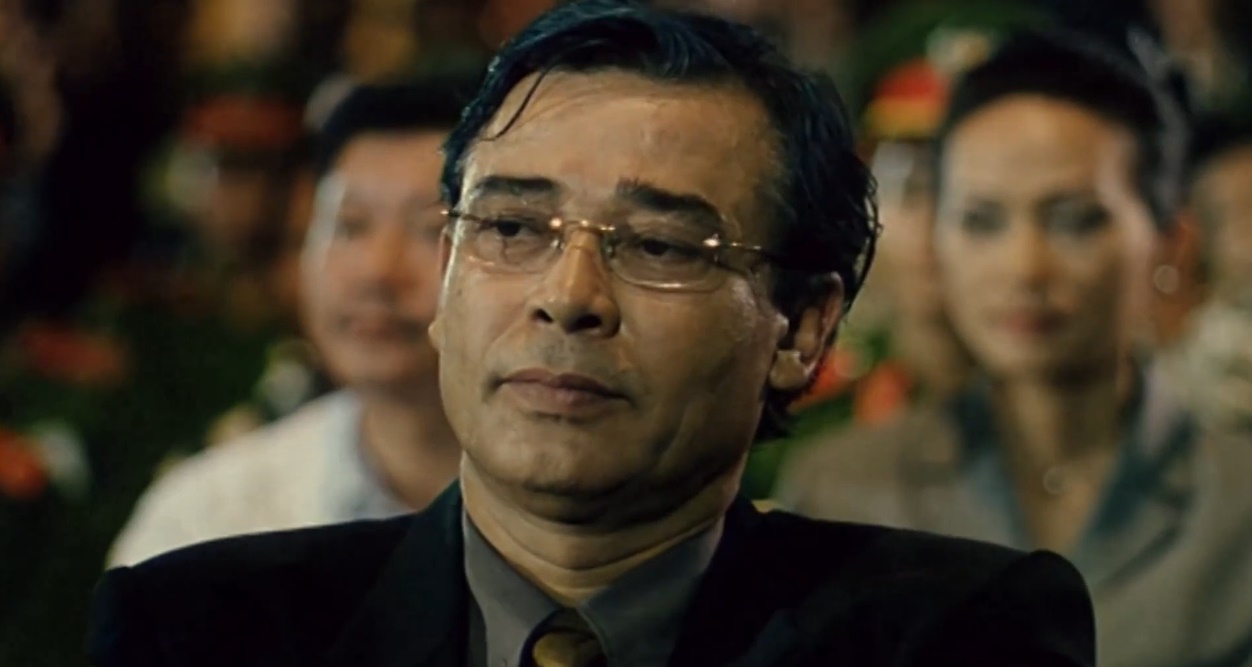
This is one of the rare large-scale scenes of Vietnamese cinema during filmmaking, with more than 500 extras mobilized.
The space is expanded from the courthouse lobby, stairs, waiting room to the courtroom, all organized like a real-life trial.
Hundreds of police officers, hundreds of people in prison uniforms appearing together in one frame created a tense atmosphere.
Artist Dao Ba Son as Tu Le, General Director of a bank, once admitted to the feeling of trembling, "goosebumps" when entering the court setting.
The challenge is even harsher when the film is filmed entirely in film, with a total length of up to 6,500 meters but only about 3,000 meters chosen for editing.
The ratio of almost "2 turns, 1 use" makes each shot become a great pressure, with not many opportunities to correct mistakes like in the digital age.
That requires actors to practice carefully, maintain high concentration and get into the role right from the first shots.
It is in those strict conditions that the court grand scene is not only a grand staging, but also becomes a "living space" for actors to truly blend into the character - something that director Phi Tien Son considers the core of acting.
Despite winning many important awards such as the 2002 Golden Kite Award, Silver Lotus Award and the Best Screenwriter award at the 14th Vietnam Film Festival, or the Best Actress award at the 2003 Mai Vang Awards, "Luoi Troi" when released did not have many opportunities to reach audiences. The film was released in a limited way and had almost no promotional activities.
After all, amidst the changes of Vietnamese cinema, "Sky Net" with the impressive court scene of that year is still a mark of Vietnamese cinema in the renovation era.
The movie "Rain Net" is one of the carefully selected films to contribute to looking back at the face of Vietnamese cinema in 40 years of Doi Moi, within the framework of the program "The Face of Vietnamese Cinema 40 Years of Doi Moi" of the Organizing Committee of the 4th Da Nang Asian Film Festival (DANAFF IV).


