
The Ministry of Education and Training (MOET) sent to the Ministry of Justice for appraisal the draft Decree regulating salary policies and allowance regimes for teachers. In which, many noteworthy contents relate to the salary scale applied and the specific salary coefficient for the teaching staff in the national education system.
Applying the administrative and professional salary scale, professors receive senior expert salaries
According to Article 3 of the draft Decree, the Ministry of Education and Training proposes that teachers at public educational institutions be allowed to apply professional and nghiep vu salary scales for officials and employees in public non-business units in accordance with the law.
For teachers appointed to professor titles, a high-level expert salary scale will be applied. The Minister of Education and Training is assigned to specifically regulate the appointment and salary ranking for teachers, ensuring suitability with the job position, professional qualifications and professional characteristics.
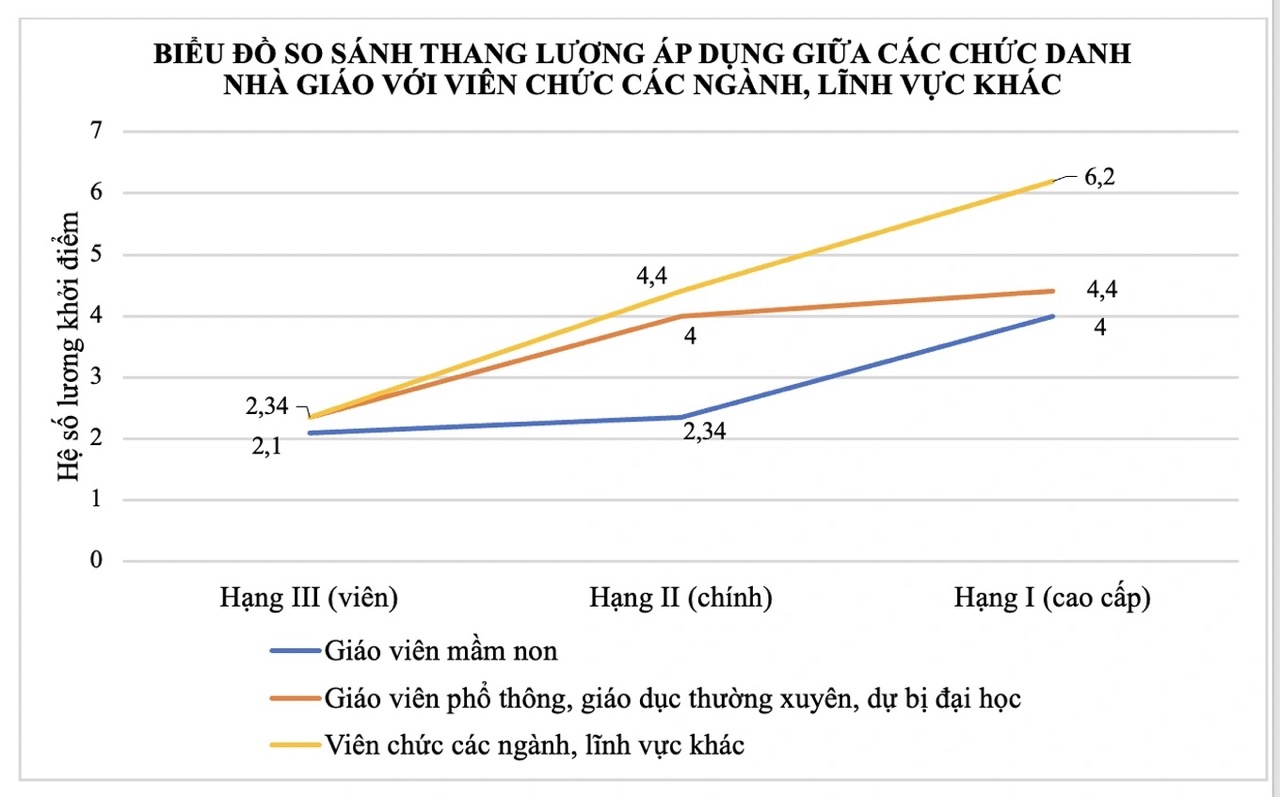
Proposal for a higher specific salary coefficient for preschool and inclusive education teachers
Notably, in Article 4 of the draft Decree, the Ministry of Education and Training proposes to apply a special salary coefficient for teachers, calculated on the current salary coefficient, with specific levels:
Coefficient 1.15: Applicable to teachers in public educational institutions under the national education system (except for other special cases).
Coefficient 1.25: Applicable to teachers in public preschool education institutions.
Coefficient 1,2: Applied to teachers teaching at schools and classes for people with disabilities; centers supporting the development of inclusive education (except preschool); boarding schools in land border areas; teachers teaching at the Ho Chi Minh National Academy of Politics and provincial and city political schools.
Coefficient 1.3: Applied to teachers teaching at schools, classes for people with disabilities, and centers supporting the development of inclusive education for preschool children.
This is considered a step to concretize the preferential salary policy for educational fields with specific characteristics, high labor intensity and special professional requirements.
In line with the spirit of the 2025 Law on Teachers
The above proposals are built on the basis of Article 23 of the 2025 Law on Teachers, effective from January 1, 2026. Accordingly, the salary of teachers in public educational institutions is ranked highest in the administrative and non-business salary scale, and at the same time enjoys professional preferential allowances and other allowances by region, according to the nature of the job.
The Law also emphasizes prioritizing higher salary and allowance regimes for preschool teachers; teachers working in ethnic minority, mountainous, border, and island areas; teachers teaching specialized schools, implementing inclusive education and some specialized industries and occupations.
For teachers in non-public educational institutions, salaries are implemented according to the provisions of labor law.
The salary policy for teachers is currently determined according to two mechanisms:
Teachers of public educational institutions: Salary is ranked according to the administrative and non-business salary scale system, calculated on the base salary level and coefficients, allowances according to regulations.
Teachers of non-public educational institutions: Salaries are implemented according to labor law, calculated on the regional minimum wage.
According to Decree No. 293/2025/ND-CP, from 2026, the regional minimum wage will continue to be adjusted. In which, the lowest level (Zone IV) is 3.7 million VND/month, as a basis for non-public educational institutions to build salary scales and tables for teachers.
The promulgation of the Decree on salaries and allowances for teachers is expected to create a synchronous legal corridor, improve income, and retain the teaching staff, especially at the preschool level and specialized education fields.


