
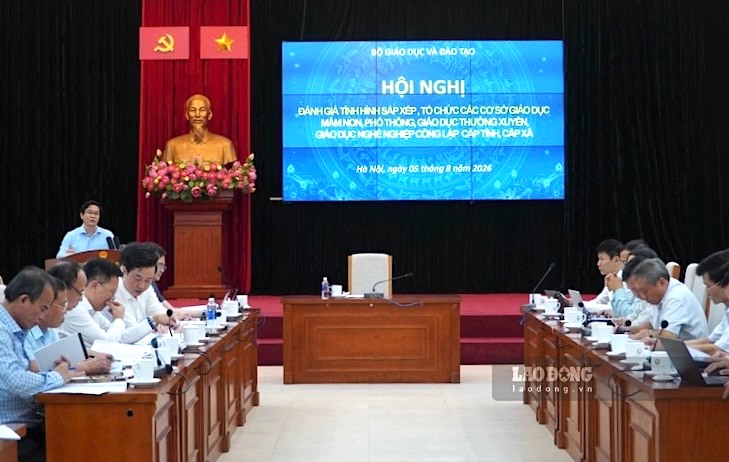
The above data was announced by the Ministry of Education and Training (MOET) at the conference to assess the situation of implementing the arrangement and organization of public preschool, general education, continuing education, and vocational education institutions at provincial and commune levels on the afternoon of August 5.
Ensuring stable school operations, legitimate rights and interests of staff
Reporting at the conference, Mr. Thai Van Tai - Director of the Department of General Education said that by August 4, 2026, the Ministry of Education and Training had received reports from 34/34 localities. Localities have seriously implemented the Government's direction, proactively reviewed the network and developed plans suitable to actual conditions.
The arrangement of the network of educational institutions is expected to have impacts on the organizational structure and the team of management officials and school staff in localities. The team handling plan is basically built by localities in the direction of receiving and using the maximum existing personnel, ensuring the stable operation of educational institutions after arrangement, and the legitimate rights and interests of the team are affected.
Localities prioritize arranging at the main school, branch, and school point; transferring to educational institutions that are still lacking; transferring qualified people to return to teaching or arranging other jobs suitable to their capacity and expertise. In case there are no more arrangement plans, implement regimes and policies according to regulations.
For school staff, the general trend is to maintain positions directly associated with ensuring the quality of education and student care at each study location such as libraries, experimental equipment and school health; and at the same time reorganize administrative positions such as accountants, clerks, cashiers, in a streamlined direction, arranged for common use in the same legal entity.
Localities continue to review each person and each position; prioritize reassigning in the industry, transferring to units that are still lacking or transferring to suitable job positions; only resolve regimes and policies when there is no longer a possibility of assignment.
It is expected to reduce more than 17,000 educational institutions, equivalent to 45.7%.
According to reports from 34 localities, the total number of public educational institutions is expected to decrease from 37,386 to 20,284, a decrease of 17,102 focal points, equivalent to 45.7%.
The reduction of focal points is mainly implemented through the organization of multi-level schools, converting old facilities into branches, school sites and rearranging continuing education centers, vocational education centers - continuing education. Necessary teaching locations are basically maintained, especially in remote, mountainous, border and island areas, to ensure students' right to access education.
The new model needs to ensure a legal entity, a management system and accountability; clearly assign people in charge of each branch and school point; organize interconnected and unified professional procedures for managing personnel, finance, assets, data, semi-boarding, boarding, food safety and fire prevention and fighting. The focus after arrangement is not only to reduce focal points but also to ensure that educational institutions operate stably, effectively and do not affect students' learning rights.
Localities have proactively prepared conditions for operating the new model, including consolidating the organizational structure, arranging staff, handing over finances, assets, records, data and developing education plans. Along with that, the Education sector also focuses on publicity and transparency, creating consensus among staff and people, ensuring that educational institutions after arrangement operate stably before the 2026-2027 school year.


