
Ask a straightforward question
If all those expensive technology devices are removed from the classroom, what abilities will students retain? This is the fragile boundary between a movement performance and a true STEM education.
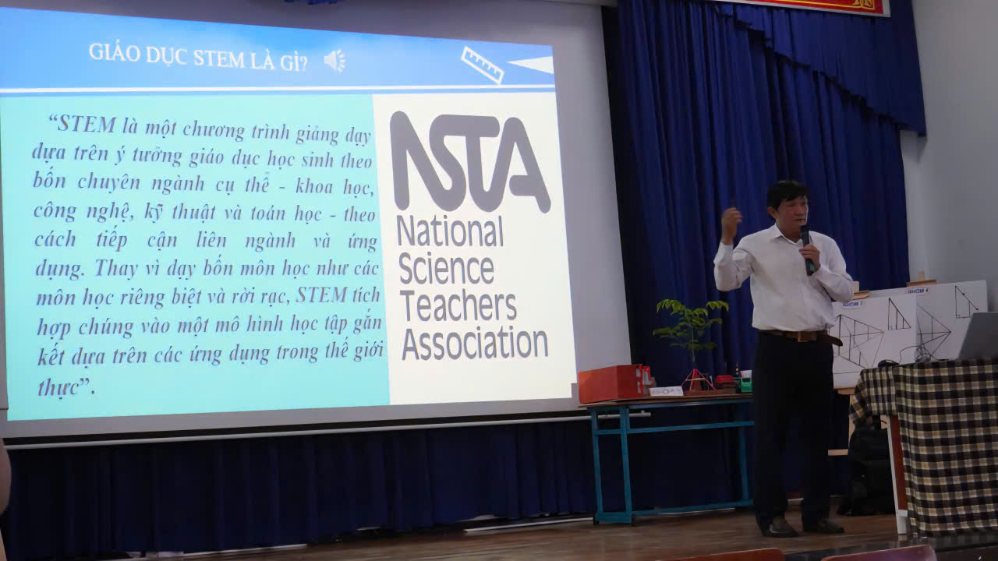
STEM is essentially an interdisciplinary integration between science, technology, engineering and mathematics to help learners apply knowledge to solve practical problems. UNESCO emphasizes that STEM education not only prepares human resources for innovation, but more importantly, develops critical thinking, problem-solving skills and creativity for future generations.
For that reason, a STEM project should not be judged mainly by whether the product has a "beautiful" appearance or the technology seems "modern" or not. The success level of the lesson lies in how students have thought, hypothesized, collected evidence, experimented and improved the solution.
The World Economic Forum (WEF)'s "Future of Employment" report forecasts that by 2030, about 39% of workers' skills will be changed or outdated, and 63% of businesses acknowledge that skill gaps are major barriers to the transition process. This reality requires schools not to simply "teach more technology" or equip machines, but to comprehensively change educational methods to help students form flexible adaptability to the constant changes of technology.
A true STEM lesson can completely start from very familiar problems in life: from designing water-saving systems, reducing plastic waste, optimizing electricity, to solutions for processing environmental data or supporting people with disabilities. In that process, science plays a role in explaining phenomena; mathematics provides tools for measurement and analysis; technology provides a means of implementation; and engineering orients the design, testing and optimization of solutions. This interdisciplinary perception is completely different from forcing four separate subjects into one activity.
To make STEM substantive
However, for STEM education to become substantive, schools cannot operate as a closed system isolated from society. The companionship of businesses and research organizations is a decisive factor. Students need opportunities to access practical problems that engineers or businesses are facing; while teachers also need to constantly update technology trends and new skill requirements.
In Vietnam, the OECD assesses that insufficient close coordination between training institutions and the business sector is reducing the effectiveness of human resource training. Therefore, businesses should not only appear in the final recruitment stage, but need to participate earlier in the education process: setting practical problems, contributing ideas to build programs, creating a space for experience and feedback on the shortcomings of learners.
At the same time, innovation in testing and assessment is a mandatory link. If schools still maintain the habit of grading based on a single correct answer, we will never be able to measure true STEM competence. STEM assessment must be a comprehensive process, recording from problem-setting, hypothesis making, solution design to collaborative skills and critical thinking.
STEM education, therefore, in essence is not measured by the number of robots or modern machines displayed in the classroom, but must be proven by the number of practical problems that students have enough capacity and confidence to solve themselves.


