
Bringing technology and artificial intelligence (AI) into each class hour
Exactly six years ago, when the COVID-19 pandemic suddenly spread globally, all fields were affected and Vietnamese education was no exception. From crowded classrooms, teachers and students across the country had to immediately switch to online learning - something seemingly strange and challenging. At that time, it was hard for anyone to imagine that first graders could open computers themselves, connect to online classrooms and interact confidently and proficiently. However, reality shows that both teachers and students have made efforts to adapt, turning internet connections and small screens into knowledge doors in the most difficult period.
When the pandemic recedes, the school drums resonate again, students across the country excitedly return to the classroom directly. But the transformation has not stopped there. Technologies that were once a temporary solution, are now continuing to be maintained and developed more strongly, present in each lecture, each learning activity, from urban to difficult rural areas.
From interactive classrooms with interactive screens, digital lectures to rich electronic learning resources, technology has become a companion, providing effective support for both teachers and students. This special turning point has created a solid premise for the education innovation process, opening up a more modern, flexible and most important direction - contributing to forming lifelong learning ability for each learner in the new era.
At Doan Ket Elementary School (Long Bien Ward, Hanoi City), technology is not only applied in all classroom teaching activities but also used in student education. For example, teachers in the school have created the "incubator of thousands of good deeds" model. In that incubator, every time students do good deeds and are recognized, they will receive a green tree, on which is attached a QR code. Just scan the code and you can know information about students, achievements, and good deeds commended by students. "This way of doing things helps educate children about planting trees, protecting the environment, and creates an environment for students to compete and strive, doing many good deeds. Thereby, training morality and lifestyle for them" - Ms. Nguyen Thi Lieu, Principal of Doan Ket Elementary School, shared.
This approach not only creates excitement but also forms self-training habits – an element of lifelong learning ability.
If in urban areas, teachers have many conditions in terms of facilities and technical infrastructure to bring AI and technology into classrooms and activities, then in difficult mountainous areas, having such classrooms is many times more effort and overcoming difficulties for teachers.
The classroom of Ms. Hoang Huong Lan - a teacher at Tri Le Ethnic Minority Boarding Secondary School (Lang Son), is a typical example.
Since 2022 when ChatGPT was first introduced in the world - still quite new in Vietnam - she actively researched and bought accounts from abroad for testing.
After learning and experiencing, Ms. Hoang Huong Lan boldly applied this tool to the lecture "Searching for information on the Internet". This first class not only delighted students but also opened up a new direction for her in education innovation.
With the desire to master technology, in each lesson, she considers choosing suitable software, aiming to create excitement for students, so that students can both learn and play, and absorb knowledge in the most natural way.
“A lesson, I usually need up to 7 or up to 8 support tools, from image design, video editing to creating interactive games” - Ms. Lan Huong shared.
Thanks to the application of technology and artificial intelligence, each lesson of Ms. Lan Huong always brings a new feeling, arousing excitement for students. But few people know that she has had to make a lot of effort. The biggest difficulty she faces is the facilities, network transmission is sometimes still intermittent, students are still hesitant... However, she is still persistent with her innovation journey, firmly believing that "only when teachers do not stop learning, students can go further".
Assoc. Prof. Dr. Le Hieu Hoc - Head of the Faculty of Science and Technology of Education, Hanoi University of Science and Technology - said that artificial intelligence (AI) is currently being widely applied, creating many positive values in all fields, including education and training.
“Teachers can use AI to support brainstorming; make highly interactive teaching plans; look up published materials in less common languages; create rich teaching content, design beautiful presentations... Learners also have tools to support learning more conveniently and easily” - Mr. Hoc said.
Although it brings many positive values, experts emphasize that the improper use of AI may cause users to shift from being proactive to being passive and dependent. Because in the end, AI or all supporting tools are machines, requiring human verification for output products to ensure accuracy.
Mastering AI to build a lifelong learning future
The Ministry of Education and Training is seeking opinions on the draft Guidelines for piloting artificial intelligence (AI) education content in general education. This is a move showing the determination of the entire sector to help students develop their ability to absorb, expand knowledge and be creative in the digital world.
The content framework is designed to correspond to two educational stages: the basic education stage (including primary and secondary education) and the career orientation education stage (high school). The content framework is designed throughout but clearly differentiated according to age psychology. The Ministry plans a roadmap to ensure feasibility and effectiveness through the stages: Researching the theoretical and practical basis; developing a draft AI content framework; seeking expert opinions; training teachers, piloting... and by June 2026, it will summarize and evaluate the pilot results, and complete the AI content framework to propose for widespread deployment in the following school years.
Member of the Party Central Committee, Minister Nguyen Kim Son affirmed that to adapt and effectively utilize the capabilities of AI, it requires the team of teachers and education managers to have appropriate AI capabilities to adapt to the development of AI and preserve the core values of education such as honesty, promoting creative thinking and self-learning capacity of learners.
Currently, the Ministry of Education and Training is directing educational institutions to strengthen the organization of training, improve awareness, understanding and AI application capacity to lead and master AI applications in educational institutions. The Ministry is directing the development of AI education programs to be applied from elementary school students in order to equip learners with AI awareness, understanding and capacity to understand AI, know the scope and limits of AI and gradually apply AI with control and responsibility in educational activities.
In addition, the education sector is focusing on perfecting institutions and regulations on the transformation and application of AI in education, promulgating and perfecting regulations and guidelines, including handbooks guiding the use of AI in educational institutions, rules of conduct when using AI and regulations on security, data use, and privacy. This is an important legal corridor to ensure responsible, safe and ethical and humane application of AI in education.
In addition, the draft Circular on the digital competency framework for teachers, including AI competence, is also being urgently completed and promulgated, as a basis for guiding the training and assessment of AI competence for teachers.
When teachers are fully equipped with skills, recognized and become a pioneering force in innovation, the belief and position of teachers in the eyes of society will be affirmed and firmly consolidated," the minister said.
Promoting STEM education, strengthening experiential activities
Along with digital transformation, AI application, innovation in teaching methods, and strengthening STEM education are also orientations that schools have implemented over the years.
STEM education (Science, Technology, Engineering, Mathematics) is understood as an interdisciplinary education method, integrating STEM knowledge to solve practical problems, develop students' abilities and qualities, and link theory with practice. This orientation is in line with the objectives of the 2018 General Education Program.
At Tri Le Ethnic Minority Boarding School (PTDTBT), each class hour of students is not only theory, chalk, blackboards but also comes with many practical and experiential activities.
For example, with Natural Sciences, each sub-subject builds at least 2 STEM topics/school year, extracurricular activities are organized regularly. Students are given conditions and opportunities to come up with ideas, prepare tools and materials that are easy to find and easy to find in daily life to perform experimental activities related to the fields: Physics and dynamics; Chemistry and materials science; Engineering and technology (STEM Robotics); Acoustic and sound waves; Applied optics and aerodynamics.
Teachers also regularly participate in training sessions, courses... Thanks to that, the quality of teaching of students in the school has been clearly improved" - Ms. Hoang Thi Luong, Principal of Tri Le Ethnic Minority Boarding Secondary School (Lang Son province), assessed and affirmed that STEM education has been implemented by the school for many years, but in the past 2 years there has been more depth.
Previously, when teachers taught, students mainly studied through theory, but now, through STEM activities, students have learned to apply from theory to practice, and have made initial steps in research on science and technology.
From the perspective of state management agencies, Assoc. Prof. Dr. Le Huy Hoang - Deputy Director of the Department of Education, Central Propaganda and Mass Mobilization Committee - affirmed that bringing STEM into general schools will help students nurture their passion for science, improve academic achievements and form innovative capacity - qualities suitable for sustainable development requirements.
TEACHERS STRIVE TO INNOVATE, STUDENTS BENEFIT
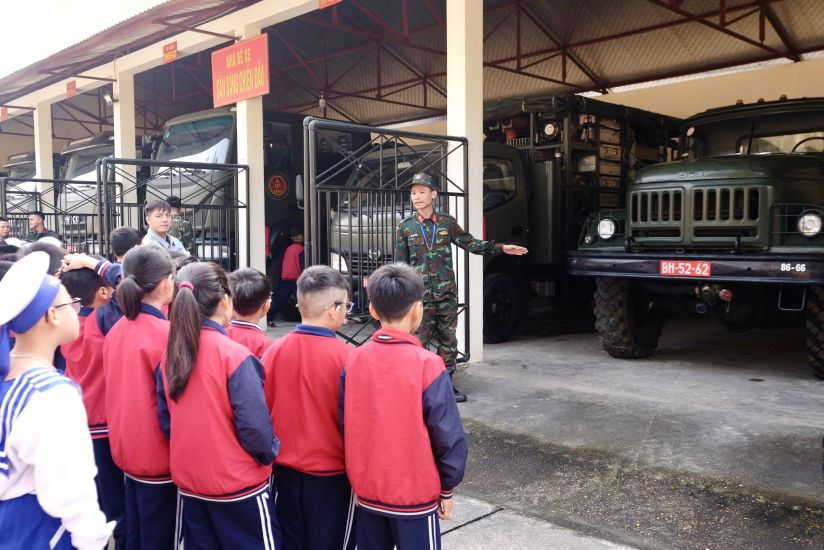
Ms. Le Thi Gam - Head of Block 4, Tay Tuu A Primary School (Hanoi) shared that according to the 2018 General Education Program, teachers are forced to innovate teaching methods, strengthen experiential activities, towards the goal of educating students to "learn to do". Therefore, not only in experiential activities but in all subjects, teachers must be more flexible and create more opportunities for students to practice. To do this, each teacher needs to constantly learn, explore, innovate, be creative and spend more effort and time.
Teachers are much more vat va, but the joy and experience of students is the motivation for the teachers to strive to complete the work" - Ms. Gam said.


