
Teachers' salaries are not easily sky-high
Ms. Hang, a secondary school teacher in Thanh Hoa with nearly 28 years of experience in the profession. With the current salary of about 16.5 million (including all allowances) - Ms. Hang said, it is not high.
Explaining, this teacher said that 28 years ago, her starting salary was only about 200,000 VND/month. When she was appointed as a secondary school teacher of rank III, her salary had not improved much. After decades of working, holding rank, along with many conditions on degrees, certificates, achievements, 4 years ago, she was promoted to secondary school teacher of rank II.
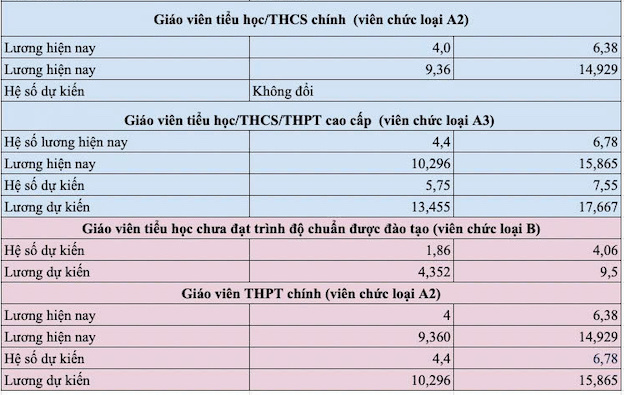
From grade III to grade II, my income has improved. Previously, for many years, salaries only revolved around the 10 million mark. The sky-high salary is often associated with grade I teachers. But getting into grade I is a long journey "crossing the gate" that few people can do" - Ms. Hang said.
Before the information about salary reform, along with a series of new proposals on allowances, special coefficients,... Ms. Hang calculated that her total income increased from 16.5 to about 20 million VND/month. As for new teachers, the income level from more than 6 million can reach 8-9 million VND/month.
In general, this salary level is still not enough to cover the living expenses of new teachers. Veterans like me think it is high, but when compared to other professions, it is insignificant.
We still joke with each other, there have been 3 salary increases, many reforms, but only on Facebook, TV. It has been 2026, but the salary is still the same" - Ms. Hang expressed.
88% of teachers are ranked lower than civil servants in other sectors and fields
Many inadequacies in the salary policy for teachers have also been clearly stated by the Ministry of Education and Training: The actual ranking of teachers' salaries is not as the Party has determined for nearly 30 years: Teachers' salaries are currently not ranked highest in the administrative and non-business salary scale, even the majority of teachers are ranked at a lower salary scale.
12% of teachers are ranked in 3 groups: A1 – A2.1 – A3.1, but nearly 100% of civil servants in other sectors and fields are ranked in these 3 groups.
Among them, only a maximum of 1.17% of senior teachers (rank I) are ranked with the highest salary scale (including A3.1 and A3.2), while other sectors have a maximum of 10% of civil servants ranked with A3.1 salary scale.
The Ministry of Education and Training quoted statistics that 88% of teachers are ranked lower than civil servants in other sectors and fields: 88% of teachers may enjoy the highest salary coefficient of 6.78 (the highest level of the A2.1 salary scale); while civil servants in other sectors may enjoy the highest salary coefficient of 8.0 (the highest level of the A3.3 salary scale, about 1.18 times higher).
Meanwhile, except for public employees in the health and science and technology sectors, public employees in other sectors only require university training in all 3 grades and do not require the highest grade to develop policies like senior specialists.
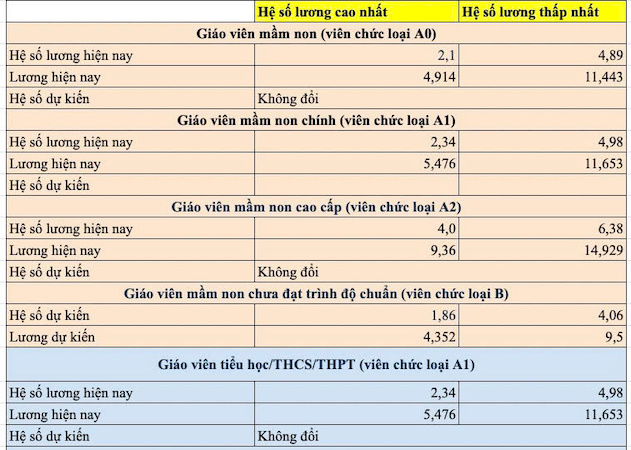
Notably, 100% of preschool teachers are ranked as the lowest salary in the administrative and non-business salary scale system, in which:
The starting coefficient of grade III preschool teachers is 2.10 while grade III titles of other sectoral civil servants are 2.34 (about 1.11 times higher);
The starting coefficient of grade II preschool teachers is 2.34 while grade II titles of other sectoral civil servants are 4.4 (about 1.88 times higher);
The starting coefficient of grade I preschool teachers is 4.0 while grade I titles of other sectoral civil servants are 6.2 (about 1.55 times higher);
The highest salary coefficient that preschool teachers can enjoy is 6.38, while the highest salary coefficient that civil servants in other sectors can enjoy is 8.0 (about 1.25 times higher).
According to the Ministry of Education and Training, new teachers in the first 5 years of work only receive salaries according to the salary coefficient and preferential allowances, there is no seniority allowance, so total income is still low, therefore, there is still a long gap compared to long-term teachers even though the basic tasks are the same.
The lowest salary for preschool teachers is about 6.6 million VND, primary school teachers about 7.3 million VND, secondary school (THCS), high school, and university preparatory school teachers about 7.1 million VND; there is a long gap compared to the highest salary of teachers, corresponding to 20.6 million, 24.6 million, 28.5 million and 30.5 million respectively; lower than the average salary of 7.7 million VND of workers in 2024.
From January 1, 2026, when the Law on Teachers takes effect, teachers' salaries will be ranked highest in the administrative and non-business salary scale system. However, to ensure implementation, the Ministry of Education and Training is urgently developing a series of circulars and decrees such as: Decree detailing a number of articles of the Law on Teachers; Decree regulating salary policies, allowance regimes, support and attraction policies for teachers; Decree regulating professional preferential allowance regimes for public employees of the Education sector,...
From the obstacles and inadequacies in the above salary policy, the teaching staff expects that the salary policy and allowance regime for teachers will soon be approved and put into life so that they can feel secure in their work and stick with the profession.
It's a bit of a bit of a bit of a bit of a bit of a bit.


