
This is an inadequacy in assessment and development motivation, which is clearly pointed out by the Ministry of Education and Training in the submission of the Decree detailing a number of articles of the Law on Teachers, which is being appraised by the Ministry of Justice.
Expected shift from "promotion" to "professional advancement
The Ministry of Education and Training said that, according to current regulations, the title of teacher is regulated to be distributed in Clause 1, Article 66 of the 2019 Law on Education; Clause 2, Article 54 of the Law on Higher Education; Clauses 2, 3, Article 53 of the Law on Vocational Education.
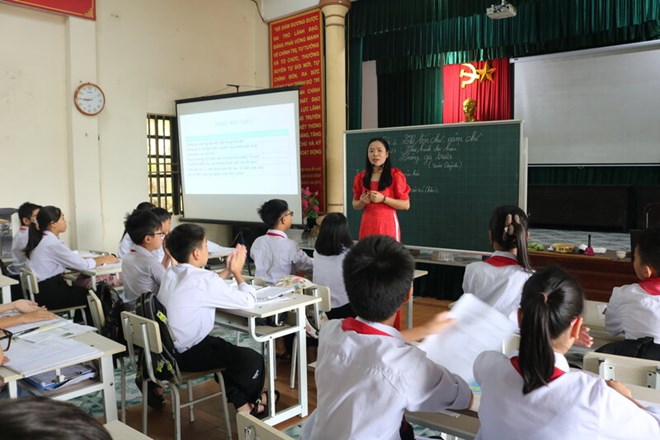
The current system of titles, regulations on titles, professional standards of teachers, and changes in teacher titles still have obstacles and inadequacies such as lack of unity, legal gaps, inadequacies in assessment and development motivation.
Current regulations on standards and titles are not synchronized between levels of education and training levels. Currently, the title of teacher is managed according to the professional title rank of civil servants (from rank I to rank V) according to Decree No. 115/2020/ND-CP. This regulation leads to a lack of unity between levels of education, a lack of legal intercommunication when teachers change the type of educational institution.
At the same time, the current promotion mechanism does not have regulations on unexpected promotion to value teachers with particularly outstanding achievements (except for professor and associate professor titles), leading to the elimination of continuous striving motivation.
The legal gap is reflected in the fact that the regulations mainly focus on public schools; for non-public and foreign teachers, the legal system is still unclear, causing difficulties for management and placement when teachers change the type of educational institution.
In addition, teachers are under pressure from "double assessment" (both according to professional standards and according to professional title standards), causing overload of administrative dossiers but low management effectiveness. Current regulations on appointing professional titles only have "increases" but no "decreases", and have not created real motivation for continuous striving.
The special promotion is currently only applied to the titles of Professor and Associate Professor, not yet comprehensive enough to value teachers with other outstanding achievements" - the Ministry of Education and Training stated clearly.
Through reviewing the system of legal documents and summarizing opinions from grassroots practice, the Drafting Committee found that some current regulations for public employees in general are no longer suitable for the specific occupations of teachers, and need to be adjusted in the draft Decree, specifically:
The content stipulated in the draft: Chapter II (from Article 3 to Article 17), the draft establishes a unified list of titles for the entire system; converting from the "promotion" mechanism to the "professional advancement" including sequential promotion and unexpected promotion associated with professional standards.
Assessing the impact, the Ministry of Education and Training believes that this regulation will create motivation and fair opportunities for all teachers to continuously develop their careers; improve professionalism and serve as a unified basis for managing teachers in both the public and non-public sectors.
Expected to remove control of promotion consideration rate
The draft Decree sets out the concepts:
Teacher professional advancement is the fact that a teacher is ranked in a position with a higher title in the same academic level or training level, demonstrating the professional development of a teacher. Teacher professional advancement includes sequential and special promotion.
Progress sequentially means that an educator is ranked in a position with a higher title adjacent to the same academic level or training level when it meets the professional standards of that title.
Special promotion is the case where an educator is considered for special consideration to be placed in a position with a higher title adjacent or highest in the same educational level or training level.
Professional advancement of teachers is carried out through consideration, based on the job position and professional standards of teachers.
Teachers are allowed to register for professional promotion if the educational institution has a need and the teacher meets the professional standards of the teacher according to the provisions of law, except in cases of special promotion.
Teachers are allowed to register for vocational promotion consideration when they meet the following standards and conditions:
Be classified for quality at the level of completing the task well or higher in the academic year immediately preceding the time of registration for professional promotion consideration;
Have good political qualities and professional ethics;
Not during the period of considering disciplinary action, disciplinary enforcement or during the period of appraisal, verification, and conclusion of complaints and denunciations according to regulations on resolving complaints and denunciations;
Meeting the professional qualification requirements for the title of teacher participating in professional promotion consideration, except for cases of special promotion consideration.
It's a bit of a bit of a bit of a bit of a bit of a bit.


