
On December 3, in Hanoi, the Department of E-commerce and Digital Economy, Ministry of Industry and Trade organized the 2025 Industry and Trade Digital Transformation Forum with the theme "Dug- transformation: Supply chain digitalization - Growing greening".
Retail e-commerce forecast to surpass 25 billion USD
Speaking at the opening of the Forum, Deputy Minister of Industry and Trade Nguyen Sinh Nhat Tan emphasized that for Vietnam, the digital economy is continuing to improve significantly and become a new pillar to help improve productivity, expand the market and increase the resilience of the economy. Retail e-commerce is forecast to surpass the 25 billion USD mark and continue to be a major pillar of the Internet economy.

The Deputy Minister pointed out that the Government has identified 2025 as the year to accelerate the implementation of Resolution 57 on digital transformation, with the consistent view that digital transformation is an important driving force to develop productive forces and improve national competitiveness. 2025 requires the Industry and Trade sector to innovate more strongly and comprehensively to take advantage of opportunities from dual transformation - digital transformation and green transformation.
To realize this goal and propose policies, models, and solutions to promote effective and sustainable e-commerce and digital economy development, Deputy Minister Nguyen Sinh Nhat Tan suggested that delegates focus on discussing three major groups of contents:
First, identify new technology trends such as artificial intelligence, the Internet of Things, big data, cloud computing and the ability to apply in digital government, smart manufacturing, smart energy and e-commerce.
Second, perfecting solutions to develop a green - sustainable - safe e-commerce market; strengthening cross-border e-commerce management; promoting regional linkages and supporting local product consumption on digital platforms.
Third, propose models and solutions for digital economic development of the Industry and Trade sector in the locality, especially for small businesses and business households - important forces in digital transformation of the market.
Vietnam's digital economy in 2025 is expected to reach 39 billion USD
Reporting on the "orientation for digital transformation of the Industry and Trade sector in 2026", Mr. Hoang Ninh, Deputy Director of the Department of E-commerce and Digital Economy, Ministry of Industry and Trade affirmed that digital transformation continues to be identified as a strategic task, closely linked to green transformation and sustainable development, and is also an important driving force to promote comprehensive restructuring of the Industry and Trade sector by 2030.
In the development of the digital economy, Mr. Hoang Ninh said that e-commerce continues to be the main growth driver with the B2C scale in 2024 reaching about 25 billion USD, accounting for 10% of total retail sales of consumer goods and services. Digital transformation in industry - smart manufacturing recorded many positive signals with the IIP index increasing by 8.4% - the highest level in 5 years; about 90% of processing - manufacturing enterprises have implemented part of digital solutions; 35% apply robots and sensors in manufacturing; and 10'12% reached the level of smart factory 3.0.
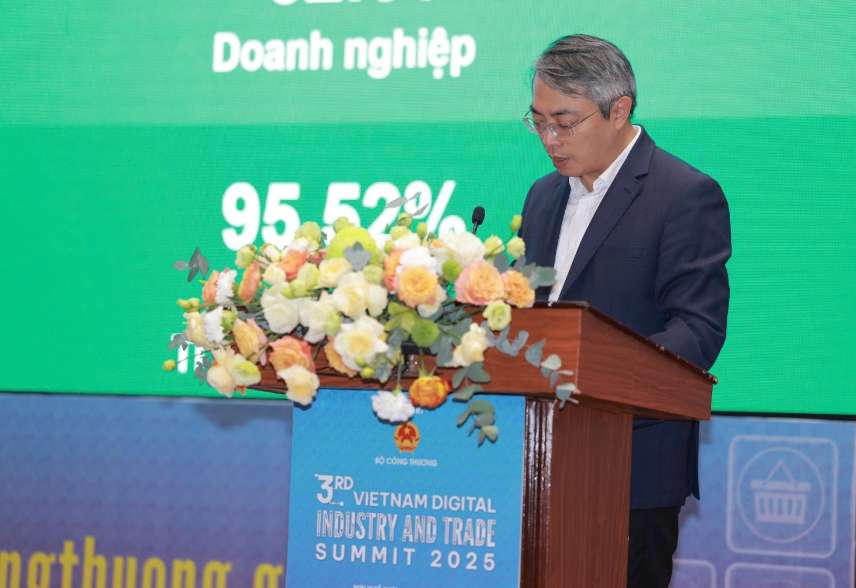
Mr. Ninh also emphasized that Vietnam's digital economy in 2025 is expected to reach 39 billion USD, continuing to be in the fastest growing group in the region; more than 40 AI startups have attracted 123 million USD in private capital; 81% of users interact with AI every day and 96% expressed confidence in AI agents.

From the local perspective, Party Secretary and Chairman of the People's Council of Phuong Duc Commune (Hanoi) Le Van Binh shared another perspective on digital transformation - not only at the macro level or at the large enterprise level, but also at the traditional craft villages.
Through the story of " awakening the land of a hundred occupations through digital transformation", Mr. Binh shows how technology helps craft villages gradually approach the market, increase product value and improve management quality.
The shift from manual business model to modern distribution model through digital platforms has contributed to proving that digital transformation is only truly sustainable when spreading to each grassroots level, where small-scale production and business activities are facing new requirements for innovation and market access.


