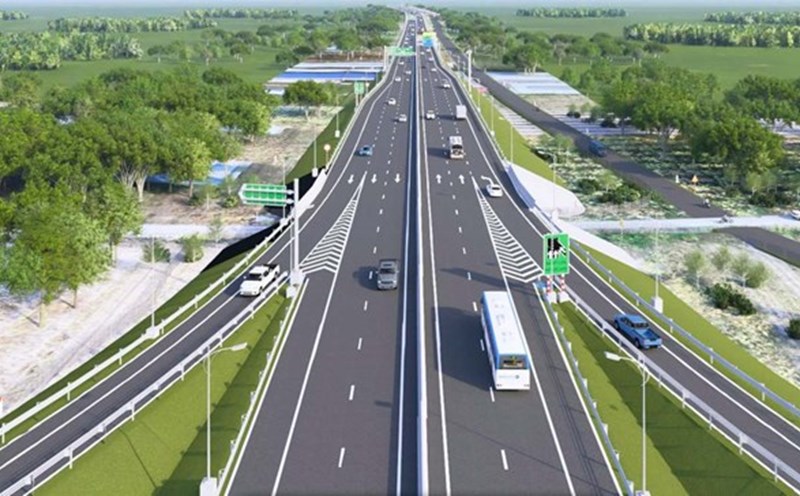
The Ho Chi Minh City People's Committee has just issued a Decision to establish a Steering Committee for the implementation of the Ho Chi Minh City Ring Road 4 investment project.
According to the decision, the Steering Committee consists of 15 members, headed by Chairman of the Ho Chi Minh City People's Committee Nguyen Van Duoc.
Vice Chairman of Ho Chi Minh City People's Committee Bui Xuan Cuong holds the position of Permanent Deputy Head of the Committee; Vice Chairman of Ho Chi Minh City People's Committee Hoang Nguyen Dinh is in charge of directing compensation, support and resettlement work.
Other Deputy Heads of the Committee include Vice Chairman of Dong Nai Provincial People's Committee Ho Van Ha and Vice Chairman of Tay Ninh Provincial People's Committee Nguyen Minh Lam.
Regarding functions and tasks, the Ho Chi Minh City Department of Construction is assigned as the standing agency, responsible for directing the implementation of the Project in accordance with Resolution No. 220/2025/QH15 of the National Assembly, Resolution No. 297/NQ-CP of the Government and current legal regulations.
The Steering Committee will also promptly resolve problems arising during the implementation process; in case of exceeding its authority, it will report to the National Assembly, the Government and the Prime Minister.
At the same time, the Steering Committee will organize the implementation of the Coordination Regulations between ministries, branches, Ho Chi Minh City People's Committee, Dong Nai and Tay Ninh provincial People's Committees and related units.

The Ho Chi Minh City Ring Road 4 project has a total length of 207 km, passing through Ho Chi Minh City, Dong Nai and Tay Ninh.
Of which, the 47 km section through Binh Duong province was previously started in June 2025.
The remaining sections, with a total length of about 160 km, with a total investment of more than VND 120,400 billion, were approved by the National Assembly in June 2025.
Phase 1 of the project will invest in a scale of 4 expressway lanes, while site clearance will be carried out for 8 lanes, reserving land for future expansion.
Previously, the route passing through Ho Chi Minh City was only about 17 km, but after merging with Ba Ria - Vung Tau and Binh Duong, the length of the section passing through Ho Chi Minh City increased to nearly 83 km, becoming the longest section in the entire route.
Ho Chi Minh City and the provinces aim to hand over at least 70% of the site by April 2026 and complete the entire site in 2026. The public investment component project is expected to start construction in February 2026 and be completed in the first quarter of 2028.
For projects under the form of public-private partnership (PPP), the feasibility study dossier is expected to be completed and approved in January 2026; investor selection and signing of BOT contracts are expected in June 2026.
The entire Ho Chi Minh City Ring Road 4 route is expected to start construction on September 2, 2026, complete in the second quarter of 2028, and be put into operation in 2028.
When completed, Ho Chi Minh City Ring Road 4 will become a strategic connecting axis between the Southeast, Southwest and Central Highlands, facilitating the movement of goods between industrial parks, urban areas and seaports.
The route also optimizes connections with Long Thanh airport, international ports, opening up new development space, increasing land fund value and promoting industrial, logistics and urban development in provinces in the region.
In particular, Ring Road 4 will help traffic flows from National Highway 13 and National Highway 22 access ports in Tay Ninh and Hiep Phuoc (HCMC), contributing to reducing the load on the inner city and gateway routes that are often congested.
This is considered a transportation project with a great impact, opening a turning point in infrastructure connectivity of Ho Chi Minh City and the entire Southeast region.