
To achieve double-digit growth, digital economy needs to break through
On April 24, the National Economics University coordinated with the Central Policy and Strategy Committee; the National Assembly's Economic and Finance Committee to organize a National Science Conference to assess the Vietnamese economy in 2025 and prospects for 2026 and announce the publication "Vietnam Economic Annual Assessment 2025 - Promoting Digital Economy Development in the New Era".
At the conference, Dr. Nguyen Duc Hien - Deputy Head of the Central Policy and Strategy Committee said that Vietnam's digital economy is currently growing quite impressively, but the level of spillover is not yet commensurate with the new development requirements.

To achieve the growth target of over 10% in the period 2026-2030, the processing, manufacturing and manufacturing sectors play a very important role. Therefore, digital economy development policies need to go into core bottlenecks such as data institutions, digital human resources, linkages between high-tech FDI and domestic enterprises, digitization of traditional industries, especially agriculture, logistics, finance and industrial production" - Dr. Nguyen Duc Hien emphasized.
On that basis, Dr. Nguyen Duc Hien believes that digital transformation support programs for small and medium-sized enterprises, supporting businesses to reach out to the international market need to change their approach, linking with markets, associations, universities and businesses, instead of just implementing administratively from ministries and sectors.

Three pillars for Vietnam's digital economy to reach 30% of GDP
In the period 2020-2025, Vietnam's digital economy scale has increased significantly, with the proportion in GDP increasing from 12.66% to about 14.02%, equivalent to a scale of more than 70 billion USD.
Representative of the research group presenting the publication, Prof. Dr. To Trung Thanh - National Economics University emphasized that Vietnam's digital economy development orientation to 2030 needs to be seen as a structural transformation. In which digital technology becomes a core production factor, deciding productivity, growth quality and national competitiveness.
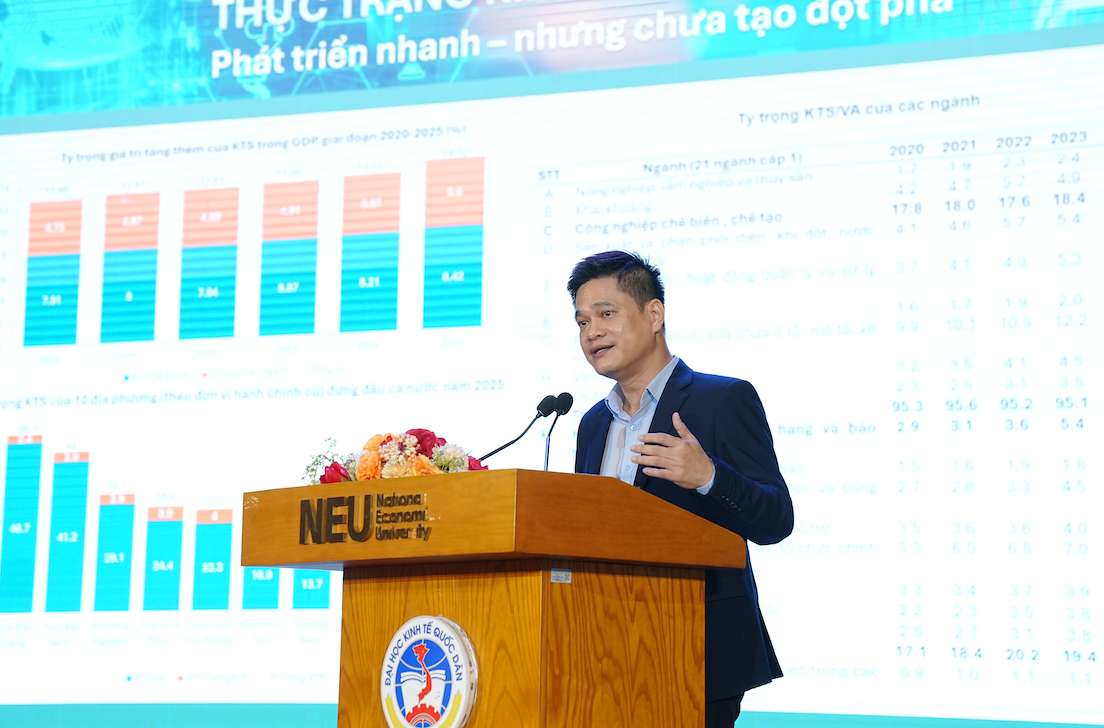
Prof. Dr. To Trung Thanh emphasized that to realize the goal of bringing the digital economy to account for about 30% of GDP by 2030, the development model needs to be based on three main pillars.
First, the core digital economy (ICT) must shift from processing to mastering technology. The focus is not only on maintaining a high proportion but also on upgrading the quality of added value, through the "Make in Vietnam" strategy, developing core technologies such as semiconductors, 5G/6G devices and national digital platforms.
Second, the digital economy sector needs to be deeply digitized into the value chain. The finance – banking, retail, logistics and agriculture sectors need to shift from applying surface technology to restructuring operational models based on data and AI.
Third, digital governance must become the institutional foundation for the digital economy. The transition from e-government to data-based digital government will help reduce compliance costs, improve transparency and efficiency of resource allocation. Data needs to be considered a strategic resource, with an interconnected system between ministries, sectors and localities.

These three pillars can only be effective when placed in the context of breakthroughs in technology and development space, including the development of digital infrastructure, data centers, and the formation of digital growth poles in major cities, while spreading to localities. Through this, the digital economy is not only a driving force for growth but also a tool to narrow the development gap between regions.


