
Removing obstacles in exploiting more than 11,000 redundant houses and land plots
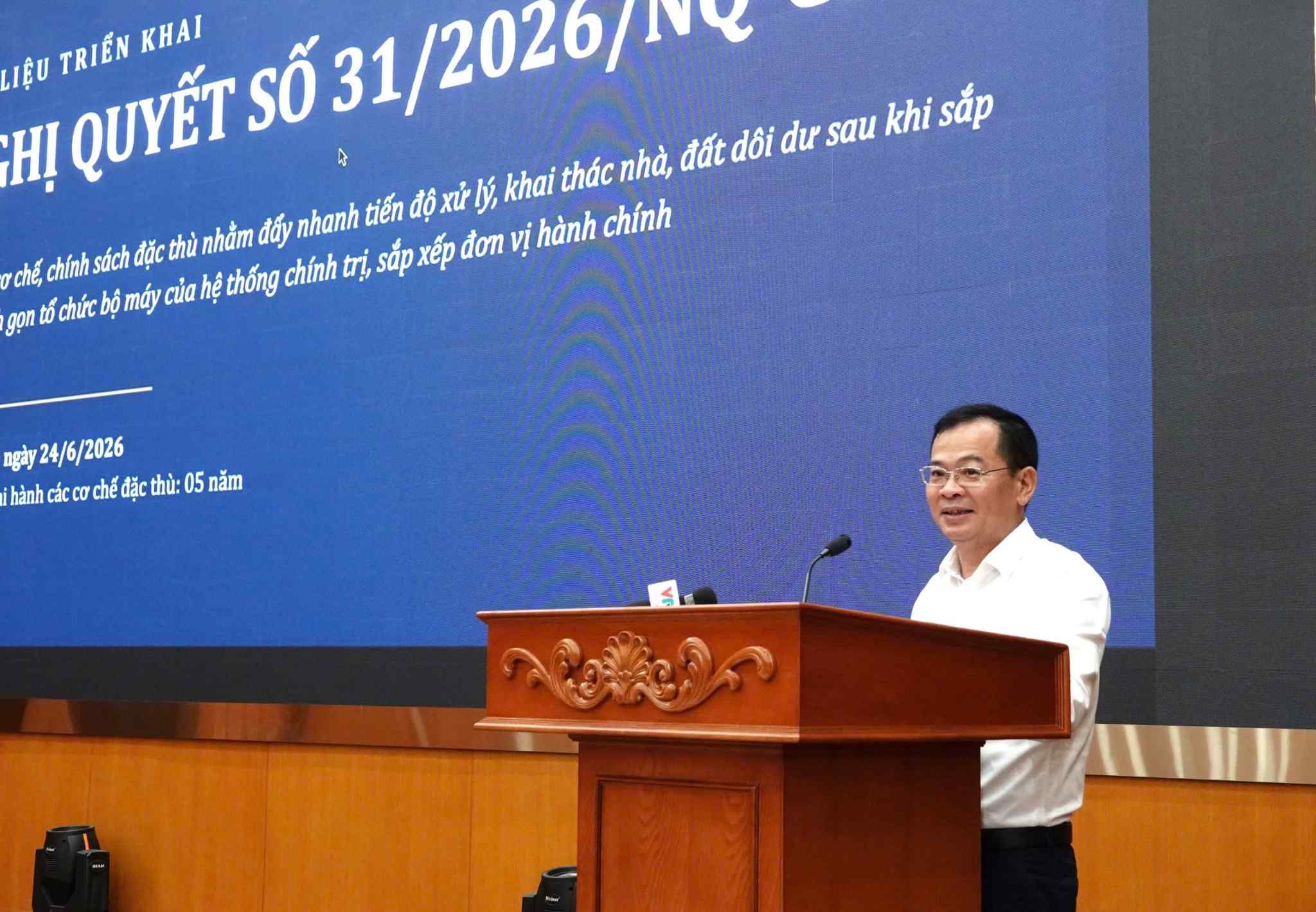
On June 26, the Ministry of Finance organized a Conference to implement Resolution No. 31/2026/NQ-CP dated June 24, 2026 of the Government on specific mechanisms and policies to accelerate the progress of handling and exploiting redundant houses and land after arranging the organizational structure and administrative units.
The Ministry of Finance said that, according to a summary of reports from ministries, branches, and localities, there are currently about 11,000 redundant houses and land that have been recovered or transferred to localities for management and handling, but have not completed the next step of handling to put them into operation or thoroughly handle them.
Mr. Nguyen Tan Thinh - Director of the Department of Public Asset Management (Ministry of Finance) said that the exploitation and handling of these houses and land facilities is facing many difficulties due to the large number and dispersion across the country; many facilities are small-scale, located in remote and isolated areas or areas with low market demand. In addition, many cases of incomplete legal documents are lost or are in dispute or encroachment. If implemented according to the procedures specified in current legal documents, it will be difficult to meet the requirements of quick and thorough handling as required by competent authorities.
Stemming from the above practical requirements, the Ministry of Finance has chaired the development and submission to the Government for promulgation Resolution No. 31/2026/NQ-CP on specific mechanisms and policies to accelerate the progress of handling and exploiting redundant houses and land after arranging the organizational structure and administrative units.
One of the notable new points is the addition of many mechanisms to facilitate the exploitation of surplus houses and land. For leasing activities, the maximum lease term is increased from 5 years to 10 years and is allowed to be extended many times if the conditions according to regulations are met.
According to a representative of the Ministry of Finance, this regulation will create land stability for investors, businesses and organizations in need of lease, thereby increasing the ability to attract tenants and soon put redundant housing and land facilities into operation.
In addition, the Resolution adds a new rental method of competitive bidding, with simpler procedures and processes than auctions but still ensuring publicity, transparency, healthy competition and prevention of negativity.
At the same time, allowing the exploitation of houses and land in some cases where there is no Certificate of Land Use Rights or the certificate is lost; allowing the exploitation of surplus houses and land without having to adjust the planning and land use plan, thereby shortening the time to put assets into use.
Strong decentralization to localities
To speed up the handling progress, the Resolution strengthens decentralization and delegation of power to localities. Accordingly, the Chairman of the Provincial People's Committee is allowed to decide on the management and exploitation of redundant houses and land under local management, including facilities previously managed by agencies, organizations, and units under the Central Government but have been transferred or recovered by localities for handling.
The Chairman of the Provincial People's Committee is also allowed to adjust decisions on allocation, transfer, and transfer of houses and land in accordance with reality and decide on operating spending norms for house management and business organizations according to a percentage of the money collected from asset exploitation.
Heads of housing management and business organizations and Chairmen of commune-level People's Committees are also authorized to approve rental unit prices instead of hiring valuation units and submitting to provincial-level People's Committees to issue price lists as before.
Along with that, many administrative procedures are reduced to shorten processing time. Organizations managing and trading houses are proactively developing plans for managing and exploiting houses and land without having to implement the process of adjusting and supplementing plans as before. For house and land facilities that have been decided to be transferred to localities, they do not have to redo the procedures for asset handover.
The procedure for building a house rental price list is replaced by a mechanism to determine unit prices according to a unified, transparent and easy-to-apply formula. At the same time, the procedure for collecting opinions from the Chairman of the Provincial People's Committee before transferring redundant houses and land of the Central Government to local management is also reduced.
For special cases, the Resolution allows the demolition of works that are no longer suitable for implementing new use plans for houses and land facilities with suitable locations for public purposes such as parks, playgrounds, cultural institutions or serving innovation and startups. At the same time, adjust the mechanism for handling assets attached to land when allocating land or leasing land to create conditions to attract organizations and individuals to participate in effectively exploiting surplus land areas.
The Resolution also allows the conversion of the function of using houses and land first, then updating and adjusting the planning for establishments used as working headquarters, public non-business establishments, public purposes, national defense and security.


