
In today's trading session (March 19), DGC shares of Duc Giang Chemical Group continued to be heavily sold off and recorded the 3rd consecutive floor-dropping session after negative information from businesses. At the end of the trading session, DGC shares only matched about 1.3 million units, but the floor selling surplus reached nearly 23 million units.
Thus, after 5 consecutive sharp declines, DGC shares of Duc Giang Chemicals fell below 60,000 VND/share, the lowest in nearly 3 years since July 2023. Market capitalization also "evaporated" 8,000 billion VND, only less than 23,000 billion VND and no longer in the billion-dollar business group.
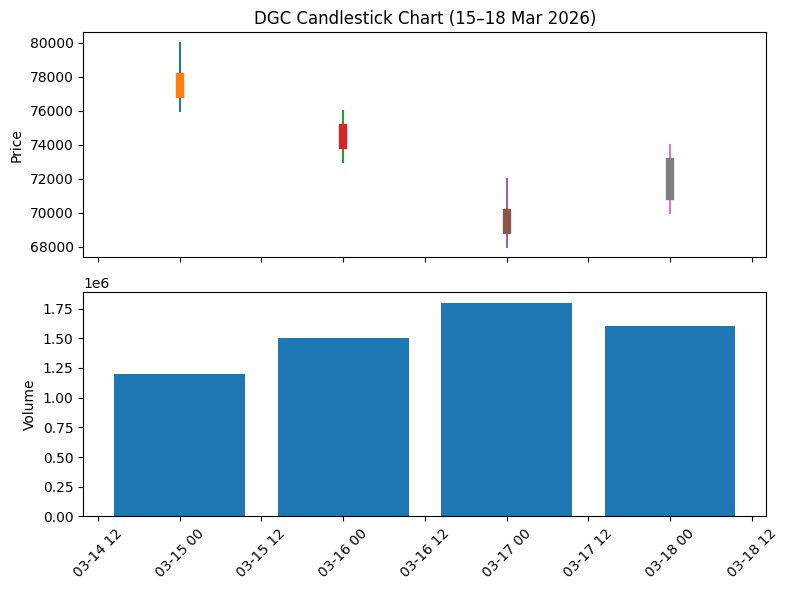
Notably, in 5 sessions of sharp decline, DGC had 3 sessions of floor-price decline. In the last 2 sessions, this stock almost fell into a state of liquidity "shutdown" when matched orders were only a few hundred thousand to more than 1 million units while the selling surplus at the floor price was up to 20-30 million units (accounting for about 7-10% of the total outstanding shares).
DGC shares were sold off after the Investigation Police Agency of the Ministry of Public Security initiated a case occurring at the enterprise and related units, with contents related to accounting, resource exploitation and environment.
After the news that some leaders of Duc Giang Chemical Group were arrested and prosecuted, securities companies began to cut margin for DGC shares.
Mirae Asset Vietnam Securities Company announced a reduction in the lending ratio for shares of Duc Giang Chemical Group Joint Stock Company from 45% to 0%, effective from March 17. In addition, SSI Securities Company announced that although it still maintains a support ratio of 50% for DGC shares, it has reduced the collateral ratio from 100% to 70%, effective from March 19, 2026.
Before the incident occurred, Duc Giang Chemicals was the leading gold phosphorus exporter in the region with tens of trillions of VND in revenue and trillions of VND in profit each year. DGC shares are still considered a Bluechip in the portfolio of many important index sets.
In 2025, the business activities of Duc Giang Chemical Group recorded notable points such as: consolidated net revenue of nearly 11,266 billion VND (up 14%); consolidated after-tax profit of more than 3, 188 billion VND.
However, in the separate financial statements, financial revenue decreased by nearly 40%; net profit decreased by more than 35%. This decline reflects pressure from financial activities and fluctuations in non-core revenue sources.
Some noteworthy financial indicators such as inventory increased by 70%, to nearly 1,700 billion VND; unfinished basic construction costs increased sharply from 161 billion to 797 billion VND, mainly at the Nghi Son Industrial Park Project.
Meanwhile, payables doubled, to more than 4,144 billion VND, especially, short-term payables increased sharply from nearly 10 billion VND to more than 1,273 billion VND, a sign that financial obligation pressure is increasing in the short term.
The report of Bao Viet Securities Company (BVSC) gives the view that the violations of the leadership may cause Duc Giang Chemicals to lose exploitation rights at existing mines and be difficult to extend in the future, and at the same time no longer have the opportunity to participate in large-scale projects such as bauxite - aluminum.
Sharing the same view, SHS Securities Company gave the opinion that negative information about Duc Giang Chemicals is likely to affect the process of extending the mining license of field 25 by the end of 2026. If the license is not extended, Duc Giang Chemicals will have to switch to buying from outside and importing almost all apatite ore instead of being self-sufficient in over 80% of input ore sources as before. This will put pressure on the cost of goods sold and the profit margin of the enterprise.
In the long term, possibly losing the advantage of self-sufficiency in input materials will cause Duc Giang Chemicals to be heavierly discounted and the prospect of future growth is unclear. This development may also set a precedent for the trend of tightening management throughout the chemical - mining industry.
At the same time, this information also puts significant pressure on stock prices and does not rule out the possibility that the company will face risks of legal costs, arising environmental costs or recovery in the near future.


