
Consumers prioritize modern retail channels
At Hoa Bang market (Yen Hoa ward, Hanoi), the price of green vegetables has recently tended to increase. Mr. Bui Duc Tho - a small trader trading in vegetables and fruits - said that most vegetables at the market are imported from other places, so they are affected by freight rates. Some items such as sweet potato vegetables, mustard greens, and mustard greens currently fluctuate around 15,000 - 20,000 VND/bunch, higher than before by about 5,000 - 7,000 VND/bunch.
If the import price increases, the selling price must also be adjusted accordingly, we accept a slimmer profit than before, each type of vegetable and fruit only makes a profit of 1,000 VND" - Mr. Tho shared.
Meanwhile, at retail supermarkets and large supermarket systems in Hanoi, vegetable and fruit prices are quite stable. Recorded at FujiMart Trung Yen supermarket, OMG sweet mustard greens are priced at 12,500 VND/300g; OMG bok choy is priced from 13,500 VND/300g; 300g sweet mustard greens range in the range of 16,500 VND...
Sharing with reporters, the sales staff said: "The prices of vegetables and fruits are still kept stable by the supermarket system, not fluctuating according to the market.
Representatives of a large supermarket system in Hanoi said that currently, the prices of goods have remained unchanged since after the Lunar New Year. Even some items that need to be "rescued" and supported by farmers such as watermelons and pumpkins have been bought in large quantities, so the selling price is attractive.
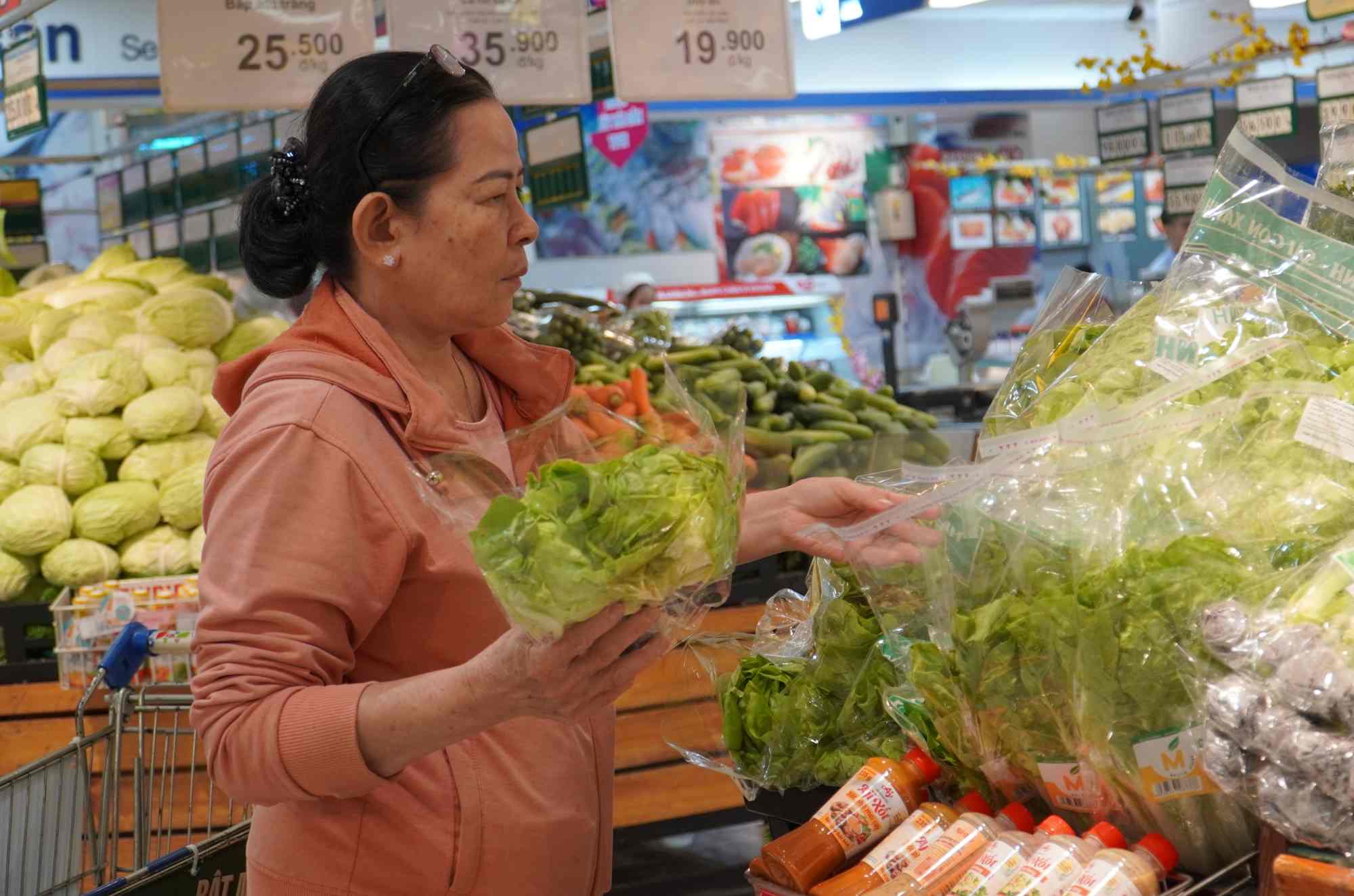
At the supermarket on Cong Quynh street (HCMC), Ms. Le Thi Mai Anh (Hoa Hung ward) spent time carefully checking labels, origins and comparing prices instead of choosing cheap goods as before.She said that outside many items have increased by 3,000 - 5,000 VND, so she chooses to buy in the supermarket because the listed price is clear, goods have origins and promotions.
Not only Ms. Mai Anh, many HCMC consumers also switch to shopping at modern retail systems when the market shows signs of fluctuation.Public prices and rotating promotions help buyers easily control spending and feel secure about quality.
According to Mr. Nguyen Van Phuong - Head of the Consumer Inquiry Department of the Vietnam High Quality Goods Business Association - the market is clearly differentiated, shifting from broad growth to deep growth, where value, standards and trust play a decisive role.
Surveys show that in the food industry, consumers prioritize safety, traceability and quality certification, no longer just looking for cheap prices but aiming for "real value" and peace of mind.
The change in shopping behavior is driving the retail market to shift strongly to a multi-channel model. Supermarkets and shopping centers still account for a large proportion, while e-commerce has exceeded 24% and continues to increase. Consumers are flexible in combining direct and online purchases depending on demand.
Vietnamese goods need to participate more deeply in the supply chain
Aeon Vietnam representative, Ms. Nguyen Bang Lang, said that the business increases inventory of essential goods to reduce the risk of supply disruption, and at the same time negotiates with suppliers to maintain prices in the short term and maintain daily promotions to stimulate consumer demand.
Similarly, Central Retail also chose the strategy of "creating lag" in the face of price increase pressure by increasing inventory levels by about 30% compared to normal.
According to Ms. Nguyen Thi Bich Van - Communications Director of Central Retail Vietnam, the enterprise optimizes logistics, maintains a vehicle occupancy rate of over 85% to reduce costs per unit of goods. Thanks to that, the distribution system can extend the price retention period by about 2-3 weeks. However, Ms. Van also noted that if cost pressure is prolonged, retail price adjustments will be difficult to avoid.
From a long-term perspective, supermarkets aim to reduce dependence on imported goods. Mr. Nguyen Minh Tam - representative of WinCommerce - said that Vietnam has many domestic products and regional specialties that can be replaced, helping to reduce logistics costs and be proactive in supply. However, to implement it, it is necessary to remove barriers to procedures to bring goods into modern distribution systems, especially for small and medium-sized enterprises. Therefore, WinCommerce proposes to simplify the quality declaration process so that Vietnamese goods can participate more deeply in the supply chain.
At the management level, Mr. Nguyen Nguyen Phuong - Deputy Director of Ho Chi Minh City Department of Industry and Trade - said that the city will synchronously implement many solutions to stabilize the market. The focus is on restructuring supply sources, prioritizing businesses with stable production capacity to take advantage of scale advantages, thereby reducing costs.
At the same time, Ho Chi Minh City continues to promote stimulus programs, support businesses in promotion and communication activities to reduce market access costs. The "Responsible Green Link" program will be expanded, focusing on essential goods, contributing to promoting consumption and maintaining stable price levels in the coming time.
Mr. Nguyen Thanh Nam - Deputy Director of the Domestic Market Management and Development Department (Ministry of Industry and Trade) - said that in order to stabilize the goods market and remove difficulties for businesses, the Ministry of Industry and Trade has implemented a series of key tasks.
In addition to continuously and promptly managing gasoline and oil prices according to world market fluctuations, and using the Price Stabilization Fund to limit price increases, the ministry has organized working sessions with businesses, essential goods industry associations, retail businesses and Departments of Industry and Trade in some localities. The ministry requested retail businesses to proactively negotiate with suppliers to extend the time to adjust prices of goods being traded, support consumers and maintain market purchasing power.
In addition to short-term solutions, the Ministry of Industry and Trade also encourages businesses to proactively seek alternative raw material sources, avoiding dependence on a single market. The Ministry has summarized the difficulties, obstacles and recommendations of businesses related to increased raw material costs, tax policies, credit, market inspection and control, as well as the need for international market information and legal support from the Vietnamese trading system abroad.
The Ministry proposed that localities direct retail distribution enterprises and essential goods manufacturing enterprises to participate in the local market stabilization program, uphold responsibility and proactively implement stabilization measures in the context of increasing input costs. Stimulating domestic consumption is also proposed as an important solution with the organization of supply-demand connection programs, bringing goods into the distribution system to reduce intermediary costs; promoting e-commerce and digital logistics to improve operational efficiency.
From a long-term perspective, Vietnam is a country that produces items such as coffee, pepper, and rice in the leading group in the world. However, there is still a paradox that "good harvest prices are low, bad harvest prices are also low". Therefore, the formation of derivative commodity exchanges is considered an important solution to improve pricing capacity, contributing to the sustainable development of the market in the long term.


