
Businesses bearing losses
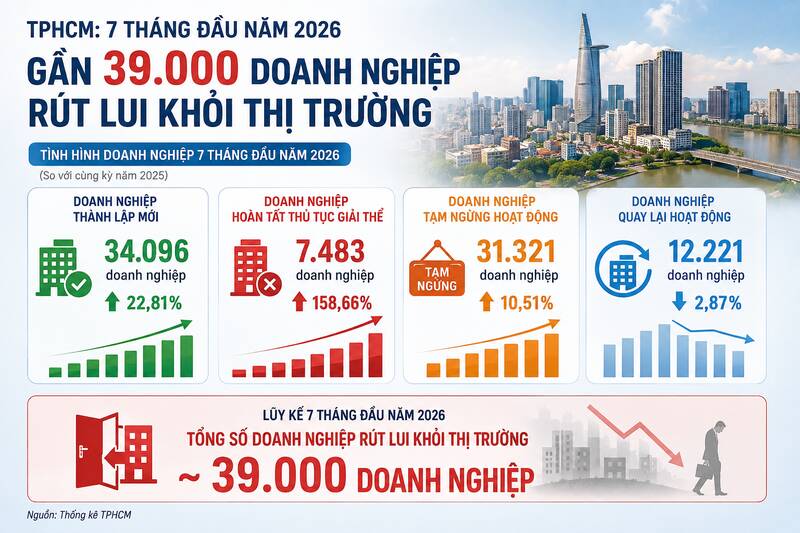
The socio-economic situation report of Ho Chi Minh City Statistics shows that in the first 7 months of 2026, Ho Chi Minh City had 34,096 newly established enterprises, an increase of 22.81% compared to the same period. In the opposite direction, there were 7,483 enterprises completing dissolution procedures, an increase of 158.66%; 31,321 enterprises temporarily suspending operations, an increase of 10.51%. Meanwhile, only 12,221 enterprises returned to operation, a decrease of 2.87%. Accumulated, the total number of enterprises withdrawing from the market in 7 months was nearly 39,000 enterprises.
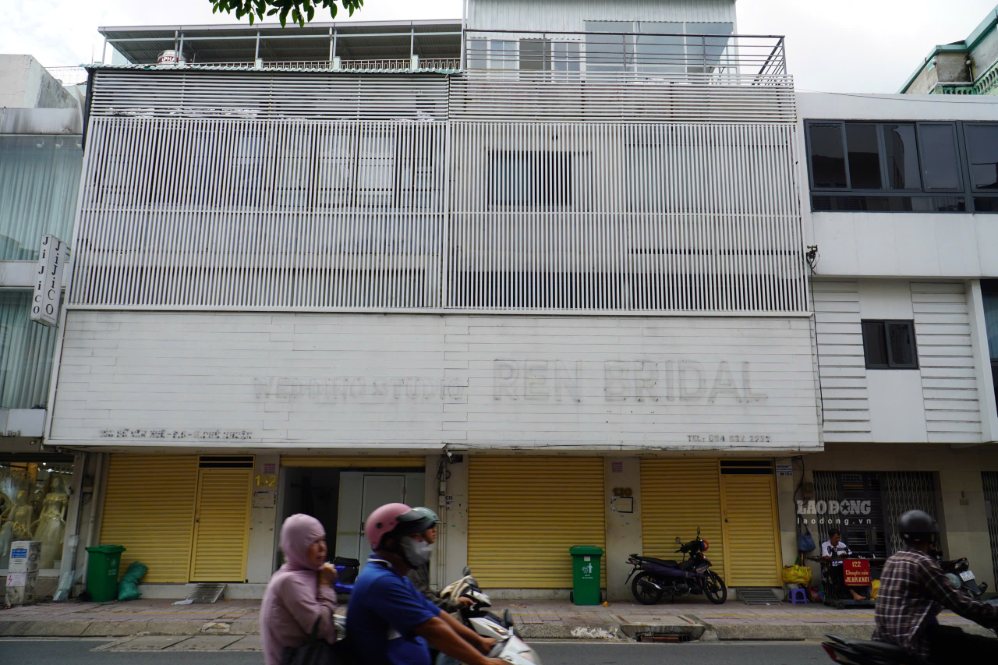
Reality in the market shows that cost pressure is causing many small businesses to shrink or temporarily suspend operations.
Doing beauty service business on Ho Van Hue street, Ms. P.T said she had to temporarily stop after a long period of "loss". Revenue is not enough to compensate for land rent, labor, operating costs and other obligations.
Over the past time, businesses have had to calculate every expenditure very carefully. If the market has not recovered strongly enough, revenue has decreased while costs are still increasing, it is very difficult to maintain long-term operations. We expect the market to be more stable in the near future and can return soon" - Ms. P.T shared.
For many small and medium-sized enterprises, cost of capital is also a major barrier.
Mr. Nguyen An Hoai - owner of a wood processing facility in Cu Chi commune - said that medium and long-term lending interest rates are commonly 9-11%/year, causing financial costs to increase nearly double compared to before.
“We almost have no room to maneuver. If we continue to borrow new loans to maintain production, the pressure to repay debt will be very high in the coming years. But without money, we cannot buy raw materials, invest in factories, leading to no orders. At that time, workers will not have jobs, and the risk of businesses closing down is always present,” Mr. Hoai said.
In addition to domestic costs, businesses are also affected by uncertainties in the world economy such as energy prices, geopolitical conflicts, logistics costs and changes in tax and trade policies. At the same time, increasingly high requirements for digital transformation, AI application and raising production standards also create more pressure for businesses with limited resources.
Businesses withdraw selectively
Talking to Lao Dong Newspaper, Ms. Le Thi Huyen Trang - General Director of JLL Vietnam - said that the commercial real estate market in the second quarter of 2026 has multi-dimensional developments. Net accumulated consumption at key commercial centers in Ho Chi Minh City is negative about 6,500 m2, showing that tenants are still cautious, but rental prices at good locations are still stable and some centers record new tenants. Meanwhile, total retail sales of goods and consumer service revenue in the first 6 months of 2026 reached 146.8 billion USD, an increase of 12.9% compared to the same period.
This contrast shows that the current wave of businesses withdrawing is selective, focusing more on small businesses and traditional business models that are struggling to adapt, rather than reflecting the general decline in purchasing power or the investment and business environment in Ho Chi Minh City" - Ms. Trang said.
According to Dr. Huynh Thanh Dien - economic expert, lecturer at Nguyen Tat Thanh University, the group of businesses withdrawing is mostly small, medium and micro enterprises. The reasons are not only due to business difficulties but also structural factors.
In which, some businesses can proactively stop operating and then establish new businesses to enjoy tax incentives according to Resolution 198. This is considered a form of technical restructuring. Therefore, it is not advisable to only rely on the number of businesses withdrawing to assess that the market is too difficult.
In addition, market standards are increasingly high in terms of labor, environment, green standards, technology and processes. Businesses that do not meet them will find it difficult to access orders, and will have to narrow down or withdraw. For small and medium-sized groups, interest rates are still high and difficult to access working capital further reduces resilience.


