
At the current price level, investors can witness gold adjustments. However, according to Mr. Aakash Doshi - Head of Gold Strategy at State Street Investment Management, the long-term upward trend has not changed and the possibility of gold exceeding 5,000 USD/ounce in 2026 has become more realistic than ever.
A few profit-taking days or even a month of accumulation do not shake the dominant upward trend" - he said. "The probability of gold hitting 5,000 USD in the next six to nine months has exceeded 30% and is approaching 40%.
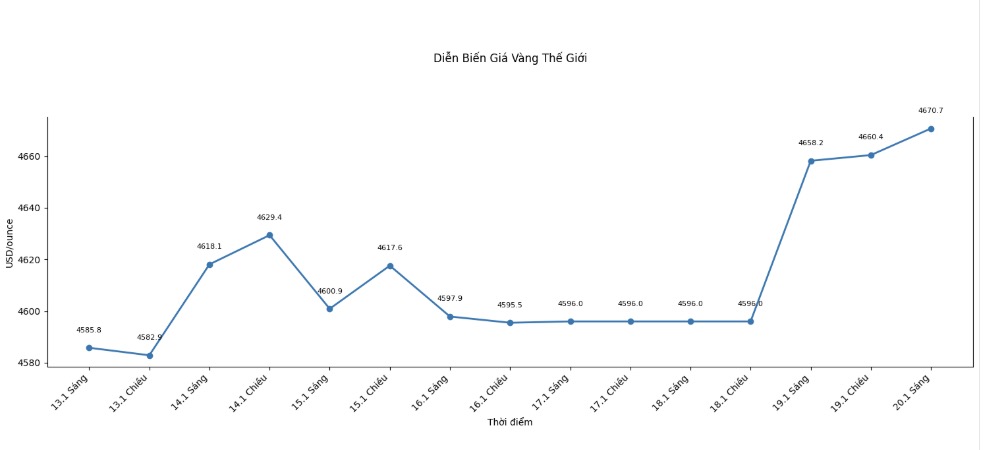
This forecast appears in the context of gold and US stocks trading at historical peaks, a development that, according to Mr. Doshi, further strengthens gold's defensive role. "If the S&P 500 reverses and gold is only at 4,500 USD, I will be worried. But when stocks are near 7,000 points and gold also peaks, it makes me more confident in maintaining my position.
Gold's steadfastness, according to Mr. Doshi, reflects the shift in market focus to tail risks instead of stories surrounding interest rates. The stock-bond ratio remains unstable, with geopolitical and policy uncertainty increasing on many fronts.
These are not just media noises" - he emphasized. "Part of the current risk contains the possibility of regime change - that is, the revaluation process of events that were once considered unimaginable.
State Street's Gold Monitor January report also outlined structural factors that are supporting gold prices: Increased geopolitical tensions, high fiscal deficits and prolonged policy uncertainties. Record-breaking government and corporate debt in 2025 continues to be a driving force driving shelter demand.
In the context of expanding risk distribution, the role of gold as a volatile low-cost hedge asset becomes even more important. “When the risk range is as wide as it is now, gold is a reasonable shelter” - Mr. Doshi said.
Although expectations of interest rate cuts still appear, he believes that monetary policy is no longer the main driving force for gold prices. Inflation has slowed down but it is difficult to return to the Fed's 2% target. "I don't call it deflation," he said. "It's stable inflation, above target but no longer unexpectedly increasing sharply.
According to State Street's baseline scenario, the Fed can keep interest rates unchanged until 2026 and further easing depends on the significant weakening of the labor market. However, history shows that gold usually performs well during periods when the Fed pauses the policy cycle. "As long as the long-term orientation is still to cut, gold has land to grow.
In addition to macroeconomic factors, physical gold demand and investment cash flow are setting a solid price base. Central banks continue to net buy strongly and are increasingly less sensitive to prices, creating a long-term support zone around 4,000 USD/ounce.
ETF capital also strengthens this trend. Gold funds closed 2025 with record net buying, contrary to the usual weakening pattern at the end of the year. State Street assesses that this upward cycle still has a large room in 2026. However, total global gold holdings are still lower than the peak of 2020, meaning the allocated room is still wide.
Gold is not yet a universal asset." Mr. Doshi said - "Therefore, the global distribution margin is still large. Gold is currently very'comfortable' in the 4,000-5,000 USD/ounce range.
According to him, a period of sideways movement does not weaken the story of price increases at all. "Sitting sideways for a few months is not a problem" - he said - "Even that creates opportunities for investors to return, especially when all recent declines are quickly bought up.


