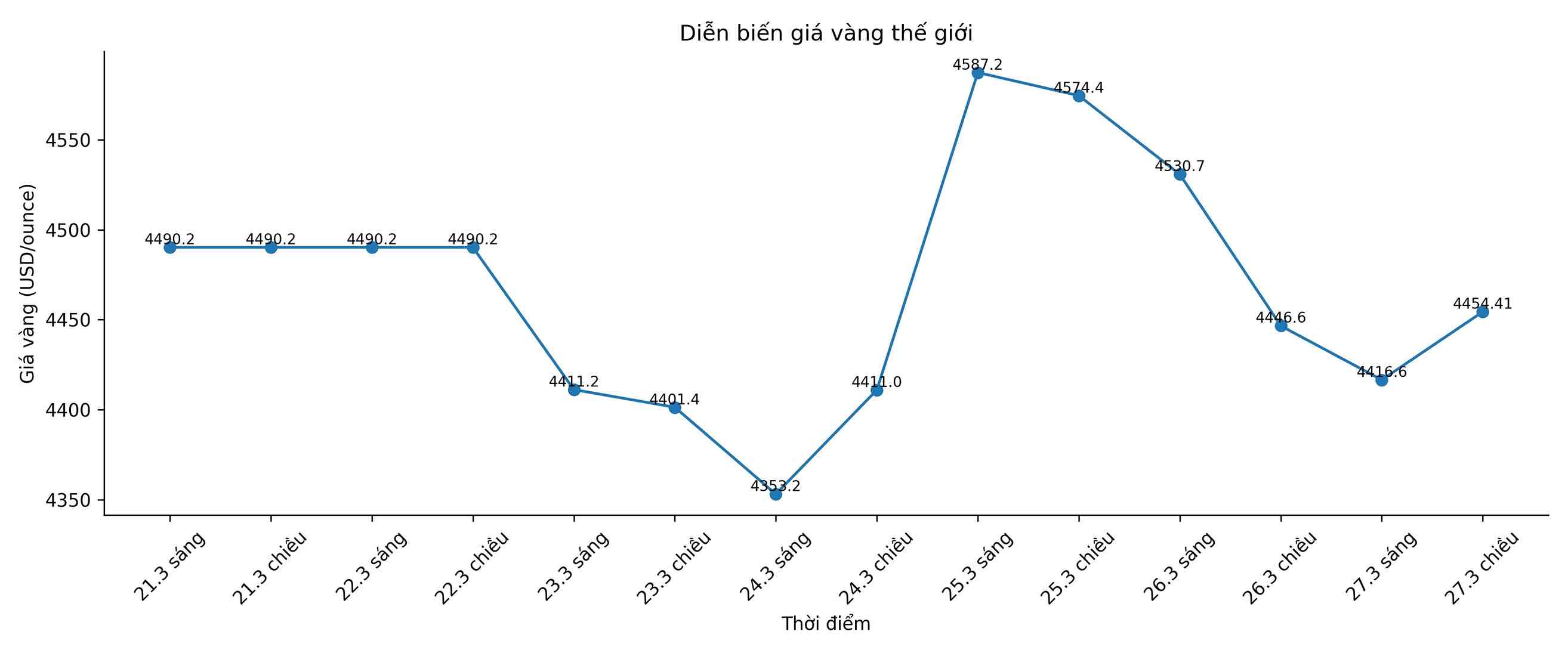
Gold prices fell after US President Donald Trump issued mixed signals about the possibility of the US and Iran reaching an agreement to end the nearly month-long conflict in the Middle East, causing global markets to continue to fluctuate.
The precious metal once fell as much as 3.4% in Thursday's trading session, before narrowing down a portion of the decline after President Donald Trump said he would extend the suspension of attacks on Iranian energy facilities. On the social network Truth Social, he said the exchanges are still ongoing and "going very positively".
Earlier on the same day, gold prices at one point approached the low-price market zone, which is usually defined when it decreases by about 20% compared to the nearest peak when President Donald Trump issued inconsistent messages about the possibility of reaching a ceasefire agreement. In a meeting at the White House, he said that Iran is hoping to reach an agreement, but also left open the possibility that the US may increase military action if the exchange process does not yield results.
After that, President Donald Trump said he would extend the 10-day commitment not to attack Iranian energy facilities, thereby partly helping the global energy market stabilize again in the short term.
Since the conflict began nearly a month ago, gold prices have fallen by more than 15%, mostly fluctuating in the same direction as the stock market and in the opposite direction to oil prices. The diễn biến of monetary policy in major economies, especially the US Federal Reserve (Fed), continues to be a significant factor affecting the trend of non-performing asset groups such as gold.
The Fed's policy outlook in the coming time is being closely monitored by the market, in the context of some financial institutions on Wall Street adjusting their US economic growth forecasts to be more cautious.
Oil prices rose in Thursday's trading session as expectations for a soon-to-be-resolved conflict declined. Earlier, Iran said it was awaiting response after rejecting the 15-point plan proposed by the US to end the conflict and at the same time set its own conditions.
According to Bloomberg calculations, about 85 tons of gold held in exchange-traded funds (ETFs) have been withdrawn since the conflict began. Standard Chartered Plc analysts, including Ms. Sudakshina Unnikrishnan, said that even at a price of about $4,500/ounce, there are still about 83 tons of gold in a loss-making state and may continue to face the risk of being sold off, equivalent to about $12 billion at the closing price on Wednesday.
Analysts believe that speculative holdings in the market may still continue to be under adjustment pressure in the short term.
Some investors are also betting on the possibility of gold prices falling through sell options contracts. Accordingly, some investors spent more than 100 million USD to buy sell options for the world's largest gold ETF this week. Selling options allow investors to sell assets at pre-determined prices and are often used to hedge risks or bet on downtrends.
The cost of buying a sell option versus an instrument purchase option that allowed investors to benefit when prices rose has risen to a six-year high.
In addition, the central bank of Turkey sold and carried out swap transactions of about 60 tons of gold, equivalent to more than 8 billion USD, in two weeks after the conflict with Iran broke out, thereby contributing to further adjustment pressure on gold prices.
Spot gold prices in this afternoon's trading session Vietnam time slightly increased by 1.6% to 4,454.41 USD/ounce. Silver prices increased by 2.6% to 69.74 USD/ounce, while platinum and palladium also decreased. The Bloomberg Dollar Spot Index – a measure of the strength of the USD – also increased slightly.