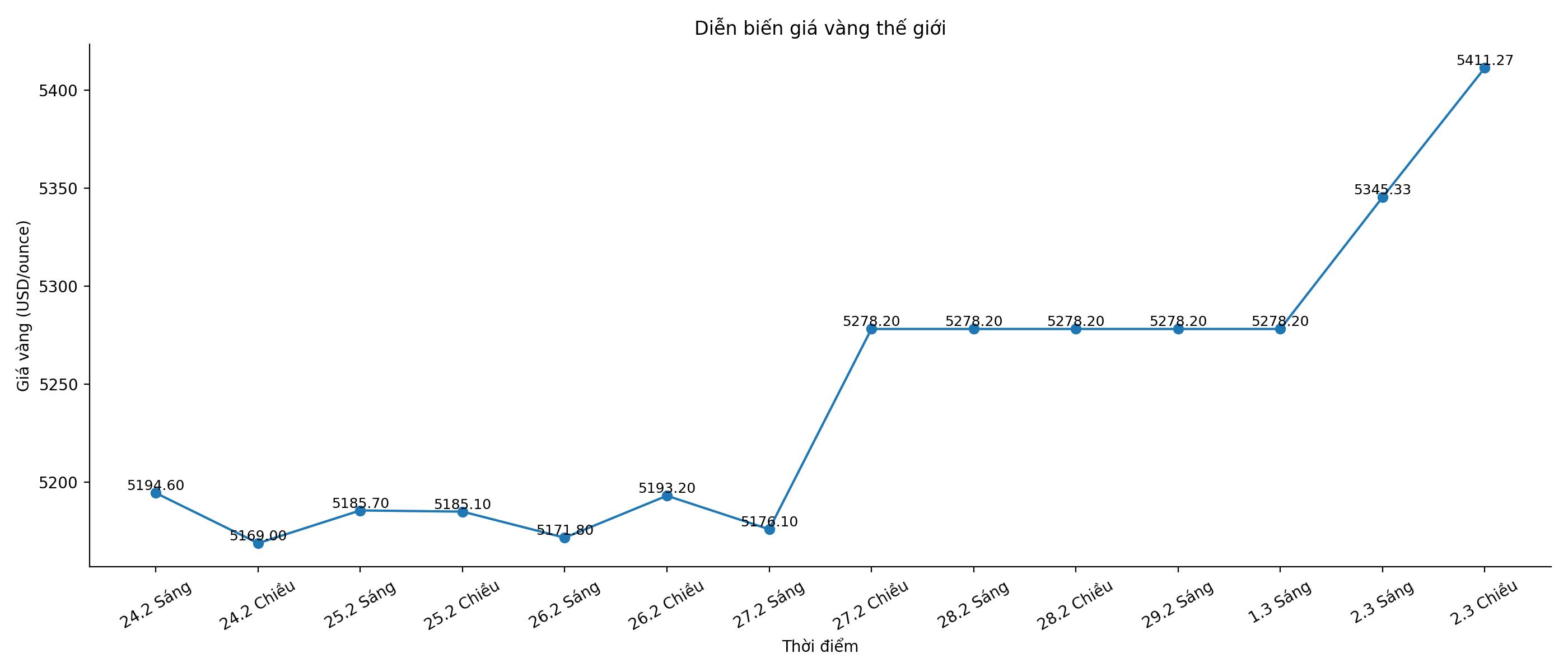
Gold prices rose for the fourth consecutive session as tensions in the Middle East shook global markets and prompted investors to seek safe assets. Silver prices also went up.
Spot gold at one point increased by 2.7%, exceeding the $5,400/ounce mark, extending the 3% increase of the previous week. Last weekend, conflict in the region escalated after the US and Israel launched airstrikes on Iran, killing Supreme Leader Ayatollah Ali Khamenei. Tehran then responded with a series of missiles aimed at targets in many countries.
Widespread geopolitical tensions, along with strong changes in US President Donald Trump's foreign and trade policies, continue to be the foundation for the long-term upward trend of gold prices. This upward momentum is also strengthened by strong buying activity by central banks and the trend of investors moving away from bonds as well as government currencies. Since the beginning of the year, gold prices have increased by about 25%, despite a sharp correction from a historic peak of over 5,595 USD/ounce at the end of January.
According to analysts from the Franklin Templeton Institute, led by Stephen Dover, gold often benefits in periods when market sentiment puts risk factors ahead of fundamentals. This group recommends that investors prioritize allocating gold selectively instead of short selling stocks on a large scale.
Even before the conflict with Iran broke out, the Trump administration pursued an increasingly tough foreign policy. The US military arrested Venezuelan President Nicolás Maduro in January, and the Washington administration also made controversial statements related to Greenland. In the context of the US deploying the largest military force in the Middle East since the Iraq War in 2003, gold prices recorded the seventh consecutive month of increase in February, the longest streak of increases since 1973.
On Saturday, the US and Israel launched widespread airstrikes in Iran, while calling on the people of this country to stand up against the Islamic government. Iran responded with attacks targeting Israel and many US bases and facilities in Qatar, the United Arab Emirates, Kuwait and Bahrain. President Trump declared that the US military will continue airstrikes until the target is achieved, while Iranian National Security Advisor Ali Larijani affirmed that Tehran will not negotiate with Washington.
Oil prices rose the most in four years when the market opened earlier this week, after the Hormuz Strait was almost blocked, raising concerns about disruptions to global crude oil supplies. The rise then cooled down and then surged again when Saudi Aramco was forced to stop operating at a refinery in Saudi Arabia due to a drone strike. The USD also rose, with the Bloomberg Dollar Spot Index at one point increasing by 0.7%.
Mr. Hong Hao, Investment Director of Lotus Asset Management, said that precious metals, oil and commodities are still simultaneously increasing in price despite the USD recovering, showing that these hard assets are playing the role of real currencies in the current period of particular instability.
As of 4:15 PM Singapore time, spot gold prices increased by 2.4% to 5,411 USD/ounce. Silver prices increased by 2.4% to 96.04 USD/ounce. Platinum increased by 1.7% and palladium increased by 3.1%.