
On the morning of April 23, the National Assembly discussed in the hall on amending tax laws.
Speaking at the hall, delegates basically agreed with assigning the Government to stipulate a revenue threshold that is not subject to personal income tax, but there needs to be a mechanism and supervision.
Delegate Trinh Thi Tu Anh (Lam Dong delegation) agreed with the policy of assigning the Government to stipulate a revenue threshold that is not subject to personal income tax. However, the core issue is not whether to assign or not, but how to assign.
This delegate emphasized that if full power is delegated without limits in the Law, the National Assembly has actually delegated a part of legislative authority in a very sensitive area.
I propose that the Law stipulate principles and framework limits; The Government operates flexibly within that framework; The National Assembly implements substantive supervision. This is an approach consistent with modern legislative practices, while ensuring the true spirit of the Constitution" - delegate Trinh Thi Tu Anh emphasized.
Also according to delegate Trinh Thi Tu Anh, the determination of the threshold should be based on the principle of only taxing when business activities generate real income higher than the social average.
If after deducting expenses, the income of business households is only equivalent to salaried workers, then taxing is not only unreasonable but also counterproductive because compliance costs are often greater than the tax payable," this delegate added.
The female delegate also said that the issue of the tax exemption threshold is also related to fairness between types of business. A threshold that is too low will create an unnecessary burden for small business households, conversely, a threshold that is too high will create a difference with businesses, distorting the competitive environment.
Policies need to aim to balance support for small economic sectors but not create "low-lying areas" in tax obligations.
Delegate Trinh Thi Tu Anh proposed that the Law stipulate a floor threshold not lower than 1 billion VND and a ceiling threshold not exceeding 2 billion VND. This amount is sufficient for the Government to operate flexibly in each period, but it is still within the limits decided by the National Assembly.
When delegating flexibility to the Government, it is necessary to simultaneously design control of the corresponding power" - delegate Tu Anh proposed.
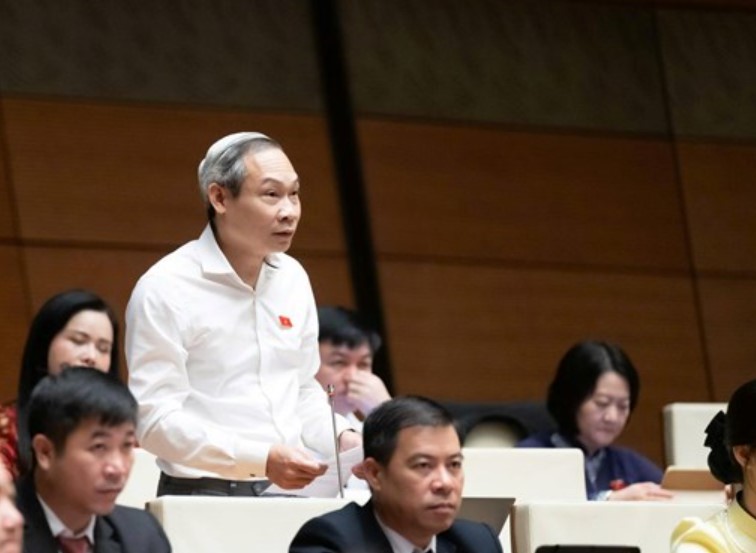
At the hall, delegate Phan Duc Hieu (Hung Yen delegation) agreed in principle to assign the Government to proactively regulate and adjust some contents related to tax policies to ensure compliance with Conclusion 18-KL/TW.
However, this delegate expressed concern about the constitutionality and legality as stipulated in Clause 4, Article 70 of the Constitution if it stipulates the delegation of full power to the Government in this matter.
This delegate proposed that the Government study and consider a plan that is most suitable for both Conclusion 18-KL/TW and Clause 4, Article 70 of the Constitution, as follows: The Law will stipulate the minimum and maximum framework level of taxable revenue. On that basis, the Government will determine a specific revenue level depending on each period.
For example, with the income level of enterprises and organizations being exempt from corporate income tax, it is from 1 billion to 3 billion or from 1 billion to 5 billion VND. The Government should study, consider further, and propose a specific framework including the minimum and maximum levels.
With the above regulations, the Government can completely stipulate a specific revenue level applied generally or different levels for different business areas... ensuring flexibility and authority of the Government, in accordance with Conclusion 18-KL/TW" - delegate Phan Duc Hieu expressed his opinion.


