
Just hours after the earthquake, the Japan Meteorological Agency issued a special warning, saying that the risk of strong earthquakes of magnitude 8 or more in the next few days is slightly increased. The agency estimates the possibility of a "super earthquake" is 1%, higher than 0.1% in normal conditions.
The earthquake on April 20th occurred just days after the Indonesian Bureau of Meteorology, Climate and Geophysics (BMKG) issued a new warning about the risk of a "megathrust" earthquake with a magnitude of 9.0 in Bali.
According to the US Geological Survey, supershocks caused by submerged faults occur when a tectonic plate is trapped along the fault and slides down to the adjacent plate, causing extremely large earthquakes. Smaller earthquakes that occur frequently can also occur in the lower plate or the crust of the upper plate.
Bali and Sumba and Flores islands are forecast to be the most severely affected if a super earthquake occurs, according to The Bali Sun.
However, BMKG emphasized that these warnings are risk assessments, not specific forecasts.
The 2024 report of the National Center for Earthquake Research shows that Bali is located in an area likely to be affected by a super earthquake due to submerged faults on the Sumba fault" - meteorologist-geophysicist Yogha Mahardika told the Bali Post.
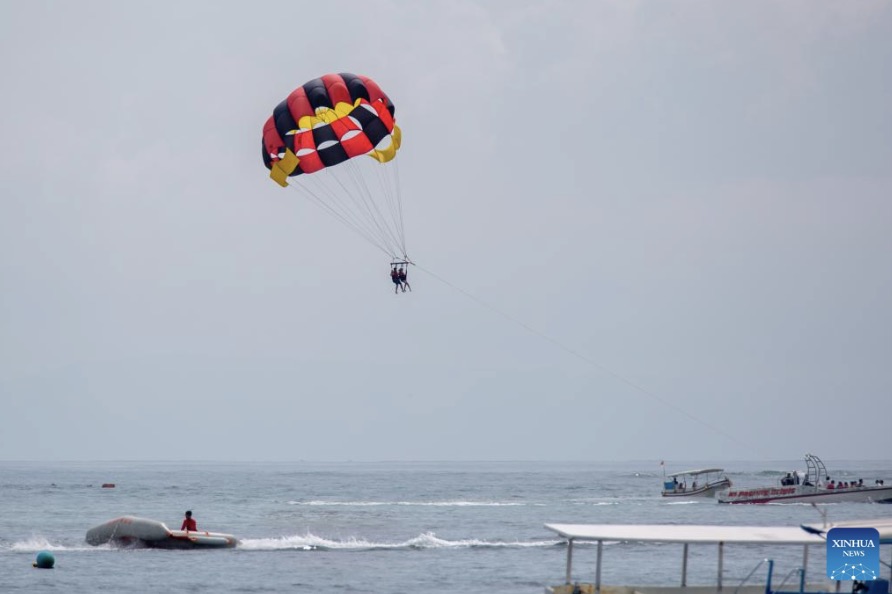
Researchers believe that Indonesia's super earthquake will only be a matter of time, but there is currently no technology that can accurately predict the time, according to Mr. Yogha. Therefore, BMKG regularly issues warnings to prepare people.
Indonesia's Earthquake source and risk map for 2024 identifies 14 "hotspots" of super earthquakes due to submerged faults around the archipelago, an increase compared to 13 points in 2017.
BMKG especially noted 2 areas that were "overdue" for super earthquakes: the Sunda Strait near Bali (last time in 1757) and the Mentawai-Siberut area (last time in 1797).
Bali is also facing the risk of tsunamis from super earthquakes along the Nankai Trench - a 900km long fault off the Pacific coast of Japan, where the Philippine Sea plate sinks under the Eurasian plate.
If a major earthquake occurs in Nankai and causes a tsunami, we need to be vigilant because a major tsunami in Japan could spread to Indonesian territory" - the head of the BMKG Earthquake and Tsunami Center warned in July 2025, according to The Bali Sun.
Indonesia is considered the country with the strongest seismic activity in the world. Japan ranks 3rd in this list.
Immediately after the latest earthquake in Japan on April 20, a magnitude 6 earthquake occurred in North Central Timor, East Nusa Tenggara province of Indonesia on April 21. The epicenter was 67km northwest of North Central Timor, at a depth of 31km. This earthquake does not pose a tsunami risk.


