
In the context of Ho Chi Minh City setting a double-digit economic growth target, energy demand is forecast to increase sharply, especially when the city promotes the development of industry, digital economy and data centers. Therefore, ensuring energy sources is not only an urgent requirement but also a decisive factor in attracting investment and sustainable growth.
According to Mr. Nguyen Thanh Toan - representative of the Ho Chi Minh City Renewable Energy Association, from an investor's perspective, financial efficiency is a key factor. However, currently only about 20% of businesses participate in investing in rooftop solar power, while the household sector is still very limited.
The main reason, according to Mr. Toan, lies in the fact that the surplus electricity purchase price is not attractive enough. Although the surplus electricity sales ratio may be increased to 50% in the near future, the current price is still lower than expected. The capital recovery period of about 8 years is equivalent to the loan repayment period, making many investors still hesitant.
Only when the electricity purchase price is surplus and approaches investment costs can it create strong momentum for the market" - Mr. Toan assessed. In addition, combining rooftop solar power with a power storage system (BESS) is considered an important solution to improve exploitation efficiency and balance with the grid.
From a management perspective, Mr. Thai Thanh Son - Head of the Enterprise and Collective Economy Department, Ho Chi Minh City Department of Finance, said that to achieve the growth target in 2026, the city needs to mobilize about 1.18 million billion VND of social investment capital, of which about 11 billion USD is from FDI. The industrial sector alone sets a high growth target, leading to a minimum electricity demand increase of 7%.
The city is also linking development planning with energy assurance, especially information technology zones, data centers - large electricity consumption sectors. Along with that, industries, urban areas, commerce and services continue to expand, increasing pressure on the power system.
In the coming time, when Ho Chi Minh City builds a special urban law, supplementing support mechanisms for businesses and households is considered necessary. Departments and sectors are coordinating to propose policies to submit to competent authorities, as a basis for synchronous implementation.
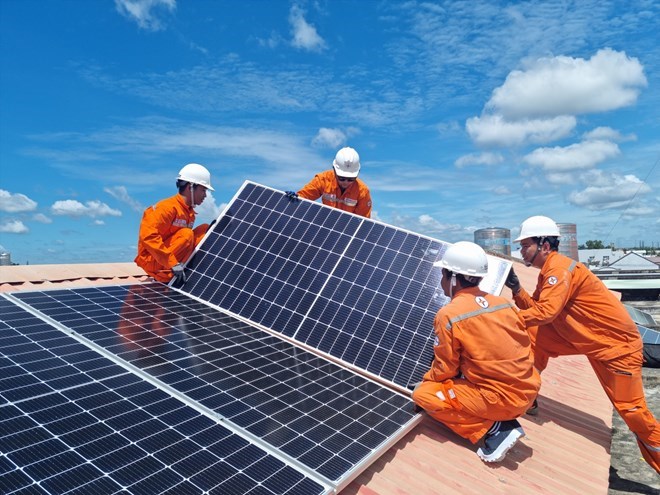
According to Ms. Nguyen Thi Kim Ngoc - Deputy Director of Ho Chi Minh City Department of Industry and Trade, the city has identified 6 key groups of solutions to ensure energy security. Among them, prioritizing the balanced development of power sources, accelerating LNG gas power projects, promoting the gas industry and especially increasing the proportion of renewable energy.
The city also encourages self-produced and self-consumed electricity models, especially rooftop solar power, and promotes the use of energy economically and efficiently. Businesses are called upon to switch to using green energy to reduce pressure on the power system.
Currently, Ho Chi Minh City has more than 22,000 rooftop solar power systems with a total capacity of about 1,832 MWp. However, the development potential is still very large, especially in residential and commercial areas.
To exploit effectively, the city will synchronously implement many solutions such as strengthening communication, diversifying capital sources (green credit, preferential capital), technical support, digital transformation in the energy industry and building a map of solar power potential.
Notably, the development orientation of rooftop solar power will be associated with energy storage systems to overcome instability, reduce peak hour pressure and optimize costs.
With synchronous solutions from price mechanisms to support policies, Ho Chi Minh City expects to create a boost for rooftop solar power, contributing to ensuring energy security and promoting sustainable growth in the coming period.


