
To give businesses the opportunity to return to the market
Mr. Nguyen Minh Thanh (character name has been changed), owner of a company waiting for dissolution, said that the business stopped operating from 2017 due to inefficient business. The company has paid the tax amounts notified, personnel have quit their jobs, no revenue is left and no invoices are issued.
Due to not understanding the procedures and no longer having accounting support, Mr. Thanh has not completed the dissolution. After many years of doing other jobs and accumulating capital to return to business, he discovered that the old company still exists on the system, in a state of not operating at the registered address.
The company has been closed for a long time but legally it has not ended. I want to resolve it thoroughly to focus on a new business plan, but the cost may be up to tens of millions of VND. If accumulated capital must be used to handle arising fees and fines, the opportunity to start over will be even more difficult" - Mr. Thanh said.
Also waiting to complete the dissolution procedures, Ms. Le Thi Huong (character name has been changed), owner of an electronics business, said that the company was established in 2016 and stopped operating after the COVID-19 epidemic. The seal and business registration certificate are still there, but part of the books and invoices in 6 years of operation have been lost, and the previous accountant has also lost contact.
The dissolution dossier has been submitted for more than 1 month but has not been completed. She still has to supplement documents and explain some contents.
To complete the procedures, Ms. Huong had to hire an accountant to review books, find documents, supplement documents and handle fees and fines incurred during the company's suspension of operations.
According to her, many small businesses also face a similar situation when they are running out of capital, personnel resign, and books are in shortage. She proposed simplifying procedures for businesses that have stopped operating for many years, without generating invoices, disputes or signs of fraud; and at the same time reviewing fees, charges and penalties arising.
Classification for handling, supporting the right subjects
Ms. Nguyen Thi Cuc - Chairwoman of the Vietnam Tax Consultants Association - said that it is necessary to clearly classify each group of taxpayers to have appropriate handling measures, avoiding equating business failures with cases of intentional violations.
For serious acts, it is necessary to strictly handle cases of taking advantage of open policies to establish "ghost" businesses, buying and selling invoices for profit; not operating at registered addresses to evade taxes or stealing or forging information of others to establish businesses and household businesses serving illegal activities.
Meanwhile, for businesses that have ceased operations but have not terminated the validity of tax codes due to lack of understanding or "forgetting", other handling directions are needed. If taxpayers actually do not engage in production and business activities, do not generate revenue, expenses and do not owe taxes, it is possible to study not retroactively collecting business license fees, late payment fees and not penalizing the act of late payment of tax returns during the period of cessation of operation.
Instead of penalizing a series of violations arising during the time the enterprise is not actually operating, it is possible to only penalize the act of not carrying out procedures to terminate the validity of the tax identification number. This handling method will create conditions for taxpayers to fulfill their obligations and close businesses.
Regarding the budget debt arising before the enterprise ceased operations, if there is no fraud or tax evasion, Ms. Cuc proposes to classify it by tax and debt period to collect sufficient principal tax.
Ms. Cuc proposed that it is possible to study only calculating late payment fees for a maximum of 5 years, reducing accumulation obligations and helping taxpayers soon complete procedures to terminate the validity of the tax identification number.
Support the right people, avoid creating loopholes
According to Ms. Vu Thi Binh - Director of Binh Vu Enterprise Management Consulting and Training Co., Ltd., to remove difficulties and support businesses in carrying out dissolution procedures, it is necessary to build a clear verification mechanism, with a basis to determine that businesses do not generate revenue, expenses, invoices and bank transactions related to business activities during the period of consideration. Determine the actual time when businesses cease operations, because this is the basis for zoning the scope of obligations to be handled.
According to Ms. Binh, there should be specific regulations on the scope of application, clearly defining which amounts are exempted, which amounts taxpayers still have to implement, and in which order backlogs are processed. Removing obstacles should focus on businesses and business households that have actually stopped operating, have not generated business, and have no signs of fraud.
According to her, clear verification criteria and correct classification of each group will help handle prolonged backlogs, while preventing policies from becoming loopholes to evade obligations.
Clean up data, support businesses to return to the market
Exchanging about the campaign "Cleaning up tax identification numbers - Removing bottlenecks in business", Mr. Mai Son - Deputy Director of the Tax Department - said that the first goal is to standardize the data of the Tax sector, contributing to the national database according to the requirements of being accurate, sufficient, clean, and lively.
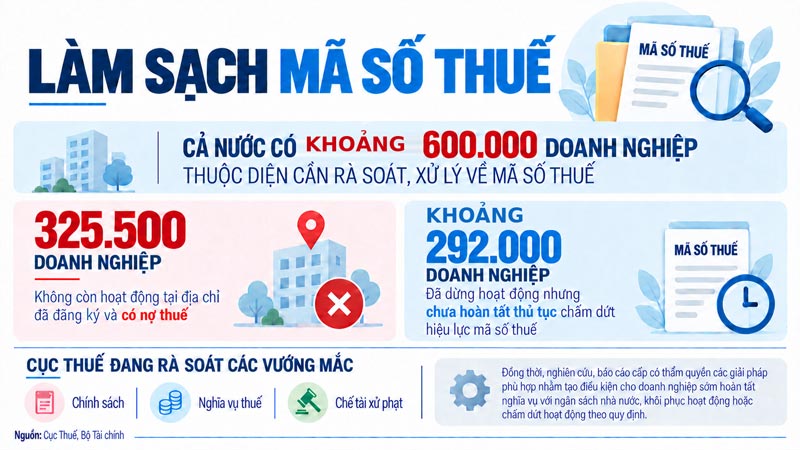
Every year, the tax authority still handles cases of temporary suspension, termination of operation or no longer operating at the registered address. However, dossiers have been backlogged for many years while resources are limited, so the campaign is being implemented to handle them thoroughly.
To implement it, the tax authority must review and standardize information about addresses, phone numbers, legal representatives, owners and shareholders. For businesses that no longer operate at registered addresses, the tax authority must coordinate with local authorities, the police force and relevant agencies to verify.
The review focuses on cases in status 03, i.e., taxpayers who have stopped operating but have not completed procedures to terminate the validity of the tax identification number and status 06, i.e., taxpayers who do not operate at the registered address.
We continue to record difficulties and obstacles of businesses and taxpayers, assess the impact to report to the Ministry of Finance, the Government and the National Assembly for consideration and resolution. The goal is to both improve management discipline and improve service quality, helping businesses feel secure in fulfilling tax obligations and focusing on production and business" - Mr. Mai Son said.


