
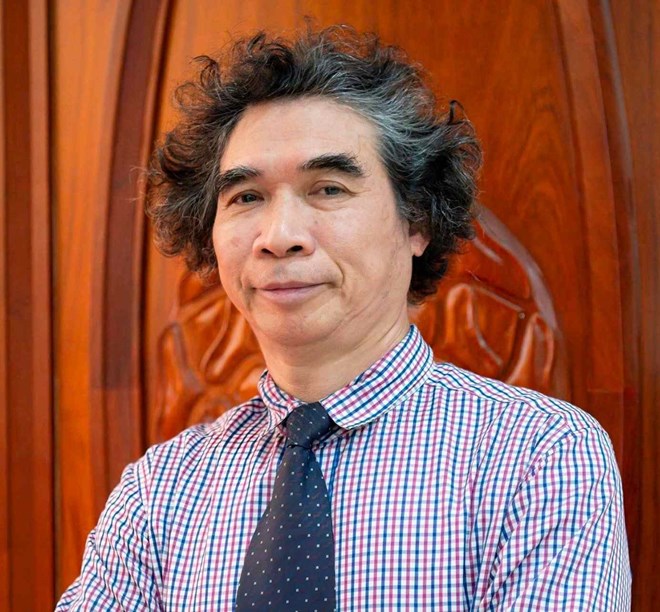
Reporters had a conversation with Assoc. Prof. Dr. Nguyen Thuong Lang - economic expert, senior lecturer at the Institute of International Trade and Economics (National Economics University) to assess the achievements of the Vietnamese economy in the period 2021-2025.
According to the Report of the 14th Party Congress, the average growth rate in the period 2021-2025 is 6.3%. How do you assess Vietnam's GDP growth rate?
- GDP growth achieved quite impressively, exceeding expectations. The average growth rate for the whole period 2021-2025, despite being affected by the pandemic and geopolitical competition, fierce armed conflict, and broken supply chains, still reached 6.3%, higher than the period 2016-2020. This result shows Vietnam's high resilience, effective adaptability, and ability to maintain stable and solid growth in particularly unfavorable conditions.
What are the main drivers driving Vietnam's economic growth in the past 5 years, sir?
- There are 3 main drivers promoting Vietnam's economic growth.
The first driving force is public investment being implemented on a large scale and drastically, creating a large spillover effect such as infrastructure projects: Quickly completing the 500kV circuit 3 power line project from Quang Trach (Quang Binh) to Pho Noi (Hung Yen), completing over 3,000 km of expressway, Long Thanh airport... In addition, foreign direct investment still maintains a high attraction rate. Private investment is effectively mobilized. Many private economic groups have been formed and developed strongly such as FPT, TH True Milk, Hoa Phat...
The second driving force is that consumption tends to increase due to improved income. Very large stimulus packages such as the 347 trillion VND package after the pandemic, tax exemption and reduction activities, tax extensions, basic salary increase adjustments, income tax adjustments, national promotion programs... have strongly promoted consumption. Domestic and international tourism exploded after the pandemic, and are expected to welcome about 25 million international visitors in 2025.
The third driving force is high-speed import and export growth. In 5 years, total import and export turnover increased from 500 billion USD to more than 900 billion USD. The trade balance is continuously surplus, reaching tens of billions of USD.
Looking to the future, what are the key growth pillars of Vietnam's economy in the 2026-2030 period, sir?
- In the period 2026-2030, Vietnam's economic growth needs to reach at least 10% consecutively to achieve the goal of becoming a high-income country by 2030 and an industrialized high-income country by 2045. This is an unprecedented goal, almost an acceleration process, requiring maximizing the impact of growth pillars. Growth pillars in the new period will certainly have to be based on a close combination of traditional pillars and new pillars.
For traditional pillars, public investment needs to be drastically expanded in terms of scale, speed and scope. Many national, inter-local and local-level projects are needed to increase spillover effects. Increasing domestic consumption through stimulus policies such as national promotions; increasing domestic tourism and strongly attracting international tourists; improving income through salary increases, increasing family deductions, income tax exemptions and reductions; increasing festivals and events... will create more growth momentum.
Continuing to strengthen attracting foreign investment and mobilizing domestic investment, especially private investment, will create the ability to expand the scale of industries. Promoting import and export of goods to increase the ability to exploit foreign markets, participate more deeply in the supply chain and improve competitiveness is also a particularly important pillar.
For new growth pillars, it is necessary to attach importance to scientific and technological breakthroughs, innovation and national digital transformation.
Next, it is necessary to promote the driving force of green transformation, sustainable development standards such as ESG, turning these strict requirements into new development driving forces.
At the same time, promote new development models and business models such as digital economy, circular economy, sharing economy, knowledge economy; the role of international and regional financial centers; the development of the cryptocurrency market, carbon credit market to mobilize maximum resources into creating diverse values.
In addition, the goal of establishing 2 million new businesses and developing at least 20 corporations to deeply participate in the global value chain will be a focal point to mobilize significant development resources, creating a solid foundation to improve economic strength, increase resilience to rapid and uncertain changes in the world, and ensure a balanced state in the acceleration phase.
Growth pillars, when effectively combined, will promote growth to the right targets set in the new period.


