
In the context of increasingly diverse production and business activities, especially individual and online business, tax law has had very specific regulations to ensure fairness, transparency and prevent budget losses.
However, reality shows that many business households still have a subjective mentality, thinking that tax violations only stop at the level of reminders or light administrative fines. In fact, tax evasion can be heavily punished, even criminal prosecuted.
To help taxpayers in the area understand and proactively prevent violations, Hanoi Tax has specific notes on violations and penalties according to current regulations.
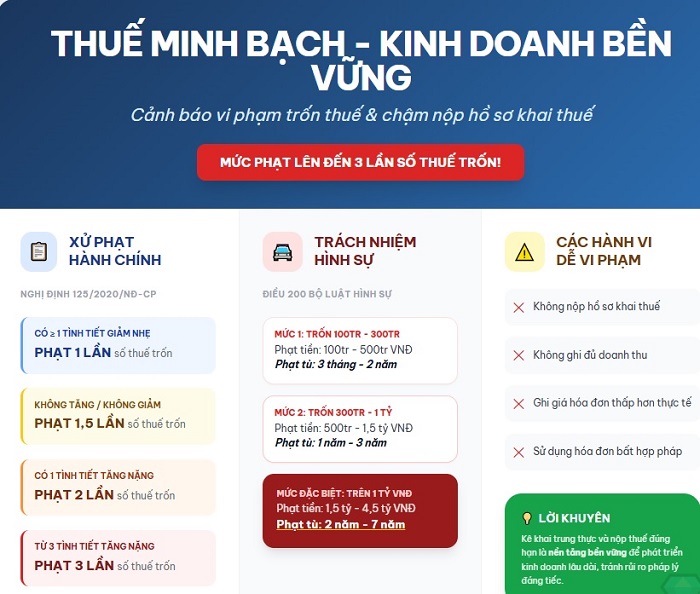
Administrative fines up to 3 times the amount of tax evasion
According to Article 17 of Decree No. 125/2020/ND-CP of the Government, tax evasion will be punished based on the level of violation and aggravating and mitigating circumstances, with the fine calculated according to the "number of times tax evasion is paid".
Accordingly, taxpayers who have a mitigating circumstance or more but commit acts such as not submitting tax registration documents, not submitting tax declaration documents or submitting tax declaration documents after 90 days from the expiration date (or the expiration date of the extension period) will be fined at 1 tax evasion.
In case of performing the above acts without aggravating or mitigating circumstances, the fine will be 1.5 times the amount of tax evasion.
If there is one aggravating circumstance, the violator will be fined twice the amount of tax evasion; there are two aggravating circumstance, the fine increases to 2.5 times; and if there are three or more aggravating circumstances, the highest fine can be up to 3 times the amount of tax evasion.
According to the tax authority, this is a very heavy penalty, enough to deter acts of deliberately neglecting, concealing revenue or failing to fulfill tax declaration and payment obligations according to regulations.
When will tax evasion be criminally prosecuted?
Not stopping at administrative sanctions, many tax evasion acts can also be prosecuted under Article 200 of the 2015 Penal Code (amended and supplemented).
Accordingly, a person who commits tax evasion with an amount of VND 100 million to under VND 300 million, or tax evasion under VND 100 million but has been previously administratively sanctioned or has been convicted of tax evasion (not cleared but still violated) may be subject to a fine of VND 100 million to VND 500 million or imprisonment from 3 months to 2 years.
The acts that are easily considered for criminal liability include: Not submitting tax registration documents; not submitting or not submitting tax declarations on time; not recording all revenue in accounting books; not issuing invoices when selling goods and services or recording values on invoices lower than the actual value; using illegal invoices and documents to reduce the amount of tax payable or increase the amount of tax refunded; using other fake documents and documents to determine tax obligations.
Organized tax capital, large amount: Penalties are very strict
The Penal Code also stipulates heavier penalty levels for serious violations. Specifically, tax evasioners with organizations; tax evasion with amounts from VND300 million to under VND1 billion; taking advantage of positions and powers; committing crimes more than twice or re-offending dangerously may be subject to a fine of VND500 million to VND1.5 billion or imprisonment from 1 year to 3 years.
In particular, if the tax evasion amount is VND1 billion or more, the violator may be fined from VND1.5 billion to VND4.5 billion or imprisoned from 2 to 7 years.
In addition to the main penalty, criminals may also be subject to additional penalties such as a fine of VND20 million to VND100 million, a ban on holding positions, a ban on practicing a profession or doing certain jobs from 1 year to 5 years, and even the confiscation of part or all of their assets.
Proactively comply to avoid "excessive prices"
According to experts, the line between administrative violations and criminal liability in the tax sector is becoming increasingly clear. In the context of tax authorities promoting digital transformation, data management and post-inspection, tax evasion will be difficult to hide.
Therefore, to avoid having to pay "excessive prices", households and individuals doing business need to proactively fully understand tax laws; register for taxes, declare honestly, issue full invoices and pay taxes on time. Compliance with the law not only helps avoid legal risks but is also a foundation for sustainable and long-term business development.


