
Reality from business households shows that the story of the tax exemption threshold is not simply the figure of 500 million, 1 billion or 2 billion VND, but lies in the tax policy approach to this sector.
Ms. Nguyen Thu Trang, owner of a ready-to-swear tailor shop on Ton Duc Thang street (Hanoi) - shared that monthly revenue can reach about 50 million VND, but after deducting the cost of renting premises of about 15-16 million VND, hiring labor, electricity, water and raw materials, the actual profit is insignificant.
Some months I have to compensate for rent, some months I have enough expenses, it seems like I'm just maintaining it. There are not many customers but I still have to keep tailors, each person 5-7 million VND/month. Before, I even hired students to look after the store in the evening shift, now I have to do it myself to reduce costs" - Ms. Trang said.
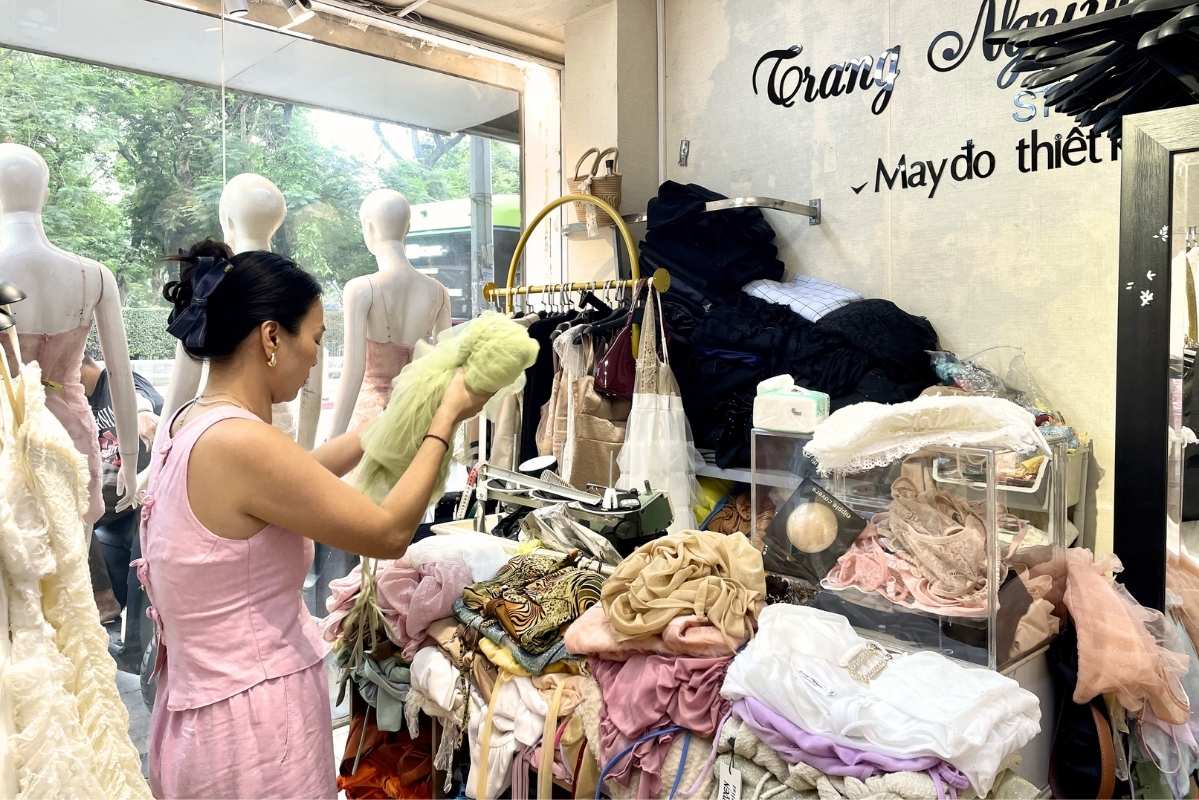
According to her, raising the tax exemption threshold to 1 billion VND helps reduce pressure on small businesses.
From another perspective, Mr. Nguyen Anh Tuan, owner of Mini Mart store - said that even if the tax exemption threshold is 1 or 2 billion VND, in essence many households are still just "taking labor for profit". What he is more concerned about is that administrative procedures need to be simplified, helping businesses focus on trading activities.
It is necessary to have a list of suppliers to ensure complete invoices and input documents so that retailers can confidently import goods" - Mr. Tuan proposed.

Cannot "equalize" a revenue threshold
Discussing this issue, Dr. Le Duy Binh - Director of Economica Vietnam - said that raising the tax exemption threshold will not solve thoroughly if fundamental and root problems are not addressed.
According to him, first of all, it is necessary to clearly define the legal status of business households. Currently, this area does not have a complete legal framework, while Vietnam has about 5.2 million business households with nearly 8 million workers, with an average of about 1.5 workers per household.
In essence, business households operate in the form of individual business (individual business), doing it themselves, and being self-responsible indefinitely. In order to be consistent with the current legal system of Vietnam and in accordance with international practices, the tax treatment for business households needs to be the same as for individual businesses. Because the essence is individual business, as individual businesses, the main tax applied to them is personal income tax (PIT) and not revenue tax as it is now" - Mr. Binh emphasized.
When applying personal income tax to business households, specifically to household owners, it is easy to immediately use the provisions of the latest Personal Income Tax Law applied from the 2026 tax period.
In which, the threshold of income not subject to PIT has been raised with a family deduction for the taxpayer themselves of 15.5 million VND/month, equivalent to 186 million VND/year. At that time, business households will also have to pay tax if income or profit, i.e. revenue minus expenses including labor costs, starts to exceed 15.5 million VND/month or 186 million VND/year.
The threshold of 1 billion VND: Reasonable for this business household, inadequate for another household
Another big issue is the difference between business households. With the same revenue level of 1 billion VND, but profits may differ significantly between industries.
Mr. Binh cited an example, the threshold of 1 billion VND may be reasonable for business households in the food, beverage, service, and trade industries where the profit margin can reach 20%-25%. However, this threshold is not fair for business households such as grocery stores and retailers, which often struggle with a thin profit margin of 5%-8%.
According to experts, the threshold of 1 billion VND may also be reasonable for the scale of business households with 1 worker, who is also the head of household. In the opposite direction, irrationality will come to business households using up to 5-6 workers to generate this revenue level. The threshold of 1 billion VND may also be suitable for business households in rural and suburban areas, but not yet reasonable for business households in urban centers where living costs and input costs are much higher.


