
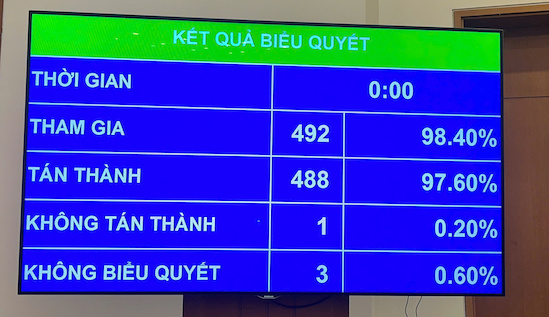
In the afternoon of April 23, with 488/492 delegates present participating in the vote in favor (accounting for 97.6%), the National Assembly officially passed the Law on Civil Status (amended).
The law consists of 4 chapters, 30 articles, and takes effect from March 1, 2027.
Before the electronic vote, Minister of Justice Hoang Thanh Tung presented a report on receiving, explaining and revising the draft Law on Civil Status (amended) to submit to the National Assembly for consideration and approval.
Accordingly, the draft Law is built in the direction of ensuring compliance with the requirements of reforming legislative thinking, in which the Law focuses on stipulating principled and stable contents under the authority of the National Assembly; limiting detailed regulations, increasing flexibility in implementation organization.

The draft Law, after being revised, ensures constitutionality and consistency with relevant laws; at the same time, concretizes the policy of promoting decentralization, delegation of power, administrative procedure reform, and digital transformation in the field of civil status. The regulations are completed to ensure clarity, tightness, feasibility, closeness to reality, creating maximum convenience for people and improving the effectiveness and efficiency of state management.
Regarding authorizing the signing of civil status papers, receiving opinions from National Assembly deputies, the draft Law has been revised in a flexible direction: No restrictions on authorization for death certificates to ensure timely resolution.
Specifically for birth certificates and marriage certificates - which are original and important civil status documents, the regulation signed by the leaders of the commune-level People's Committee is necessary to ensure strictness and solemnity.
Regarding birth registration and death registration by proactive method (Article 15, Article 20), absorbing the opinions of National Assembly deputies, the Government has supplemented the roadmap for implementing birth registration and death registration by unified proactive method nationwide no later than January 1, 2031.
This is a major reform, shifting from the "people's request" mechanism to "state agencies proactively serving", requiring synchronous completion of digital infrastructure and data connection, especially in the healthcare sector.
In the transitional period, localities that meet the conditions are allowed to proactively implement first; at the same time, the State continues to invest in infrastructure, train human resources and promote policy communication to ensure feasibility and social consensus.


