Promoting circular economy to develop sustainable shrimp industry

MỸ LY |

The new requirements of the market are requiring the shrimp industry to continue to innovate production models, improve resource efficiency, and reduce emissions.

On September 21, the Public-Private Partnership (PPP) Forum to promote the circular economy of the shrimp industry in the Mekong Delta (Mekong Delta) region was held in Can Tho City.

According to data at the forum, in 2025, Vietnam's brackish water shrimp area is about 755.4 thousand hectares, with an output of about 1.405 million tons. Shrimp export turnover reached about 4.6 billion USD.

Through the period 2021-2025, the shrimp industry has had a fairly clear shift in area, output and value, especially in intensive farming, superintensive farming and high-tech application farming groups. In which, the Mekong Delta region accounts for the majority of the shrimp area and output of the whole country.

Providing information at the forum, Mr. Vu Duc Dam Quang - Deputy Director of the International Cooperation Department (Ministry of Agriculture and Environment) - said that the shrimp industry has an important position in production, export and creating livelihoods for people, especially in the Mekong Delta region.

The shrimp industry is facing many challenges such as input costs, climate change, saltwater intrusion, requiring innovation in production models, resource saving, emission reduction and improving the ability to meet the international market.

According to Mr. Quang, the circular economy is a suitable direction, helping the shrimp industry improve resource efficiency, reuse water, by-products, save energy, apply technology and increase data transparency.

In the current context, Mr. Ngo The Anh - Head of Aquaculture Department, Department of Fisheries and Fisheries Surveillance (Ministry of Agriculture and Environment) - determined that the circular economy of the shrimp industry is not a separate technology but a way to reorganize production in an efficient, circular and sustainable direction.

The Mekong Delta currently has implemented a number of circular economic models, typically the shrimp-rice model, shrimp-forest model and farming models applying technology and production management. These models have advantages in taking advantage of natural resources, reducing input costs and improving production efficiency.

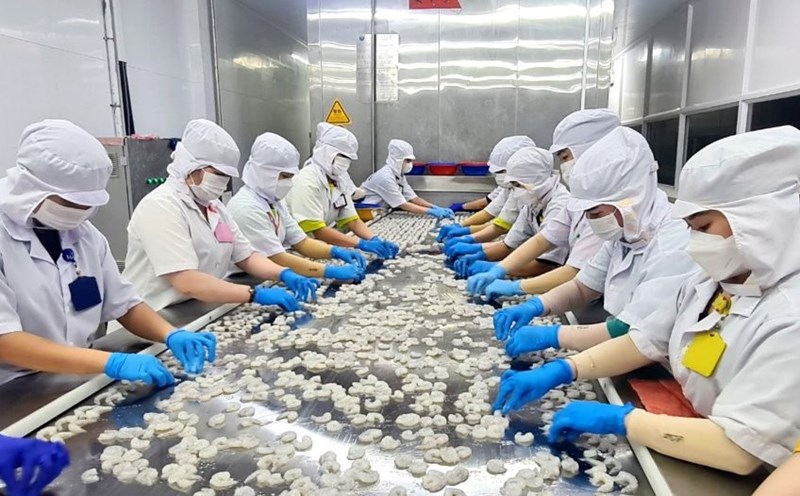
In addition, the circular economy in processing can take advantage of by-products such as shrimp heads and shells to produce value-added products. If there are appropriate solutions, these by-products can become raw materials for other manufacturing industries, thereby increasing value for the entire chain.

However, the development of the circular economy in the shrimp industry currently still has gaps. First of all, there are issues of institutions, policies and governance. Besides, there are issues of infrastructure, technology, data, financial markets, production organization and implementation capacity.

According to Mr. Ngo The Anh, solving these gaps is a prerequisite for realizing the circular economy in the shrimp industry, towards green production, high value, low emissions and sustainable development.

MỸ LY
RELATED NEWS

Identifying gaps in the circular economy development of the shrimp industry

|

Mekong Delta - The circular economy of the shrimp industry is a way to reorganize production in an efficient, circular and sustainable direction.

Ca Mau repositions the shrimp industry chain to increase export value

|

Ca Mau - As the "carp capital" of the country, Ca Mau repositions the shrimp industry chain to break through in shrimp exports.

Ca Mau seeks solutions to deal with the shrimp industry when the US imposes a 46% tax

|

Ca Mau - The Provincial People's Committee predicts that it will seriously affect the seafood production, processing and export industry - especially the shrimp industry - when the US imposes a 46% tax rate.

Shrimp face many difficulties, shrimp industry faces the risk of falling behind

|

Feed, shrimp seeds, farming techniques, preservation, export… all are weak. If innovation is slow, the Vietnamese shrimp industry will face many difficulties.

Removing difficulties and improving competitiveness of shrimp industry

|

Since the beginning of the year, brackish water shrimp farming has encountered many difficulties. Some localities have put forward initiatives and proposals to resolve the difficulties in order to improve the competitiveness of the shrimp industry.

Driving training vehicles under strict control by Hanoi traffic police

|

Hanoi - Traffic police force increases inspection of driving practice vehicles on the road, handling cases of traffic safety violations.

Tennis player involved in doping at ASIAD once dubbed the "female goddess of badminton" of Thailand

|

Pitchamon Opatniputh - a young Thai female tennis player - is going through the most difficult time since stepping onto the professional arena.

Update ASIAD medal standings today (September 22)

|

Update on ASIAD 20 medal standings on competition day 22. 9.

Identifying gaps in the circular economy development of the shrimp industry

MỸ LY |

Mekong Delta - The circular economy of the shrimp industry is a way to reorganize production in an efficient, circular and sustainable direction.

Ca Mau repositions the shrimp industry chain to increase export value

NHẬT HỒ |

Ca Mau - As the "carp capital" of the country, Ca Mau repositions the shrimp industry chain to break through in shrimp exports.

Ca Mau seeks solutions to deal with the shrimp industry when the US imposes a 46% tax

NHẬT HỒ |

Ca Mau - The Provincial People's Committee predicts that it will seriously affect the seafood production, processing and export industry - especially the shrimp industry - when the US imposes a 46% tax rate.

Shrimp face many difficulties, shrimp industry faces the risk of falling behind

NHẬT HỒ |

Feed, shrimp seeds, farming techniques, preservation, export… all are weak. If innovation is slow, the Vietnamese shrimp industry will face many difficulties.

Removing difficulties and improving competitiveness of shrimp industry

Phan Anh |

Since the beginning of the year, brackish water shrimp farming has encountered many difficulties. Some localities have put forward initiatives and proposals to resolve the difficulties in order to improve the competitiveness of the shrimp industry.