Food prices simultaneously decrease, Ho Chi Minh City residents reduce spending pressure

HẠ MÂY |

Many essential food items in Ho Chi Minh City are being discounted, contributing to reducing the burden of spending and stimulating consumer demand.

Ms. Nguyen Thuy Kieu's family (resident of Vinh Loc commune) has four members, of which pork (pork) is an almost indispensable dish in daily meals. Therefore, in recent days, every time she goes to the supermarket to buy food, she clearly feels that the cost for family meals has become "easier" than a few months ago.

Previously, every time I went to the market, I had to calculate very carefully how much meat and vegetables to buy for a week. Now the price of pork and vegetables has decreased by several thousand VND per kg, so each month I also save a sum to buy more milk for my children" - Ms. Thuy Kieu shared when shopping at a supermarket in Ho Chi Minh City.

Recorded at many traditional markets in Ho Chi Minh City, the prices of some essential food items have cooled down, down about 10,000-15,000 VND/kg compared to a few months ago.
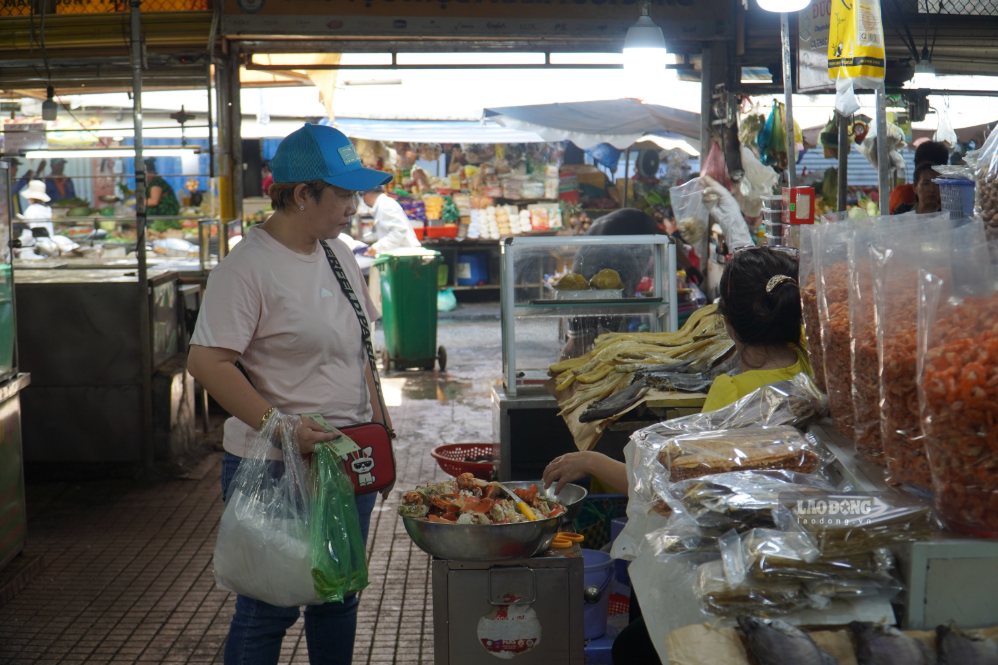
Nhiều mặt hàng thực phẩm thiết yếu được giảm giá, thu hút người dân mua sắm ở TPHCM. Ảnh: Hạ Mây
Many essential food items are discounted, attracting people to shop in Ho Chi Minh City. Photo: Ha May

Ms. Nguyen Thi An - a small trader selling pork near Hoa Binh market, said that although retail prices have decreased, purchasing power has not yet improved. According to her, people still tend to tighten spending, so they mainly buy just enough to use, and the number of customers has not increased significantly even though meat prices have become "softer" than before.

Meanwhile, at some supermarket systems in Ho Chi Minh City such as Co.opmart, Lotte Mart, Bach Hoa Xanh... many fresh food and vegetable items simultaneously reduced prices from 20-50%, attracting many people to shop.

Assessing the pork market through the trading floor, Mr. Nguyen Nguyen Phuong - Deputy Director of Ho Chi Minh City Department of Industry and Trade - said that pork products traded through the floor, sold at traditional markets, are being applied by suppliers with many attractive promotions. Thanks to that, compared to similar products at other stalls in the market, stalls selling through the floor have greater attraction, and the number of customers coming to buy is more crowded and stable.

To contribute to market stability, the Ho Chi Minh City Department of Finance has adjusted down prices for 9 items of pork and pork bones in the Market Stabilization Program, with reductions ranging from 2,000-8,000 VND/kg depending on each item and business.

Accordingly, the price of thigh meat decreased to 127,000 VND/kg; shoulder meat is 132,000-145,000 VND/kg; Cutlet meat is 139,000-147,000 VND/kg; Pork leg is still 119,000-123,000 VND/kg; Armpit meat is still 145,000 VND/kg...

Businesses participating in the program include C.P Vietnam, Saigon Agriculture Corporation, Central Retail Vietnam, Vissan and Saigon Co.op.

Besides pork, rice items in the Market Stabilization Program are still maintained at a price level at least 5% lower than the average of similar products on the market. Maintaining the prices of essential goods is expected to continue to reduce the burden of spending for people, and at the same time contribute to stimulating consumer demand in Ho Chi Minh City.

HẠ MÂY
RELATED NEWS

Ho Chi Minh City retail increases by 16.7%, becoming a driving force for trade and services

|

Retail sales of goods continue to be the main driving force of Ho Chi Minh City's trade and services, contributing to promoting consumption and expanding the year-end market.

Ho Chi Minh City traditional markets innovate sales methods to attract customers

|

In the context of slow purchasing power, many traditional markets in Ho Chi Minh City simultaneously implement promotional programs, improve service quality and gradually transform digitally to stimulate consumer demand.

Supermarkets in Ho Chi Minh City expand "Responsible Green Tiles", build clean supply chains

|

Ho Chi Minh City - July 17, the "Responsible Green Stick" program continued to spread in localities and businesses, contributing to building a transparent supply chain.

Proposing more prohibited acts in publishing activities

|

The draft Law amending and supplementing a number of articles of the Publishing Law proposes to add prohibited acts in publishing activities.

Proposal to swap work schedule for 4 days off on Vietnam Culture Day 2026

|

Among the 2 options proposed, the Ministry of Home Affairs proposed the option of exchanging 1 working day for civil servants and public employees to take 4 consecutive days off on Vietnam Culture Day 2026.

5 candidates whose exam results in Quang Tri were canceled are allowed to re-register for the 2027 exam

|

Quang Tri - 5 candidates whose exam results were canceled due to negativity at the Le Truc High School exam site were registered to retake the exam in 2027.

School transcripts record unusual place names, Quang Tri Department of Education and Training requests police to verify

|

Quang Tri - The Provincial Department of Education and Training is coordinating with the police to verify the secondary school transcript of Vo Danh Thuan, Chairman of the Vietnam Fatherland Front Committee of Sen Ngu commune.

Ho Chi Minh City retail increases by 16.7%, becoming a driving force for trade and services

HẠ MÂY |

Retail sales of goods continue to be the main driving force of Ho Chi Minh City's trade and services, contributing to promoting consumption and expanding the year-end market.

Ho Chi Minh City traditional markets innovate sales methods to attract customers

NGỌC LÊ |

In the context of slow purchasing power, many traditional markets in Ho Chi Minh City simultaneously implement promotional programs, improve service quality and gradually transform digitally to stimulate consumer demand.

Supermarkets in Ho Chi Minh City expand "Responsible Green Tiles", build clean supply chains

NGỌC LÊ |

Ho Chi Minh City - July 17, the "Responsible Green Stick" program continued to spread in localities and businesses, contributing to building a transparent supply chain.
