
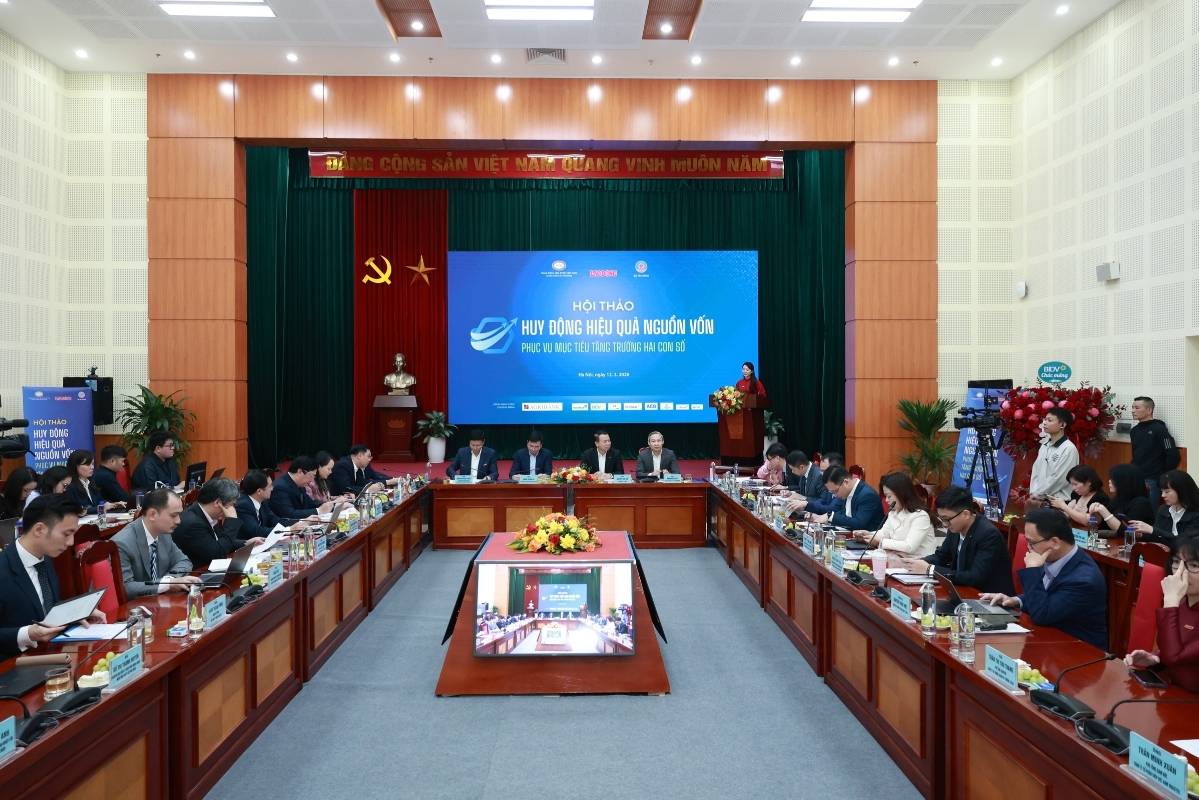
In the context of Vietnam setting a double-digit economic growth target in the period 2026-2030, the need to mobilize financial resources for infrastructure development, industry, energy and technology transformation is increasing. The problem posed is not only to expand the scale of capital flows but also to build an effective mechanism to absorb and allocate financial resources to the economy.
Exchanging at the workshop "Effectively mobilizing capital sources, serving the goal of double-digit growth" organized by Lao Dong Newspaper in coordination with the Ministry of Finance and the State Bank of Vietnam on March 12, Mr. Duong Thanh Tung - Deputy General Director of Strategic, Risk and Transaction Consulting Services of Deloitte Vietnam - said that Vietnam's current challenge is not the lack of capital but the lack of appropriate structure to absorb capital flows.

The bottleneck is not in capital scale
According to Mr. Tung, long-term international capital flows are often associated with strict requirements on the ability to create sustainable cash flow and market transparency. Institutional investors often look for stable investment opportunities in the long term, instead of depending on short-term market fluctuations.
In addition, most long-term capital comes from the private sector through forms of strategic equity investment, debt instruments, consolidation deals or business restructuring. These capital flows often focus on areas such as finance, infrastructure, energy, consumption and technology.
Another important factor for investors is the ability to divest. Long-term investment funds often require reliable "outdoors" such as initial public offerings (IPOs), share transfers or restructuring through the capital market.
However, according to a representative of Deloitte Vietnam, Vietnam's capital market ecosystem is still not deep enough to effectively support large-scale financial transactions, which partly limits the ability to attract long-term capital flows from international sources.
International financial center creates a foundation for capital attraction
Mr. Duong Thanh Tung said that building an international financial center in Vietnam can play the role of an "operating system" for the capital market, helping to effectively connect global capital flows with the investment needs of the economy.
An effectively operating international financial center not only helps enhance Vietnam's presence in international financial transactions but also supports the management of risks related to exchange rates, legality and taxes, while creating conditions for Vietnamese businesses to access the global capital market.
Experience from successful international financial centers in the world such as Dubai, Abu Dhabi or Astana shows that the decisive factor is not only in modern infrastructure or tax incentives. More importantly, it is necessary to build a synchronous institutional ecosystem, including a transparent legal framework, a reliable contract enforcement mechanism and a clear dispute resolution system.
The capital market needs to be of sufficiently deep quality with transparent, highly liquid investment products and supported by a reliable credit rating system to attract institutional investors.
Mr. Duong Thanh Tung shared that the development process of the international financial center in Vietnam can be implemented in stages. The first stage needs to prioritize building a clear licensing and supervision mechanism, establishing a reliable dispute resolution system as well as compliance standards on anti-money laundering and data security.
When the initial foundation is established, the financial center can expand capital market products, standardize the bond market, investment funds and other financial instruments to improve capital mobilization capacity for the economy.
According to representatives of Deloitte Vietnam, high economic growth is always associated with long-term capital needs and to attract this capital flow, the most important thing is to build investor confidence through a transparent playing system, modern financial infrastructure and clear market discipline.
When these foundations are fully established, Vietnam can not only attract more capital but also be able to attract the right type of capital - long-term capital flows to serve the sustainable growth goals of the economy.



