
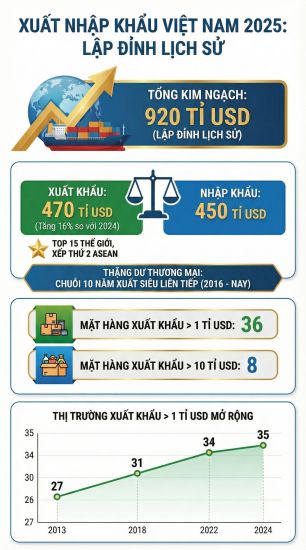
Growth foundation for the next phase According to data from the Ministry of Industry and Trade, in 2025, import and export will reach a historical peak of more than 920 billion USD.
Of which, exports are over 470 billion USD (up 16% compared to 2024).This result has put Vietnam in the Top 15 trading powers in the world, ranked 2nd in ASEAN.
In an interview with Lao Dong, Associate Professor, Dr. Ngo Tri Long - an economic expert - assessed that with a scale of 920 billion USD, more than 2 times the nominative GDP, it shows a very high level of opening of the economy. Maintaining a 10-year continuous trade surplus of 22 billion USD in 2025, not only supporting growth but also creating a solid foundation for macroeconomic stability: Reducing pressure on the balance of payments, strengthening foreign exchange reserves and stabilizing exchange rates - Associate Professor, Dr. Ngo Tri Long assessed.
In addition, the import scale accounts for nearly half of total turnover, reflecting the level of recovery and expansion of domestic production activities. The import structure with a very high proportion of machinery, equipment, and raw materials shows that import-export growth in 2025 is not "pure trade", but is closely linked to the production - investment - export chain.
Associate Professor, Dr. Ngo Tri Long said that import and export will continue to be an important pillar to help Vietnam's economy maintain growth momentum in 2025. However, it is necessary to frankly admit that 920 billion USD does not mean high-quality growth. To make this figure truly a foundation for rapid and sustainable growth, the policy focus needs to shift from expanding scale to improving the quality and depth of foreign trade growth - Associate Professor, Dr. Ngo Tri Long emphasized.
Unblocking "processing traps", increasing domestic content
Assessing the export turnover in 2025, Associate Professor, Dr. Nguyen Thuong Lang - Senior Lecturer at the International Institute of Trade and Economics (National Economics University) - said that the figure of more than 920 billion USD reflects the effectiveness of import-export policy management as well as the adaptability of enterprises.
However, Associate Professor, Dr. Nguyen Thuong Lang noted that the foreign-invested enterprise sector is still accounting for a large proportion of total export turnover.
This reflects the attractiveness of the investment environment, as well as Vietnam's ability to deeply participate in the global supply chain. However, the downside of this reality is that the domestic retained added value is still relatively limited. The majority of final profits still belong to parent corporations abroad, while Vietnam mainly benefits from wages, taxes and land and infrastructure leases.
Vietnam cannot continue to rely too much on the pure FDI attraction model in the direction of transaction, assembly. There should be policies to encourage domestic enterprises to participate more deeply in FDI projects, including in the form of capital contributions, joint ventures, associations or gradual equitization.
At that time, benefits will be distributed more harmoniously, Vietnamese enterprises will also have the opportunity to learn technology, management skills and experience in participating in international markets - Associate Professor, Dr. Nguyen Thuong Lang emphasized.
Another major note directly related to the quality of export activities is that the domestic content of exported goods is still low. Many key export industries still depend heavily on imported raw materials and components. This makes Vietnam more likely to fall into the processing trap - this expert noted.
Associate Professor, Dr. Nguyen Thuong Lang said that the world market is increasingly demanding sustainable development and traceability. This requires businesses to invest more in clean technology, environmentally friendly production processes and modern management systems.
Vietnam needs to shift from the goal of more exports to efficient exports. Only when these core problems are solved, can import and export achieve the growth target of 10% in the coming period" - Associate Professor, Dr. Nguyen Thuong Lang recommended.


