
Operating streamlined, investing billions of USD in digital transformation and not hesitating to spend tens of millions of USD on a potential draft - that is how the world's largest corporations maintain their position.
The race of "giants" and the unexpected replacement
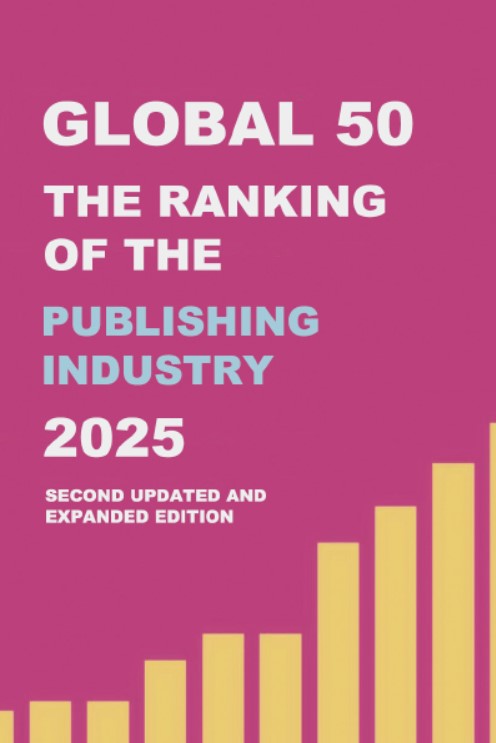
According to the annual report "Global 50 Publishing Ranking 2025" of Rudiger Wischebart Publishing Industry Consulting Company (co-published by Publishers Weekly, The Bookseller and Livres Hebdo), the top 10 publishing corporations in the world generated a total revenue of nearly 37 billion euros (1.1 million billion VND) in fiscal year 2024.
It is noteworthy that, according to analysis from the report, specialized publishers currently account for 54% of the total revenue of the 50 largest corporations, while mass-published books only account for 14%.
Leading are Thomson Reuters and RELX Group. According to data from Wischebart's report (2025), Thomson Reuters recorded revenue growth of 6% in 2024, reaching 6.43 billion USD (about 169.3 trillion VND), while RELX slightly decreased by 1% to 6.2 billion USD (about 163.3 trillion VND), falling to 2nd place after 7 years of leading.
Ranked third is Bertelsmann (mother company of Penguin Random House) with 6.07 billion USD (about 160 trillion VND), followed by Pearson (4.45 billion USD, about 117 trillion VND), Wolters Kluwer (4.25 billion USD, about 112 trillion VND), Hachette Livre (2.98 billion USD, about 78.5 trillion VND) and HarperCollins (2.09 billion USD, about 55.1 trillion VND).

Profit-making machine: "Two-speed" model of the publishing industry
According to analysis from the Wischebart report, the global publishing industry is operating under two distinct profit models.
One side is specialized corporations with stable periodic revenue. According to Wolters Kluwer's 2025 financial report, 84% of their revenue comes from data registration packages and digital platforms. Total revenue reached 6.1 billion euros (about 184.6 trillion VND), with an operating profit margin of up to 27.5%.
On the other hand, mass book publishers have to rely on the "frontlist" (new books) and "backlist" (old books) cycles. According to Publishers Weekly, only about 10 - 20% of new books are actually profitable, while most of the profit comes from the "backlist" - book titles that have recovered capital such as "Harry Potter" or "Đắc Nhân Tâm".
According to HarperCollins' 2025 fiscal report, revenue reached 2.15 billion USD (i.e., about 56.6 trillion VND), up 3%, while profit increased by 10%. This growth mainly comes from cost control and the digital book segment, which accounts for 24% of revenue - driven by audiobooks (verbal books) and ebooks (electronic books).
In the field of education, the pressure of digital transformation is increasingly clear. According to Wischebart, Pearson only grew by 4%, while McGraw-Hill achieved a digital revenue rate of 82%, showing the advantage of flexible models.
Million-dollar deals and the AI race in the publishing industry
According to The Bookseller, the global copyright market is increasingly competitive, with deals worth millions of USD.
A typical example is Hachette Book Group spending 10 million USD (about 263.4 billion VND) to win the right to publish Joe Biden's memoirs. Meanwhile, according to HarperCollins, Rioghnach Robinson's novel "Bad Words" was bought after an auction with the participation of 10 publishers.
According to Publishers Weekly, these deals are often led by literary agents - who play the role of screening, valuing and bringing manuscripts to market.
At the same time, fairs such as Frankfurt Book Fair or London Book Fair have become global copyright "traders", where contracts are finalized in just 30-minute meetings.
Another prominent trend mentioned by Wischebart in its 2025 report is the speed of artificial intelligence (AI) application in the publishing industry.
Thomson Reuters has developed AI Counsel legal assistants, while RELX Group has deployed Lexis AI. Notably, according to Wolters Kluwer's report, about 50% of the company's revenue has been tied to AI-integrated products.
In the mass segment, according to information released by HarperCollins, AI is used to create synthetic reading voices for audiobooks - especially for long books that are difficult to optimize production costs.
In addition, according to Wischebart, many publishers have opened up new sources of revenue by licensing content for AI companies to train models - a form of "data mining" from intellectual property.
It can be seen that the global publishing industry is shifting from the "book selling" model to "intelligence asset management". The boundary between publishers and technology companies is increasingly blurred. Corporations like Thomson Reuters, Wolters Kluwer or HarperCollins are not only competing with content, but also with data, platforms and the ability to exploit multi-channel reader IP.
In the context of AI, self-publishing and global economic fluctuations, Wischebart believes that the advantage no longer belongs to the biggest, but to the units that adapt the fastest to the new value chain of knowledge, to create supply chains for the knowledge industry.


