
The South Pole is more beautiful in imagination
Hon Da Bac is a cluster of 3 islands located next to each other: Hon Ong Ngo, Hon Da Bac and Hon Da Le in Ca Mau province. The name Hon Da Bac originates from granite blocks stacked on top of each other, shimmering under the reflective sunlight as if plated with silver. Stone slabs with all kinds of strange shapes interspersed in the sea waves create a scene that is both majestic and poetic, making anyone who sets foot there unable to stop for a long time to admire.
I thought Hon Da Bac was simply a "fairyland" at the southernmost point of the Fatherland. However, only when I set foot here did I understand that this place also has another value - a "red address" for revolutionary tradition education for today's and future generations.
We ran tirelessly on the road leading to Hon Da Bac. The straight road seemed to have no stopping point, on both sides were dense mangrove forests stretching endlessly. The sun gradually dawned right in front, dyeing the sky and water a brilliant orange-red color. While engrossed in admiring the scenery, Phong Linh suddenly called out loudly: "Sister, sister, run over and film this part for me".
Linh turned the car around. And then, even the second time I passed through that road, the moment the bright red sun covered the sea of water still made my emotions burst out like the first time I saw it. I kept sighing, slowing down for a long time to fully admire the scene before my eyes. It was so beautiful that I was afraid that even blinking would miss something.
Going a little further, a peaceful small fishing village appears with boats quietly anchored on the shore. Life here takes place slowly like the waves in the open sea. But what I remember forever is not the boats or the coastal roofs, but the image of a man sitting by the water's edge, one arm around the back hugging the child in his heart. The two fathers and sons just silently look towards the sea, where the boats are resting after the fishing trip. The fishing villagers look at us with the curious eyes of strangers passing by, only the two fathers and sons do not. It's as if our appearance has never stirred up that peaceful moment.
That scenery made me realize that Hon Da Bac is not only beautiful because of nature. The beauty of this place also lies in the simplicity, in the slow pace of life of people who are attached to the sea every day, so that anyone who visits has a feeling of wanting to stay longer.
Tourists surprised by the "red address
Like me, many tourists come to Hon Da Bac initially just because of curiosity about the beautiful photos of the sea and rocks. Ms. Nguyen Thi Phuong (from Can Tho) said that this is the first time she has come to Hon Da Bac after many times looking at images on social networks. What surprised her the most was that the actual scenery is much more beautiful than what she had imagined. The road through the mangrove forest, blue sea, natural rocks and fresh air bring a very relaxing feeling.
I thought this was just a sightseeing tourist destination. When I came here, I learned that this place was once associated with a very special feat of the People's Police force. The trip became much more meaningful," Ms. Phuong shared.
Another tourist from Ho Chi Minh City also said that what makes Hon Da Bac different from many other tourist destinations is the combination of natural landscape and historical value. If outside is clear blue sea and sky, million-year-old stone blocks and peaceful fishing villages, then just not far away is the place that preserves the story of a famous counter-intelligence case of the People's Police force.
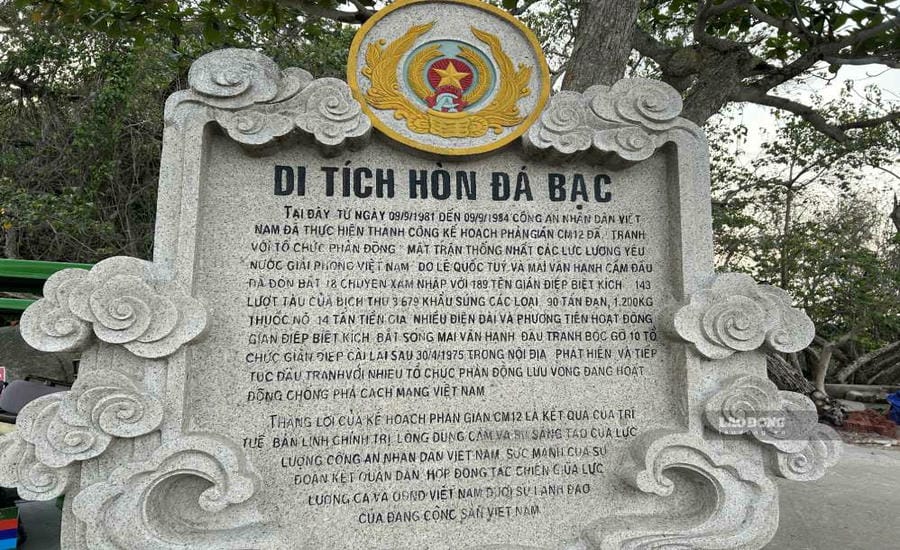
Place marking the CM-12 counter-espionage feat
According to the People's Police Museum, in the early 1980s, with the support of hostile forces abroad, the reactionary exile organization called the United Front of Vietnamese Patriotic Liberation Forces recruited and trained special forces spies and organized many illegal infiltrations into Vietnam by sea and land. Their main locations were Minh Hai provinces (now Ca Mau), An Giang... with the plot to build bases in the country, gradually carrying out sabotage and overthrow of the revolutionary government.
Faced with that situation, the People's Police force proactively grasped the situation, deployed many professional measures and established the Project coded KH-CM12 directly directed by leaders of the Ministry of Home Affairs (now the Ministry of Public Security).
In about 3 years, from 1981 to 1984, the Police force arrested 18 infiltration trips, arrested nearly 200 special operations spies, seized more than 3,600 guns of all kinds, about 90,000kg of ammunition, 1,200kg of explosives and about 300 million VND of counterfeit money that the subjects intended to bring into Vietnam to serve sabotage activities.
The peak of the CM-12 counter-espionage plan took place on September 9, 1984 at Hon Da Bac. When the ringleaders Mai Van Hanh and Tran Van Ba just docked according to the "friend" signal, the police force quickly controlled the entire commando group, successfully ending the special case. This feat contributed to maintaining political stability, protecting revolutionary achievements in the context of the country still facing many difficulties, and creating a favorable security environment for implementing the renovation policy later.

In 2009, Hon Da Bac Relic - CM-12 Counterintelligence Plan Command Center (1981-1984) was ranked as a National Historical Relic. At the end of June 2026, the Ministry of Public Security coordinated with the Provincial Party Committee and Ca Mau Provincial People's Committee to organize the inauguration ceremony of the Hon Da Bac Historical Relic Area upgrade project and hand over 500 houses to people in difficult circumstances.


