
The soul of the craft village
I was born in Ha Dong, raised in a apartment building less than 1km from Van Phuc silk village. My father's hometown is Gia Lam - a pure village in the North, separated by a dike from Bat Trang village. An interesting coincidence, these are two craft villages recognized as members of the World Creative craft cities Network.
Van Phuc village is located on the banks of the Nhue River, where the winding roads are like rivers of time, leading me into a different world. A world where every silk fiber carries the story of many generations of artisans, people who have devoted their lives to preserving and developing traditional silk weaving art. Van Phuc is not only the name of a village, but the soul of a craft that is more than a thousand years old, carrying the strong vitality of a proud culture.
When I entered the village, the atmosphere here seemed to absorb something very sacred. Along the small alleys, simple houses, the silk frames stand straight, quietly like soldiers guarding the heritage treasure. Each soft silk fiber seems to be imbued with the passion, perseverance, and endurance of the artisans here. And on each weaving frame, the morning light shines down on the silk sheets that are gradually taking shape, I feel an astonishing sophistication.
An artisan who has been involved in silk weaving for 40 years, looked at me with gentle eyes and said: "In the past, we had to use our hands to weave each fiber, meticulously down to the ends. But now, even with modern machinery, we still cannot forget old memories, the first steps in the profession". That is the one who keeps the fire burning for Van Phuc, the one who lights up the traditional lights that each generation that comes after must know and cherish.
Van Phuc has long been famous not only for its soft silk but also for its sophisticated and elaborate motifs. The ao dai, silk scarves, or hand-woven silk fabric here always have a separate soul. Each product is a work of art, an intersection between silk weaving techniques and cultural stories that have been carefully cared for for for for centuries.
I stood in front of a stall of a young artist, Ngoc Lan, who continued the family's tradition. Her eyes lit up when talking about the new silk models she was testing. "We are trying to bring our products to the world, not only as traditional silk but also as a combination of Vietnamese and international cultures. Van Phuc silk is not only a product, but a part of the soul of the nation," said Ms. Lan.
If Van Phuc is connected to the Nhue River, Bat Trang is located on the banks of the Red River. Known as the cradle of Vietnamese pottery, Bat Trang has a long history, a place where artisans in the craft village not only make pottery but also transmit the soul of the nation through each layer of soil and each flame.
However, like any other craft village, Bat Trang faces many challenges. Although modern technology has been applied to improve products and reduce pollution, pottery still faces the problem of environmental protection. The production of ceramics using clay materials and energy from fire still poses risks of pollution, affecting the health of workers as well as the environment. Local authorities have been implementing policies to support the pottery industry, encourage artisans to switch to using new technology, and promote environmental protection in production.
Like the fires rising from the ground, Bat Trang pottery will never go out, because it is the soul of a community, of a craft village that has permeated many generations, and will continue to shine with time.
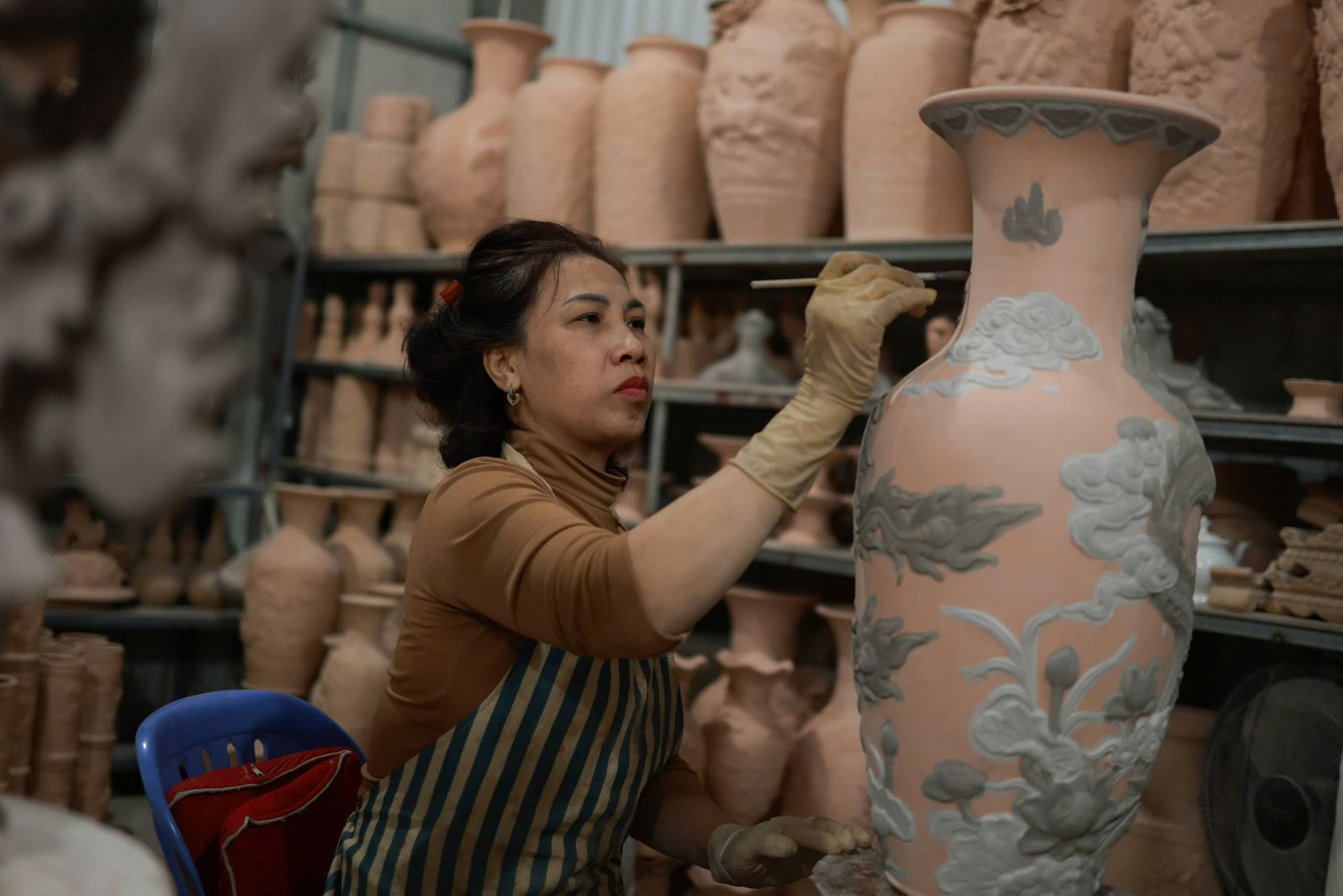
Keep the fire
Vietnam has over 5,000 traditional craft villages, Hanoi alone has 1,350 craft villages, craft villages, converging 47 occupations, but only 2 craft villages are honored, a modest number. The problem of craft villages is not only to keep the soul for hundreds of years but also to let values resist the erosion of time as well as the impact of modern life.
Recently, on December 9, 2025 in New Delhi, India, the 20th Session of the Intergovernmental Committee of the 2003 Convention on the Protection of UNESCO Intangible Cultural Heritage officially opened at the Red Apple World Cultural Heritage.
In this working session, the Committee approved Decision No. 20.COM 7.a.1, to include Dong Ho Folk Paintmaking in the list of Intangible Cultural Heritage that needs urgent protection. This is the 17th heritage of Vietnam to be recognized by UNESCO in the list of Intangible Cultural Heritage of UNESCO.
Amid the good news, there are many concerns. In fact, since 2000, the Prime Minister has just issued a document agreeing to submit a national dossier to UNESCO to consider including "Dong Ho folk painting making craft in the list of intangible cultural heritages that need to be urgently protected. It took 5 years, a long time to be recognized while the number of skilled artisans has decreased sharply, leaving only a few households to maintain the profession, due to the younger generation's lack of interest, the profession is difficult to ensure a livelihood, and the demand for woodblock printing during traditional holidays has decreased.
Speaking with Lao Dong Newspaper, expert Le Duc Thinh - Director of the Department of Economic Cooperation and Rural Development, Ministry of Agriculture and Environment once pointed out: "In the development process, from the past to the present, there have been different ups and downs of occupations and craft villages according to consumer tastes as well as product output. In addition, there are many factors that can cause occupations to decline. The art of painting printing is now easy to lose. Dong Ho paintings and Hang Chieu paintings are now only on the conservation map and not developing the profession because consumer tastes have changed, there are almost no players of these types of paintings. Regarding the chieu profession, Quang Ngai's An Phuoc chieu, Thanh Hoa's Nga Son chieu, Ninh Binh's Kim Son chieu, Dong Thap's Lai Vung chieu... are all facing difficulties.
There are many reasons for the decline of some occupations and craft villages, including both external and internal causes, but in general, the biggest difficulty within craft villages is the lack of space for development due to lack of land.
The second difficulty is also the problem of artisans in the craft village. The soul of the craft village is artisans, but this team is also decreasing a lot. The profession of craft villages is specific, not industrial, but a folk profession, so artisans are needed, but now the team of artisans has also grown up and has not been gathered properly.
The third difficulty is the raw material area for the craft. Some occupations are facing pressure on raw materials such as rattan and bamboo weaving. Clouds used in this industry must be specialized. Or Vietnamese bamboo is mostly hard bamboo with many blades, so bamboo must be imported. The raw material area is not only the quantity and output of the raw material, but also the requirement for traceability. Currently, even bamboo and rattan products or wooden furniture cannot be exported without traceability.
Another difficulty is the environmental story. This issue is related to science and technology. For example, in the current pottery industry, we have tried to convert forged materials, from burning polluted coal to burning gas or other flammable materials, but there are many other industries that have not caught up, such as the bamboo and rattan weaving industry that dried bamboo with solar heat, but there are few. Or other issues such as modernizing some technologies of the craft village, introducing machinery, reducing labor... have not yet been met. For alternative materials, the current world trend is to use environmentally friendly materials: No use of nylon, plastic..., so the speed of replacement with our environmentally friendly materials is still slow".
There have been many moves to keep the craft village. In September 2023, the Prime Minister approved the Strategy for rural industry development to 2030, with a vision to 2045. In which, the viewpoint is stated: Conserving, restoring and preserving traditional historical and cultural values, rural space and building a green - clean - beautiful rural environment; arousing potential, promoting the advantages of rural products associated with the requirements of improving quality, product design, traceability, food hygiene and safety, meeting market requirements. Diversify the forms of business organizations, cooperatives, cooperatives, and households in production and business of rural industrial activities; form linkages between production households with cooperatives, cooperatives, enterprises, and industry associations; create a breakthrough in the transition from household economy to cooperative economy".
In Hanoi, on November 26, the Hanoi People's Council passed a Resolution regulating a number of policies to support the preservation and development of craft villages and rural industries in Hanoi.
The Resolution takes effect from January 1, 2026 to implement the Capital Law 2025 on supporting the preservation and development of craft villages and rural industries. The subjects of application of the Resolution include: Enterprises, cooperatives, cooperative groups, households operating, producing, trading, and providing rural vocational services according to the provisions of law in Hanoi city; organizations and individuals related to rural vocational management in the city.
The Resolution stipulating the treatment policy for artisans in the field of handicrafts has been awarded the title of People's Artist, Meritorious Artist and Hanoi Artist by the President.
The city provides one-time support for People's Artisans of VND 40,000,000/person; Meritorious Artisans of VND 30,000,000/person; Hanoi Artisans of VND 20,000,000/person. People's artists teaching are compensated VND 500,000/person/session; Meritorious artists, Hanoi artists teaching are compensated VND 300,000/person/session...
Support 100% of travel expenses, accommodation allowances, food and accommodation expenses at work for organizations and individuals participating in the working group connecting raw material areas; support 50% of rural industry to buy new machinery, equipment, and production lines but not exceeding VND500 million/ profits.
Regarding the policy of supporting the relocation of production facilities in residential areas and production facilities in industries that do not encourage development in craft villages in rural areas, the Resolution stipulates that the support for the cost of dismantling and transporting machinery, equipment, and factories where they are relocated is 50,000 VND/m2 of factory, up to 500 million VND/factory.
In addition, relocated facilities are exempted from land rent and water surface rent for 10 years and 50% reduction in land rent and water surface rent for the remaining period; are subject to a tax rate of 5% on corporate income tax, of which, are exempted from corporate income tax for 4 years and 50% reduction in income tax payable in the next 9 years...
In Khanh Hoa, this locality has also just developed a plan to implement a project of more than 200 billion VND to preserve Cham pottery.
Cham pottery is still preserved in two localities, the old Ninh Thuan and the old Binh Thuan, the most famous of which is Bau Truc pottery village (Ninh Phuoc commune).
People here still keep the traditional manual processing technique, completely without using modern machinery or equipment.
At the end of 2022, "The art of pottery making of the Cham people" was recognized by UNESCO as an intangible cultural heritage that needs urgent protection.
This is both a source of pride and a pressure for the locality to strengthen conservation solutions.
The project "management, protection and promotion of the value of intangible cultural heritage of the Cham people in pottery" for the period 2025 - 2028 and the following years was approved by the Khanh Hoa People's Committee in December.
This is considered an urgent step to preserve the Cham pottery craft - a heritage that has existed for hundreds of years and is closely linked to the cultural and economic life of the Cham community.
Khanh Hoa's project aims to remove heritage from the need for urgent protection by 2026; by 2027, build quality standards, register the "Gom Cham" trademark for Bau Truc products.
At the same time, complete the planning to protect the cultural space of craft villages and develop a community tourism model.
From 2028 - 2030 and the following years, the province will promote the recognition of "Cham people's pottery art" as a representative intangible cultural heritage of humanity.
The total cost of the project is more than 205 billion VND, including infrastructure construction, heritage protection and promotion, vocational training, and development of the Cham pottery market. Of which, the central and local budgets are about 163.5 billion VND; the rest is mobilized from socialized sources.
For the Cham Bau Truc people, pottery making is not only a livelihood but also a cultural core of the community.
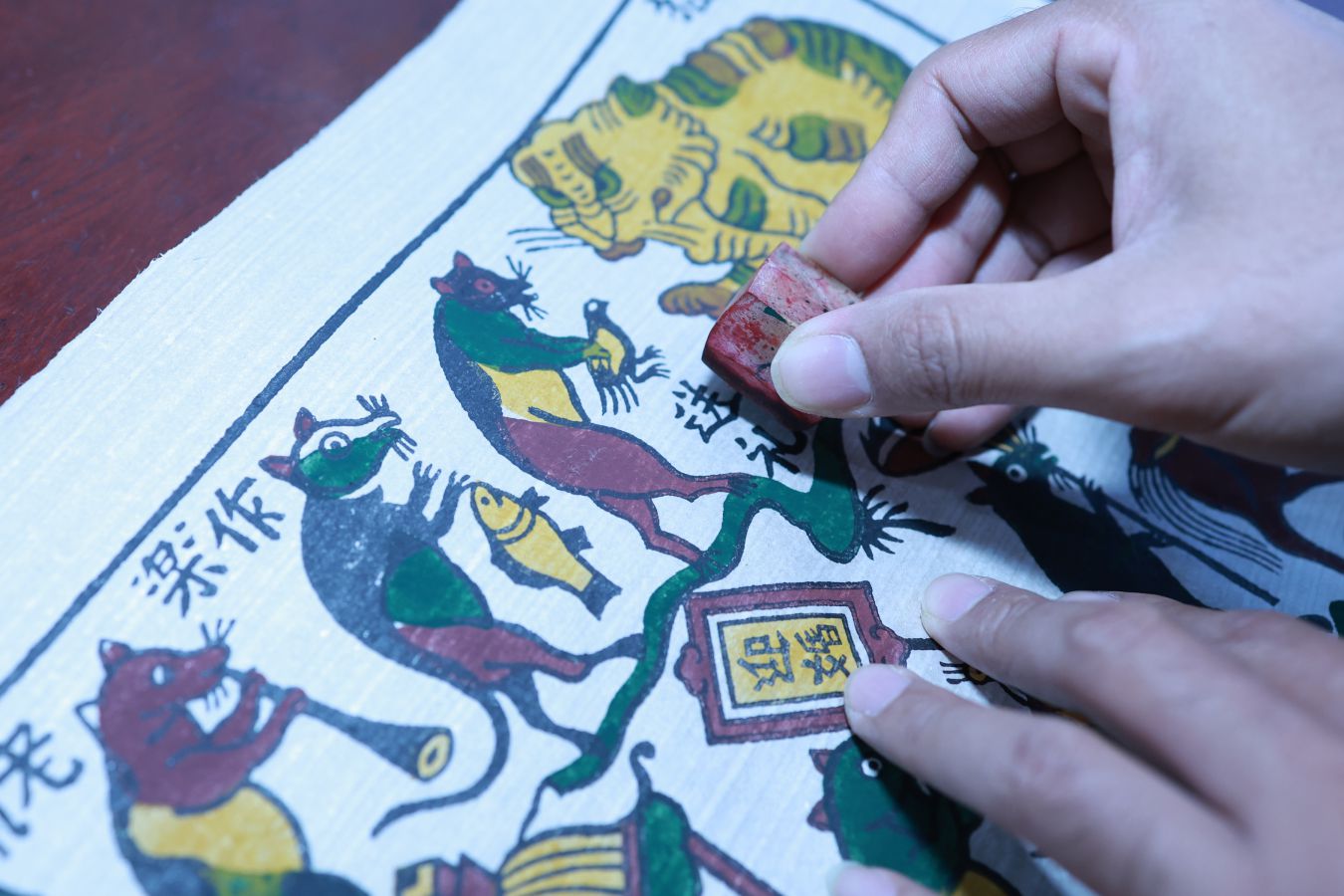
Despite many historical changes, they still persevere in their profession. This conservation project is expected to help preserve unique pottery making techniques, create sustainable livelihoods and spread heritage values more widely.
The craft village development policy not only focuses on maintaining but also opens up opportunities for creativity. Localities are focusing on building brands for craft village products, thereby connecting these products with international markets through global fairs and events. One typical example is the success of craft villages at the International Craft Village Conservation and Development Festival 2025, which was recently held at Thang Long Imperial Citadel. Here, international visitors have admired and experienced sophisticated handmade products of Vietnam, from silk, pottery to handicraft wood furniture.
A Spanish tourist shared with Lao Dong Newspaper: "I am very impressed with the meticulousness and beauty of Vietnamese handicraft products. This is the first time I have seen such a large-scale festival honoring craft villages. We have bought great gifts and are very impressed with the combination of traditional and modern products here. It is the attraction of traditional craft villages and traditional products that has created attraction and boosted Vietnam's tourism economy in the coming time".
With strong development policies and the constant creativity of artisans, Vietnamese craft villages have been and are entering the world, not only preserving cultural values but also contributing to sustainable economic development.


