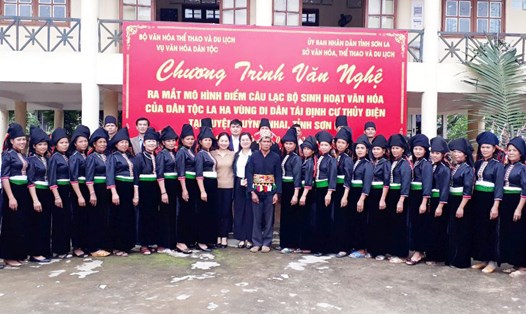
Not only imbued with traditional beliefs, Pang A is also an opportunity to connect the community, contributing to preserving the identity of one of the very few ethnic groups in the Northwest highlands.
Sacred ritual around the Xang Pang tree
The La Ha people currently have about 10,000 people, concentrated in Muong La, Quynh Nhai, Thuan Chau and Moc Chau. Due to their long-standing cohabitation with the Black Thai people, many families use both La Ha and Thai in daily life, even wearing Thai costumes, but traditional rituals are still preserved quite intact.
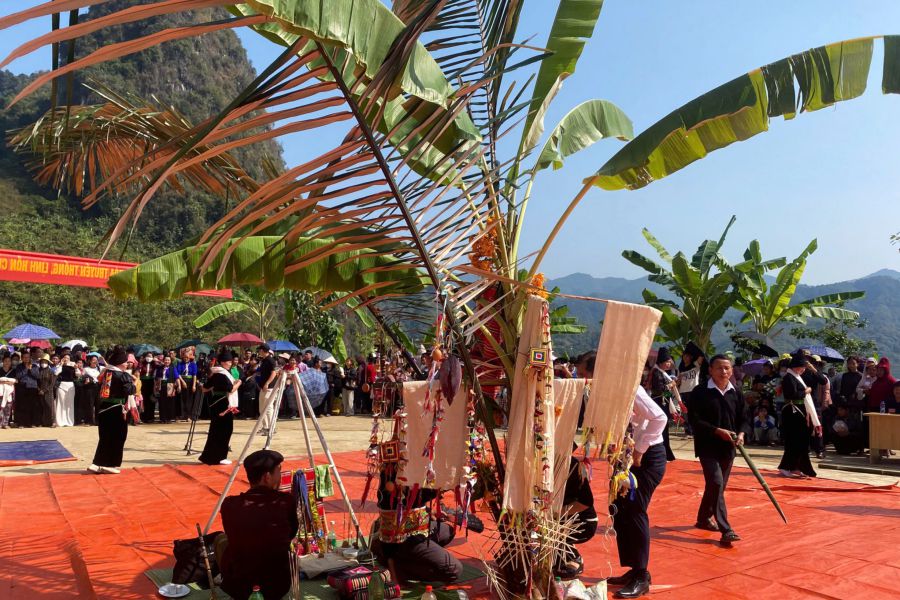
In Na Lech village, Chieng Lao commune, Pang A is solemnly organized in the village cultural house yard. From early morning, elderly people, young people, and women in traditional costumes gathered fully. In the middle of the yard, the Chang Pang tree (some places called Chang Bok) is erected as a sacred axis connecting people with gods.
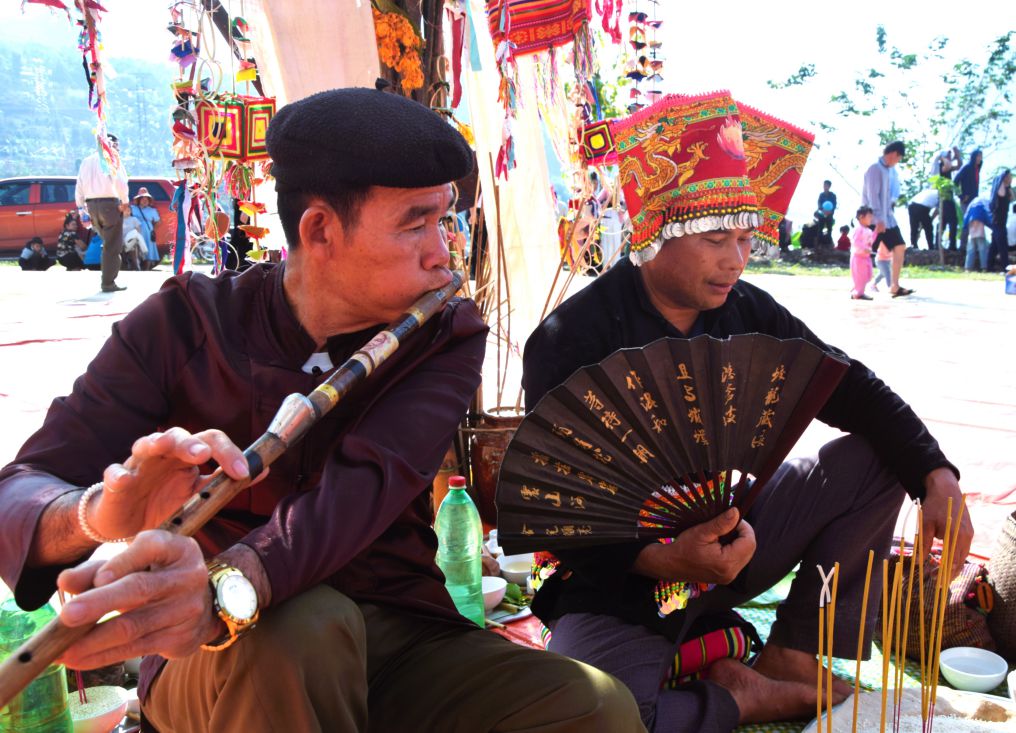
Xang Pang is made from móc tree and wild banana tree. According to the La Ha people's belief, móc tree (lăm la) symbolizes black buffaloes, wild banana tree (lăm tốc) symbolizes white buffaloes - two animals closely associated with agricultural life. On the trunk of the tree are hung many miniature models associated with production and daily life such as: còn fruit, cu gáy bird, plowing, harrowing, seedlings, ban flowers, swords, shields... Each object is made in pairs, expressing the concept of all things being harmonious, having pairs is complete and prosperous.
Mr. Lo Van Loi, Phieng Cai village, Chieng Lao commune, who has held the role of Pang A shaman for more than 10 years, shared: "La Ha people believe that people have souls. When sick, it is because the soul is lost, the shaman performs a ceremony to call the soul back, asking the gods to protect them. Pang A is also an opportunity for adopted children to thank the shaman and ancestors, and at the same time pray for a peaceful new year and good harvests.
Before entering the main ritual, the shaman's family performs a ceremony to worship the host's soul, praying for the gods to keep the soul for the shaman throughout the ritual process. After that, the shaman prays to invite ancestors, mountain and forest gods, river and stream gods, land gods, and earth gods to witness. The prayers resonate loudly in the mountain and forest space, sending wishes for the village to be healthy, with favorable weather, livestock full of barns, and rice and corn blooming well.
The offering tray is prepared depending on the conditions of each family. For people who have been seriously ill, offerings may include dried squirrels, chicken, white wine, can wine, rice, eggs... The adopted children successively offer offerings, arranged on the main tray in front of the Xang Pang tree. When the ritual is completed, the fortune is divided equally among everyone as a New Year's blessing.
Mr. Vu Minh Thai - Chairman of Chieng Lao Commune People's Committee - said: "The whole commune currently has 6/39 villages where La Ha people live. For many years, people have maintained rituals, ancient dances, and traditional handicrafts. The restoration and organization of Pang A in villages where La Ha people live not only meets spiritual needs but is also a way for the community to preserve its identity.
The Pang A space is therefore both sacred and intimate. It is a place where spiritual beliefs blend with the morality of "drinking water, remembering the source", honoring the role of shamans - who are considered a bridge between humans and the supernatural world.
Lively and unique festival part
If the ceremony part is solemn, the festival part is bustling with colors. In the sound of Tang Bu (musical instrument made from bamboo tubes), gongs, drums, people hold hands and dance around the Xang Pang tree. The rhythmic steps create a circle of solidarity, connecting each member in the village.
The Sừng Lừng dance is a special highlight of Pang A. Carrying the element of fertility, the dance sends the wish for people to be healthy, and all things to flourish. The healthy movements, the urgent rhythm and cheers make the festival atmosphere even more exciting.
Besides, there are rain praying dances, scarf dances, sword dances; performances recreating plowing, harvesting, and harvesting rice scenes. Each performance vividly reflects the production and labor life, expressing the aspiration to conquer nature and build a prosperous life.
Mr. Quang Van Chung, Muong La district, shared: "Pang A is an opportunity for people to meet, exchange, and share business experiences. Children and grandchildren can hear about their roots, about the merits of doctors and ancestors. The festival helps strengthen solidarity in the village.
In the warm wine of can wine, folk songs echo in the great forest. Many young men and women have the opportunity to get to know each other and make friends. Old people tell old stories, young people re-learn ancient dances. The festival space is therefore both sacred and full of human love.
Preserving the soul in the modern rhythm of life
Through many upheavals, the La Ha community still persistently preserves traditional customs. Pang A is one of the typical rituals, clearly showing the polytheistic belief and gratitude spirit of the people.
In recent years, along with cultural preservation work, Son La province has implemented many policies to support socio-economic development in ethnic minority areas such as investing in transport infrastructure, electricity grid, schools; supporting agricultural production; taking care of health and education. Thanks to that, the material and spiritual life of the La Ha people has gradually improved.
In the modern flow, when many traditional values are facing the risk of fading, Pang A is still maintained regularly every time ban flowers bloom. The Xang Pang tree is still erected in the middle of the village yard. The sound of gongs and drums still echoes calling for the season. The xoe circle still extends amidst the joyful laughter.
Pang A is therefore not only a festival to pray for peace at the beginning of the year, but also a symbol of faith, community spirit and sustainable cultural vitality. From the ritual to thank shamans, the La Ha people send their aspirations for a new year of peace, good harvests, and prosperous villages.
In the great mountains of Son La, when the color ban still lingers on the mountainside, Pang A continues to be a string connecting the past with the present, helping today's generation understand and be proud of their roots. That identity, preserved through each prayer, each dance, will remain strong over time - like a circle that never closes in the mountains and forests.