
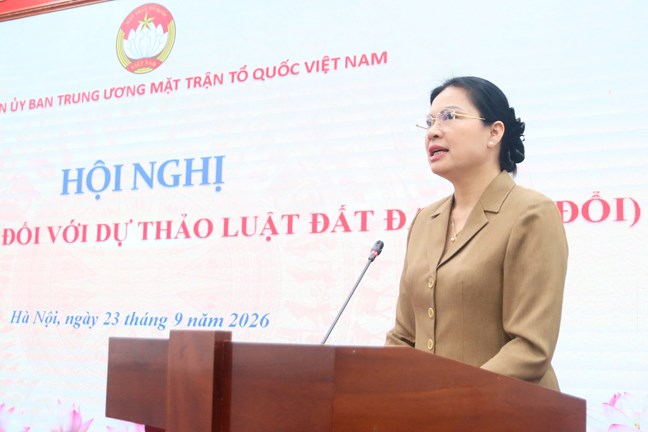
On the afternoon of September 23, in Hanoi, the Central Committee of the Vietnam Fatherland Front organized a social criticism conference on the draft revised Land Law.
Ms. Ha Thi Nga - Member of the Party Central Committee, Vice President - Secretary General of the Central Committee of the Vietnam Fatherland Front and Ms. Nguyen Thi Phuong Hoa - Deputy Minister of Agriculture and Environment chaired the conference.
According to the Submission of the Draft Land Law (amended), the draft initially consists of 13 chapters, 3 chapters less than the 2024 Land Law, focusing on policy groups on planning, land use plans; land allocation, land lease, land use purpose conversion; compensation, support, resettlement; finance, land prices; rights and obligations of land users.
The draft also focuses on administrative reform, digital transformation, decentralization, delegation of power, inspection, examination, settlement of disputes, complaints, denunciations and prevention and combat of corruption, wastefulness, and negativity.
Need to ensure the rights of the remaining 25% of households
Prof. Dr. Tran Ngoc Duong - Member of the Presidium, Chairman of the Advisory Council on Democracy and Law, Central Committee of the Vietnam Fatherland Front - assessed that the draft has quite clearly institutionalized many major orientations of Resolution No. 21-NQ/TW, especially on renovating planning, digital transformation, decentralizing land price management and exploiting land resources.
However, he noted the regulation for projects receiving land use rights transfer: if the investor has agreed on over 75% of the area and over 75% of land users, the Provincial People's Council will consider and approve the recovery of the remaining 25% of the land area to hand over to the investor.
According to Prof. Dr. Tran Ngoc Duong, using administrative decisions to recover the remaining land has the risk of turning civil transactions into mandatory recovery, easily leading to lawsuits.
The draft Law needs to consider the threshold and mechanism to ensure the rights of the remaining 25% of households in the transfer agreement project" - Prof. Dr. Tran Ngoc Duong proposed.
He also proposed limiting the delay of land price lists in the transition period to 2028, increasing data disclosure, price determination methods and independent supervision.
Do not allow planning to be adjusted according to personal interests
Assoc. Prof. Dr. Pham Huu Nghi - Member of the Advisory Council on Democracy and Law, Central Committee of the Vietnam Fatherland Front, said that streamlining planning cannot be synonymous with simplifying the mechanism of power control.
According to him, just one change in land boundaries or land use purposes can greatly change economic value.
Planning must be sufficiently stable for people and investors to trust; sufficiently flexible to meet development requirements; but the adjustment must be sufficiently strict so that it is not easy to'break' the plan according to personal interests," Assoc. Prof. Dr. Pham Huu Nghi expressed his opinion.
Contributing opinions on the land price list, Assoc. Prof. Dr. Nguyen Thi Nga - Deputy Head of the Faculty of Economic Law, Hanoi Law University, suggested that in addition to land type, area and location, it is necessary to consider additional infrastructure conditions, accessibility, spatial characteristics and legal limitations affecting land exploitation capacity.
Speaking at the conference, Ms. Ha Thi Nga said that the Standing Committee of the Central Committee of the Vietnam Fatherland Front will fully and seriously summarize the opinions, research, filter and propose to competent authorities for consideration in the process of receiving, revising, and completing the draft Land Law (amended).


