
In recent years, implementing Project 8 "Implementing gender equality and solving urgent issues for women and children" under the National Target Program for socio-economic development in ethnic minority and mountainous areas, the Women's Union (Women's Union) of Quang Tri province has focused on building communication models right in the community.
This is considered one of the important solutions to bring knowledge about gender equality, domestic violence prevention, early marriage prevention, and protection of women and children closer to people in difficult areas.
Quang Tri Provincial Women's Union said that right from the time of project 8 implementation, the Union was assigned by the Provincial People's Committee to take the lead in implementation. The Standing Committee of the Provincial Women's Union established a Project Steering Committee of 5 members, a working group of 6 members, and assigned professional departments and divisions to advise on the implementation of 4 contents of the project.
One of the key tasks of Project 8 is to propagate and mobilize people to change their "thinking and ways of doing things", gradually eliminate gender stereotypes and stereotypes in families and communities, as well as cultural customs that are no longer appropriate.
To achieve this goal, the Quang Tri Provincial Women's Union has implemented the construction of community communication groups with the participation of prestigious people, village officials, women's union members and local forces.
To date, the whole province has established 171 "Community Communication Groups", of which the Provincial Women's Union has established 20 groups, and the District Women's Union has established 151 groups with 1,379 members participating. Members of the groups include village party secretaries, village heads, women's union heads, heads of Fatherland Front committees, prestigious people, village elders, village chiefs and representatives of mass organizations.
Not only establishing a model, the Provincial Women's Union also focuses on equipping knowledge and skills for communication groups to operate effectively. Training classes focus on skills in operating activities, building communication plans, accessing information, propagating about gender equality, preventing domestic violence, preventing early marriage and social issues related to women and children.
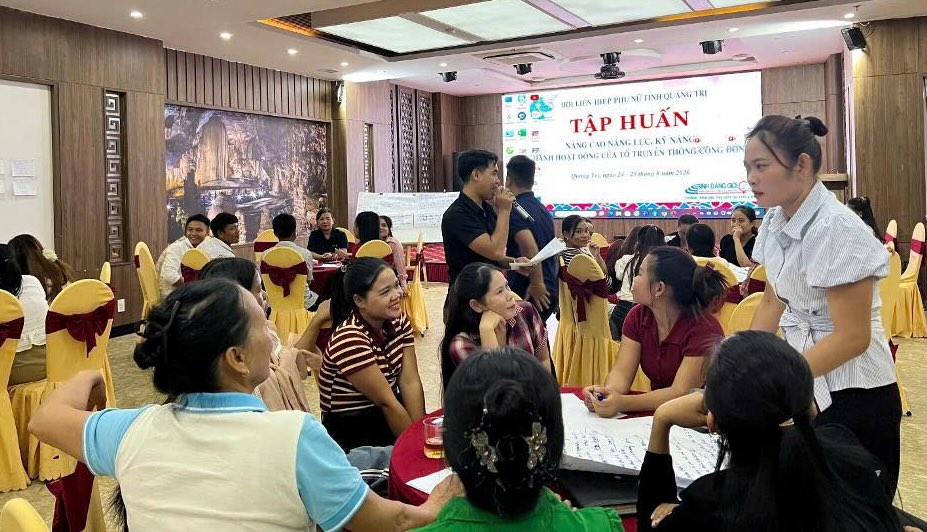
In highland villages, the activities of the communication team do not only stop at focused propaganda sessions but are also carried out in many close forms such as visiting households, integrating into village meetings, community activities, and stages.
Thanks to this approach, issues that are considered difficult to change such as gender stereotypes, the view that women are only associated with family work, domestic violence or the risk of early marriage are gradually brought up for public discussion.
According to the Quang Tri Provincial Women's Union, 100% of community communication groups have gone into operation, initially promoting the core role in propaganda and mobilizing people to change their perceptions, eliminate harmful customs, and build a safer living environment for women and children.
Notably, during the implementation of Project 8, men are also increasingly participating in activities promoting gender equality. In some localities, communication groups have the participation of village heads, prestigious people, and men in the community, creating consensus in changing perceptions about the role of women.
According to the assessment of the Provincial Women's Union, changing awareness in the community is a long process, requiring persistence and regular repetition. However, models such as community communication groups have created an important foundation for women in ethnic minority areas to be bolder, children to be better protected, and the community to gradually form equal and progressive values.
Project 8 not only brings simple propaganda activities but is creating changes from within the community. When people understand more about women's rights, children's rights and the responsibilities of each family member, gender equality is no longer a slogan but gradually becomes a part of daily life.


