
Observation data this morning shows that air quality in Hanoi continues to deteriorate significantly.
According to the Monitoring System of the Department of Environment (Ministry of Agriculture and Environment), at 7:00 a.m. this morning, the AQI at the Nhan Chinh - Khuat Duy Tien Park measuring station was 176 (bad level). At the same time yesterday morning, the AQI here was 131 (poor).
At the measuring station at the gate of Hanoi University of Science and Technology on Giai Phong Street, the AQI at 7am was 277 (purple threshold, very poor). Meanwhile, although AQI at this point was also high last morning, it only reached 216, much lower than today.
According to the IQAir Air Pollution Index Application, at 7:20 am this morning, IQAir ranked Hanoi as the 3rd most polluted city in the world with an AQI of 289 - very unhealthy.
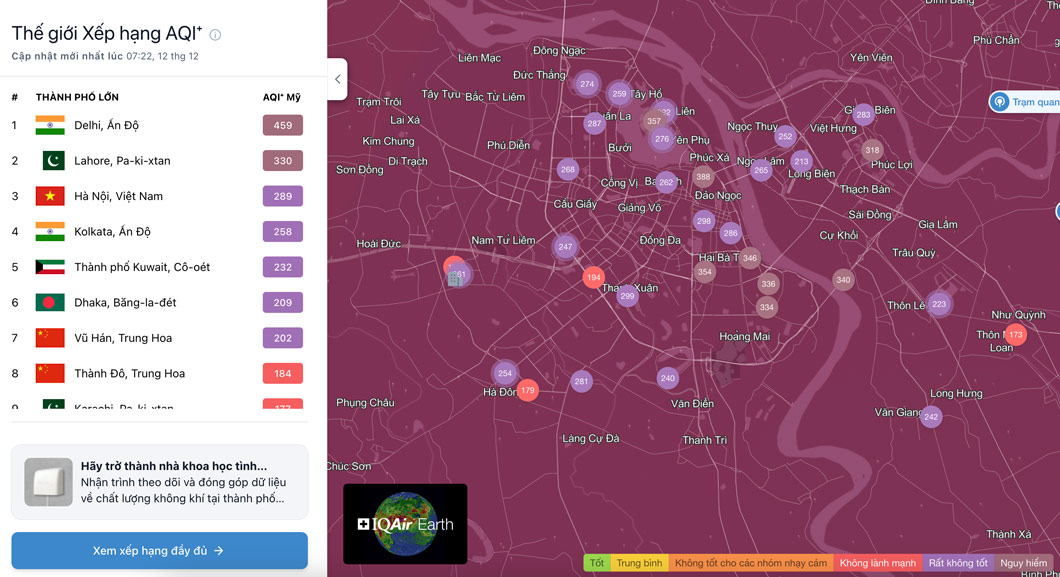
Many air quality measuring points in the inner city are also at the purple threshold (dangerous level). In which, at 7:00 a.m., AQI at Quang Khanh station was 416; Tran Vu AQI 326; Lo Duc AQI 346; Cu Khoi AQI 340...
Faced with the current situation of environmental pollution, the Chairman of Hanoi issued a Directive to strengthen urgent measures to control air pollution in the city.
In particular, the Department of Education and Training is notified and instructed schools to limit outdoor activities for students during times and days with "bad" or higher air quality; temporarily suspend or adjust students' study time when there is a warning of serious air pollution from the Department of Agriculture and Environment.
At the same time, the Department of Health is required to coordinate with media agencies, newspapers and People's Committees of wards and communes to recommend that people (especially the elderly, children, people with underlying respiratory diseases) minimize outdoor activities during the time when VN_AQI is at a high level to ensure health.
Propagating the development of a health response plan, requiring medical facilities in urban areas and areas at risk of air pollution to have provisions for vehicles and equipment to be ready to respond to serve the people in case the quality of the air environment is seriously degraded, affecting the respiratory tract of many people.


