
No construction permit will be granted for road edges and sidewalks
To overcome the pollution situation, the Chairman of the Hanoi People's Committee requested the Department of Agriculture and Environment: Deploy emergency measures under the coordination of the Ministry of Agriculture and Environment for cases of seriously polluted air environment on inter-regional, inter-provincial, and cross-border levels.
The head of the City People's Committee advised on a mechanism for coordinating with provinces and cities in the region in controlling inter-regional and inter-provincial air pollution.
Immediately deploy inspections of all solid waste treatment areas; Request units to ensure continuous transportation, not allowing dust and odor to be released. Report weekly results in December 2025.
Monitor environmental sanitation packages according to decentralization to ensure quality of sanitation at key routes; require communes and wards to report monthly results. Direct environmental health units to increase fog spraying, dust, and water for road washing.
Department of Construction: Strengthen close supervision, requiring 100% of construction sites to have strict dust control measures (locking off, washing vehicles when leaving the construction site, spraying away dust...); loose construction waste must be covered, sealed or sealed at the gathering place in the construction site and during the transportation process, ensuring no dust is released into the environment; build a dust monitoring system (enswer, camera) at 100% of works with a scale of over 1ha; complete in December 2025.
Guiding investors and contractors of construction works to arrange a fixed fog spraying system to reduce dust in concentrated residential areas (in high-rise buildings); completed in December 2025.
Preside over and coordinate with Hanoi Police, People's Committees of communes and wards to proactively organize a campaign to inspect and handle construction activities and transportation in the area that pose a high risk of spreading dust.
No construction permit for road edges and sidewalks (except for emergency cases) is granted at the end of the year when air quality is seriously polluted.
Hanoi City Police: Organize a peak period of inspection, strictly handle and publicize violations: transporting uncovered construction materials, dropping waste; acts of burning industrial solid waste, burning household waste illegally, not in accordance with regulations, especially in craft villages and craft villages.
Early synchronization of technical infrastructure with security camera systems, traffic surveillance cameras integrated with AI to serve inspection and supervision work and promptly detect and strictly handle violations and subjects.
Recommend people to limit outdoor activities during high VN_AQI
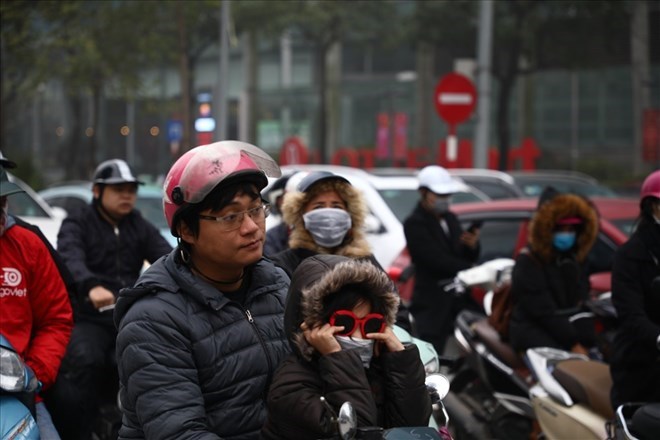
The Department of Health is required to coordinate with media agencies, newspapers and People's Committees of wards and communes to recommend that people (especially the elderly, children, people with underlying respiratory diseases) minimize outdoor activities during the high level of VN_AQI to ensure their health.
Propagating the development of a health response plan, requiring medical facilities in urban areas and areas at risk of air pollution to have provisions for vehicles and equipment to be ready to respond to serve the people in case the quality of the air environment is seriously degraded, affecting the respiratory tract of many people.
Department of Education and Training: Notify and instruct schools to limit outdoor activities for students during times and days with air quality at "bad" or higher; temporarily suspend or adjust students' study time when there is a warning of serious air pollution from the Department of Agriculture and Environment.
Department of Culture and Religious Affairs: Deploy a peak period of propaganda, mobilizing spiritual, religious, worshiping establishments and people to limit the burning of votive paper; develop a long-term propaganda plan and plan to change people's habits towards ending the burning of votive paper.
Chairmen of People's Committees of communes and wards: Direct competent agencies to strengthen inspection and supervision of construction sites in the area, requiring investors and construction units to collect, transport, and treat solid waste in accordance with regulations; strictly handle transportation methods that do not cover the construction area, waste that do not cover it well, and cause to fall onto the road; acts of burning domestic solid waste, burning straw, and agricultural by-products that are not in accordance with regulations, causing environmental pollution.
Based on the practical situation of air pollution in the area, the pro-rector promptly directs environmental health units to: increase the frequency of road sweeping and dust hutation; use specialized vehicles to spray water to wash the roads and remove dust at main traffic routes and urban gateways.
Road washing and dust extraction activities should be prioritized during off-peak hours (night and early morning, before 6am every day) to ensure effectiveness, reduce dust accumulation before rush hour and avoid congestion.
Review, strictly manage and organize environmental inspections of industrial waste sources and activities with burning phases in craft villages and industrial production facilities in the management area according to decentralization; especially recycling facilities (crafts); complete before December 15, 2025.
Chairmen of People's Committees of wards and communes are responsible to the Chairman of the Hanoi People's Committee if there is a situation of burning garbage, votive paper, gathering, dumping garbage and waste that is not in accordance with regulations, causing air pollution in the area.
For production facilities with large volumes of dust and emissions into the environment and for production facilities at risk of causing environmental pollution:
Review and ensure that emission treatment systems are deployed, operate effectively, and achieve high efficiency at this time; However, untreated discharge into the environment in all cases; Complete before December 31, 2025.
Increase the frequency of inspection and maintenance of equipment to prevent incidents for emission treatment systems and environmental protection works during air pollution.
Based on the practical situation of air pollution, there is a plan to adjust operating capacity or postpone the production stages that generate a lot of dust/emission (such as bloating, starting the furnace, grinding the raw materials...) to the time when weather and climate are more favorable.


