Cutting down 15 green trees cannot be simply explained as "incomplete legal awareness".
15 trees, including 10 mahogany trees, 3 phoenix trees and 2 cypress trees, in the premises of the state agency headquarters, not bushes.
With such a number, there must be people who know, people who decide, people who organize implementation and people who take responsibility.
According to the verification results of the Gia Lai Provincial Department of Agriculture and Environment, 10 acacia trees were cut down on June 21. The reason given was that strong winds previously broke and knocked branches, collapsed two iron frames of the headquarters fence adjacent to National Highway 25, causing danger to people and traffic.
If the tree is really at risk of falling, handling it to ensure safety is necessary. But handling danger does not mean having the right to arbitrarily cut down a series of green trees.
The most important thing to clarify at this time is the decision-making process. Who directed the felling, how many trees were felled, was a record of the current situation made, and was each tree evaluated?
More notably is the story of the remaining logs.
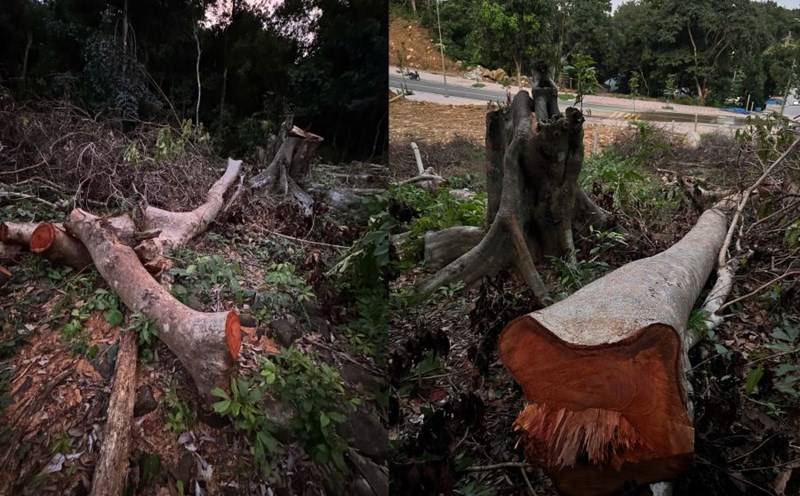
At the scene, there were 14 acer logs, but according to functional agencies, only 3 logs had a diameter suitable for the cut tree root. The remaining 11 logs had an inappropriate diameter.
Explaining that due to the technique of cutting down, opening large veins, trees with many trunks or being cut off for convenient collection is something that needs to be verified by reality and records, and should not be tacitly considered as the final explanation.
If the wood of all 15 trees has been collected, it is necessary to fully determine the quantity, type, size, and volume. Which root corresponds to which log, which tree creates which amount of wood.
If it does not match, where is the wood that does not match, what is it used for, does anyone benefit from that wood?
It is necessary to clarify to ensure fairness for all parties. If there is really no personal gain, it is even more necessary to clarify evidence to eliminate suspicion.
If there are violations, it is necessary to handle the right people and the right actions.
Managing public assets and public green trees is also a public duty.
Green trees in state headquarters are not ownerless trees. The wood after being cut down is also not an asset for anyone to keep or take away.
The case needs to be clarified, not to "catch the fault" of the person who handled the dangerous tree, but to determine the boundary between handling situations for community safety and violations of regulations.