
From paper records to the iPad in doctor's hand
At the Intensive Care Center, Bach Mai Hospital, BSCKII Nguyen Ba Cuong and colleagues went to the room only with iPads and styluses instead of paper records.
According to Dr. Cuong, patient information is now updated directly at the bed, helping to reduce recording time and limit errors. Thanks to that, doctors can easily monitor the progression of the disease, and nurses have more time to take care of patients.
At the intensive care unit, where the course of the disease can change every hour, quick access to information plays a very important role. Electronic medical records allow doctors and nurses to monitor records, test results, and diagnostic imaging anywhere via computer or phone.
Thanks to that, adjusting treatment regimens, inter-disciplinary consultations, seeking expert opinions or completing discharge records are all carried out faster.
Test results are even ahead of the patient
The medical examination and treatment process is digitized, helping patients no longer have to bring prescription forms and test results between departments. Information is transferred directly on the system, patients only need to go to the service location according to instructions.
Notably, test results and diagnostic imaging are updated almost instantly. In many cases, doctors have received the results before the patient returns to the clinic.
Assoc. Prof. Dr. Nguyen Anh Tuan - Director of Emergency Center A9, Bach Mai Hospital - said that in emergency cases, the benefits of electronic medical records are even clearer.
When the patient takes a scan, the image has been transmitted to the system. The doctor can read the results immediately and organize an inter-departmental consultation if necessary," he said.
According to Assoc. Prof. Tuan, in diseases that need to race against time such as stroke, myocardial infarction or multiple injuries, shortening waiting times can determine treatment effectiveness. When patients need to be transferred to another department, all data is also shared instantly, instead of having to wait for the handover of thick paper files as before.
Still many challenges
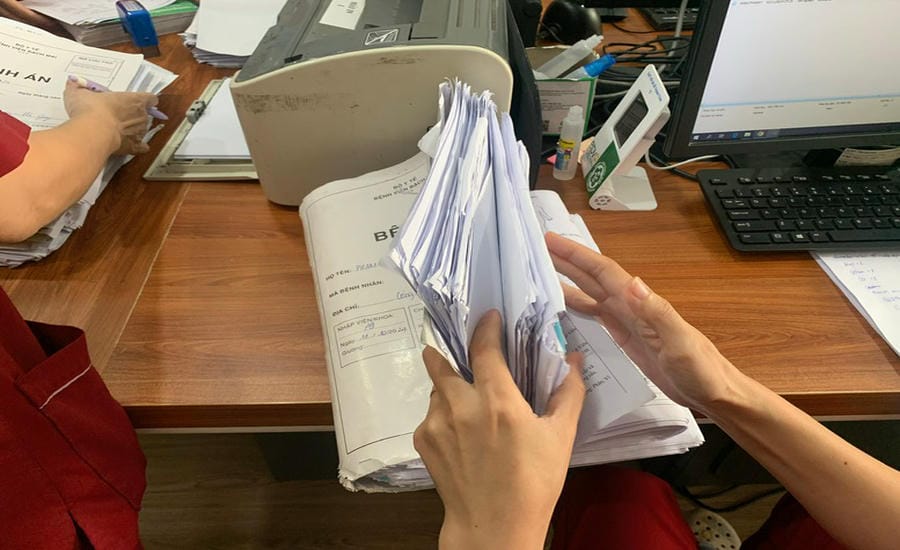
Despite achieving many positive results, the implementation of electronic medical records nationwide still faces many difficulties. Currently, about 75% of hospitals have implemented electronic medical records, but only about 15% of medical facilities completely eliminate paper medical records.
Assoc. Prof. Dr. Tran Quy Tuong - Chairman of the Vietnam Medical Informatics Association - said that many hospitals still have to maintain paper records and electronic records in parallel, increasing the workload for doctors and nurses. The simultaneous use of the two systems causes waste of resources and creates additional pressure for medical staff. Hospitals need to accelerate the transformation process to promote the effectiveness of digital transformation.
Currently, 1,238 hospitals are initially applying AI and digital technology in medical examination and treatment, hospital management and professional decision-making support. However, the health sector still faces many challenges such as technology infrastructure disparities, lack of investment resources, lack of information technology human resources, data unsynchronization and requirements for ensuring information security and protecting personal data.
Member of the Party Central Committee, Minister of Health Dao Hong Lan issued a Directive on promoting the deployment of electronic medical records nationwide. Accordingly, by December 31, 2026, all medical examination and treatment facilities must complete the deployment of electronic medical records; from January 1, 2027, public and private hospitals will stop using paper medical records.
Along with electronic medical records, non-cash payments are also being promoted. A survey at 828 medical examination and treatment facilities shows that 95% of units have implemented electronic payments using QR codes, bank transfers, bank cards or online applications. Many central and provincial hospitals achieve non-cash payment rates from 70-90%.


