
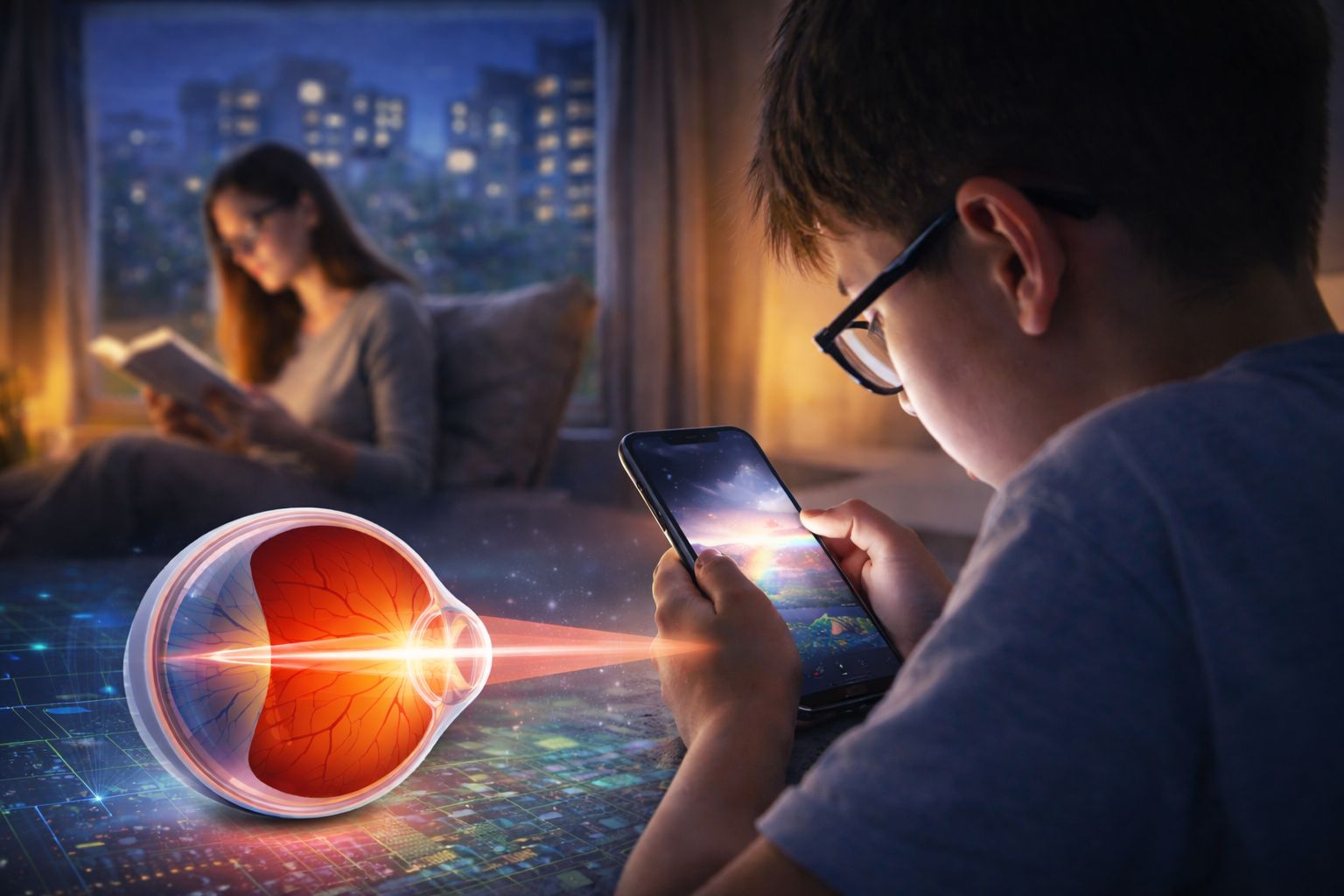
Myopia is increasing rapidly in the world and is increasingly seen as a public health problem. While many opinions believe that the main cause comes from the use of electronic devices, a new study from the College of Ophthalmology at New York State University (USA) offers a different perspective.
The research team conducted experiments with 34 volunteers, including 21 people with nearsightedness and 13 people with normal vision. Participants were asked to focus on targets with different brightness and contrast, using only one eye each time.
The results showed that near-vision activities such as reading books or using the phone can contribute to increasing the risk of nearsightedness. When focusing on objects at close range, the eye pupils shrink to clarify images, thereby reducing the amount of light entering the retina.
According to scientist Jose-Manuel Alonso, an important factor may be the amount of light that the retina receives during continuous near vision, especially in the indoor environment. This helps explain why nearsightedness is becoming increasingly common in modern society.
Research also shows that in nearsighted people, the eyes tend to look inward more and the pupils shrink more strongly than in normal people. This combination can affect how the retina processes light, thereby exacerbating nearsightedness.
Another notable finding is that the contrast of images may play a more important role than brightness in regulating eye activity. This shows that the mechanism of causing nearsightedness is more complex than previously assumed.
Scientists believe that the indoor environment, where light is weaker than outdoors, can make this situation more serious. When the eye has to contract pupils to focus and also endure low light conditions, the amount of light reaching the retina is significantly reduced.
However, the research still has limitations such as small sample size and lack of long-term monitoring. Researchers emphasize that more research is needed to clearly identify this link.
According to forecasts, by 2050, about 40% of adolescents may develop nearsightedness. The new discovery opens up another approach to prevention, in which increasing outdoor activity time may play an important role.


