
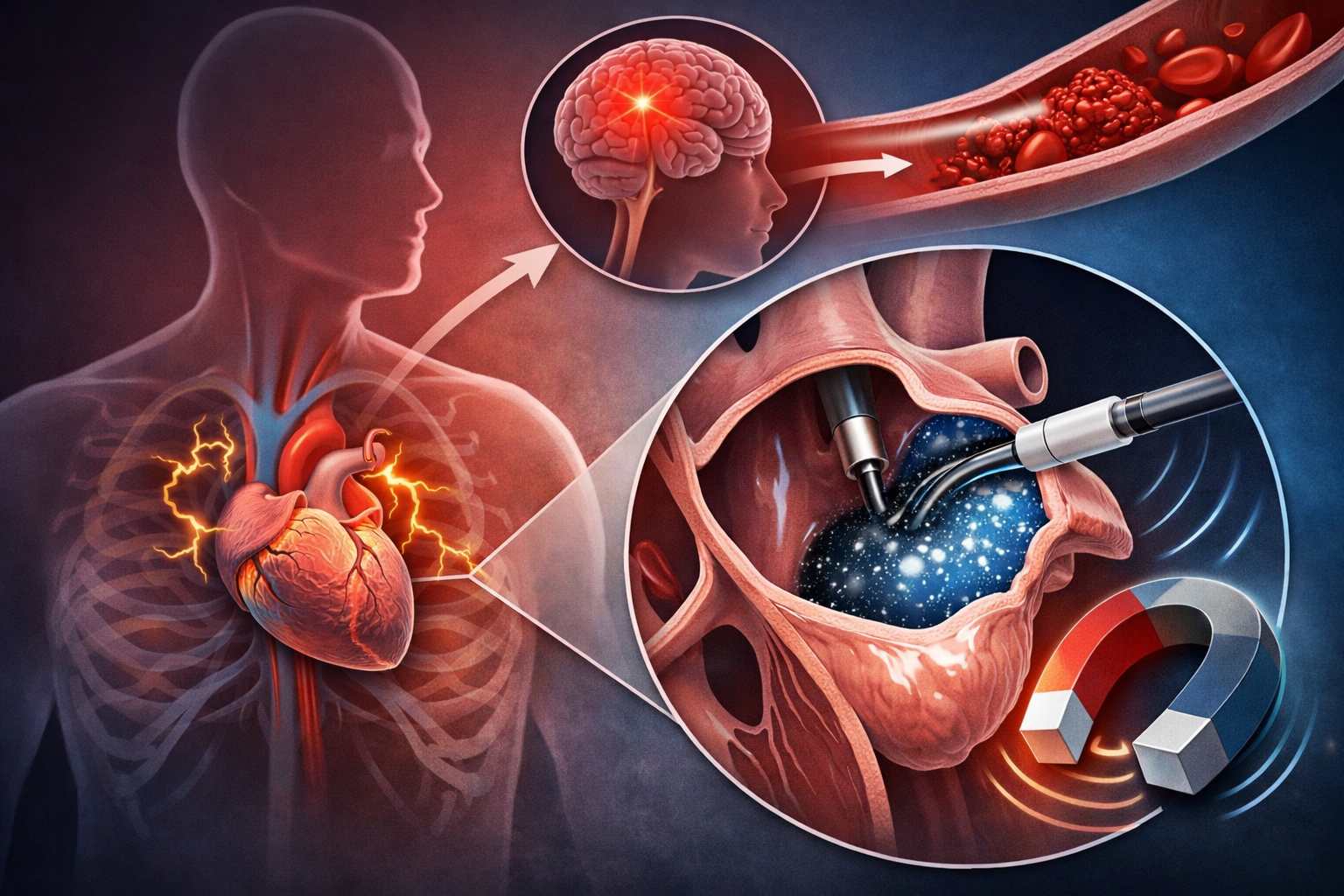
Currently, the common treatment is to use anticoagulants to reduce the risk of blood clots. However, the drug can increase the risk of bleeding, especially in the elderly or patients with underlying conditions such as hypertension, liver, kidney, or cancer. Some people cannot use it for a long time due to side effects.
Another solution is to block the left atrial appendix with a device inserted through a catheter. This device acts as a small "blanket" to seal the area prone to blood clots. Although effective, this method still has limitations due to the different heart structure of each person, making sealing not always complete. In some cases, leaks or blood clots may occur on the surface of the device.
In that context, a group of scientists including: Professor XU Tiantian - Shenzhen Institute of Advanced Technology (China) and Professor PAN Xiangbin - Fuwai Hospital, Chinese Academy of Medical Sciences are developing a new approach of using magnetic-reacting fluids to seal the left atrial appendix from the inside.
Accordingly, a special liquid is introduced into the heart through a catheter. Under the action of an external magnetic field, the liquid is kept in its proper position and fills the entire cavity. After a few minutes, this substance reacts with the blood environment and turns into a soft gel form, creating a stable seal.
Because initially in liquid form, the material can adapt to the complex shape of the heart, helping to be completely sealed compared to hard devices. At the same time, the gel layer has the ability to harmonize with heart tissue, creating a smooth surface, thereby reducing the risk of blood clots forming.
Initial trials on animals such as mice and pigs showed positive results. In pigs, the gel layer remained stable for 10 months, no leaks or blood clots were recorded. Cardiovascular tissue also developed covering the gel surface, showing good biocompatibility.
However, this method is still in the research phase. Scientists need to continue to assess long-term safety and effectiveness before it can be tested on humans. In addition, some technical issues such as affecting magnetic resonance imaging also need to be resolved.
If proven effective, this technique could become an alternative for patients who cannot use anticoagulants, while overcoming some limitations of current devices.
Atrial fibrillation affects tens of millions of people around the world. Therefore, advances in stroke prevention, even small ones, can have a major impact on public health.


